By Joanne Lockwood (she/her) FIEDP FRSA FPSA – Written from lived experience, not from the sidelines.
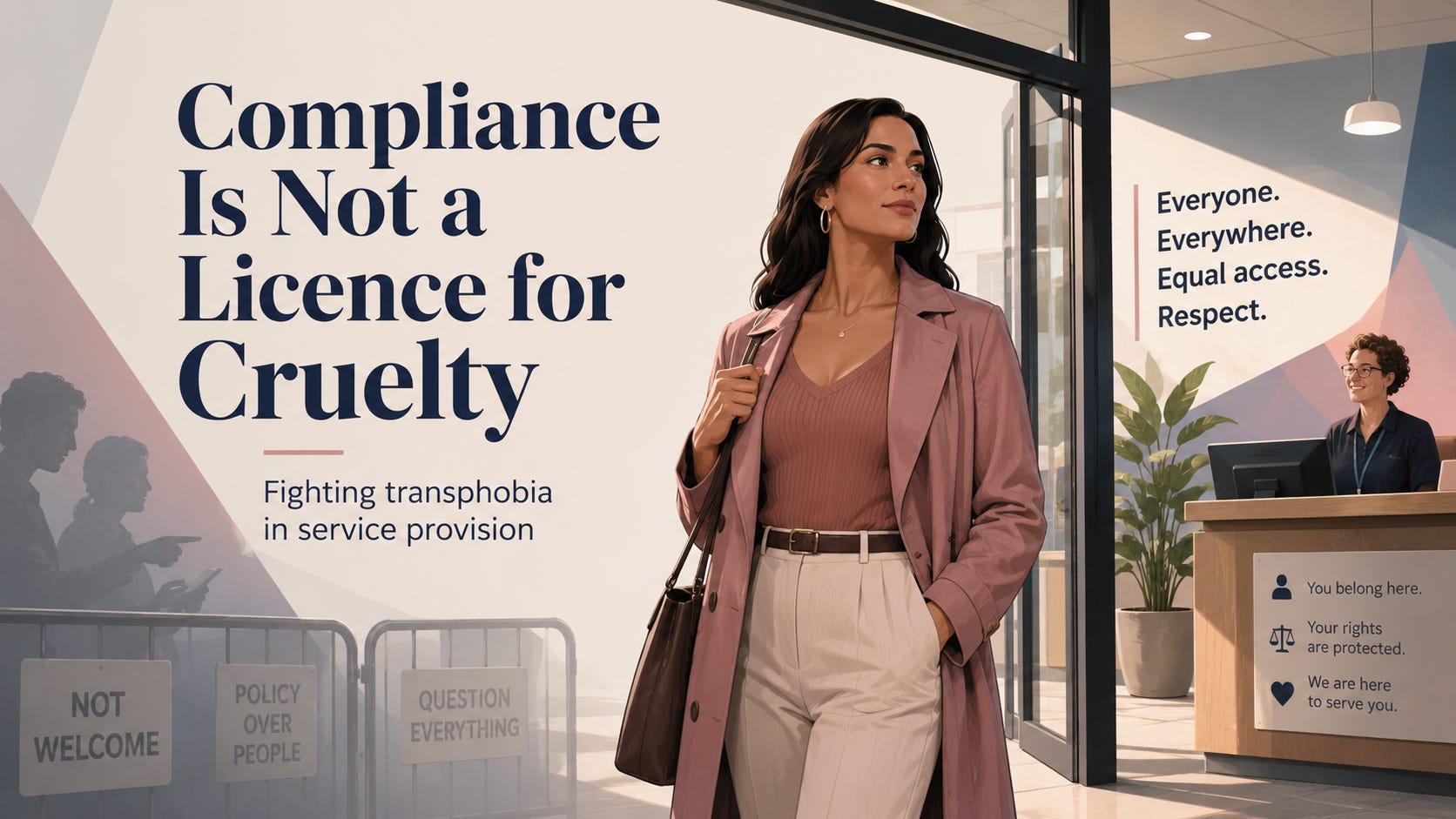
Fighting transphobia in service provision
Most public discussion since the Supreme Court judgment has focused on single-sex spaces, toilets, changing rooms and the meaning of “sex” in the Equality Act. But there is a wider and more immediate issue that must not be lost.
Trans people remain protected under the Equality Act.
Gender reassignment is still a protected characteristic. Service providers, public bodies and associations must not treat trans people worse because they are trans, because they are perceived to be trans, or because they are associated with trans people. The Equality Act continues to prohibit discrimination, victimisation and unlawful treatment in the provision of services and public functions.
That matters because, in the current climate, many trans people are not simply facing legal uncertainty. They are facing social hostility dressed up as compliance.
Examples may include:
being refused ordinary service in a pub, restaurant, gym, hotel, shop, venue or community space because someone knows or suspects you are trans;
being told to leave an event because other people “feel uncomfortable” with your presence;
being challenged, monitored or humiliated when using facilities;
being forced into unsuitable “third spaces” in a way that singles you out;
being treated as a safeguarding risk without evidence;
being denied dignity, privacy or ordinary participation because staff misunderstand the law;
being excluded because an organisation has adopted an over-cautious or hostile interpretation of recent guidance.
This may happen because you are visibly trans, because you have spoken publicly about trans inclusion, because someone has complained about your presence, or because a service provider wrongly believes that excluding trans people is now required by law.
It is not.
The law may allow separate or single-sex services in certain circumstances. The law may allow gender reassignment exceptions in specific cases where treatment is justified. But that is not the same as a blanket permission to degrade, harass, exclude or humiliate trans people. The EHRC has previously stated that separate or single-sex service providers may only prevent, limit or modify access on the basis of gender reassignment in some circumstances, and that this would need to be justified as necessary and proportionate.
The practical question for every service provider is therefore not:
“How do we keep trans people out?”
It is:
“How do we comply with the law while preserving dignity, privacy, safety and equal access for everyone?”
That distinction matters.
Quoting the law and guidance
The Equality Act 2010 lists gender reassignment as a protected characteristic. It protects people who are proposing to undergo, are undergoing, or have undergone a process, or part of a process, for the purpose of reassigning sex.
The services code covers discrimination in services, public functions and associations, and the government’s 2026 draft code states that Part 3 of the Act is about discrimination, harassment and victimisation in service provision and public functions. It also says the code can be used in legal proceedings and that courts and tribunals must consider relevant parts of it.
So when a service provider discriminates against a trans person, the complaint should not be framed only as hurt feelings, bad customer service or poor inclusion practice.
It should be framed as a potential equality law issue.
Useful legal concepts include:
Issue
What it may mean in practice
Direct discrimination
Treating a trans person worse because they are trans or perceived to be trans.
Indirect discrimination
Applying a policy that appears neutral but puts trans people at particular disadvantage and cannot be justified.
Harassment
Creating a degrading, hostile, humiliating or offensive environment related to gender reassignment.
Victimisation
Treating someone badly because they complained, supported someone else’s complaint, or asserted Equality Act rights.
Service-provider liability
Organisations may be responsible for unlawful conduct by staff unless they have taken reasonable steps to prevent it.
The point is simple: service providers cannot hide behind public controversy, staff discomfort, social media pressure or vague “risk” language. They need evidence, proportionality and a lawful basis for their decisions.
Prejudiced and proud
For years, trans people have been portrayed as problems to be managed rather than people to be served.
The language changes. The pattern does not.
Sometimes the allegation is safeguarding. Sometimes it is privacy. Sometimes it is “common sense”. Sometimes it is “following the law”. Sometimes it is “just asking questions”. But the effect can be the same: a trans person is singled out, treated as suspect, denied ordinary participation, and left to carry the emotional, social and practical burden.
This is not abstract.
Being challenged in a toilet, refused access to a changing room, asked invasive questions, removed from a venue, mocked by staff, or treated as a threat in front of strangers is not a minor inconvenience. It is humiliating. It tells the person: you are conditional here.
And in many cases, the evidence may be easy to gather.
Discrimination against trans people is often not subtle. It may appear in emails, social media posts, policy wording, complaint responses, signage, staff instructions, booking conditions or recorded conversations. Some organisations may even present exclusion as a virtue, wrongly believing that the Equality Act now requires them to act against trans people.
That is a dangerous misunderstanding.
The Supreme Court judgment did not erase trans people from equality law. It did not remove the protected characteristic of gender reassignment. It did not give service providers permission to mistreat trans people. It did not authorise blanket hostility. It did not abolish dignity.
What to do if this happens
If you are treated badly by a service provider because you are trans, perceived to be trans, or associated with trans people, consider taking the following steps.
1. Record what happened
Write down:
the date, time and location;
who was involved;
exactly what was said or done;
whether there were witnesses;
whether you were refused service, asked to leave, moved elsewhere, challenged, mocked or treated differently;
how the treatment affected you.
2. Preserve evidence
Keep:
emails;
screenshots;
booking confirmations;
policy documents;
signs or notices;
social media posts;
complaint responses;
photographs of relevant information;
names of staff or witnesses.
3. Ask for the reason in writing
A calm written question can be powerful:
Please confirm the reason I was refused service / asked to leave / treated differently. Please also confirm the policy relied upon and how that policy complies with the Equality Act 2010, including the protected characteristic of gender reassignment.
Do not argue every point verbally in the moment. Get the rationale documented.
4. Make a formal complaint
Your complaint should be clear, factual and focused.
Suggested wording:
I believe I was treated unfavourably because I am trans / was perceived to be trans / am associated with trans people. Gender reassignment is a protected characteristic under the Equality Act 2010. Please explain what steps you took to ensure that your decision was lawful, proportionate, evidence-based and non-discriminatory.
5. Challenge blanket exclusion
Where a service provider claims that the law requires exclusion, ask:
Are you saying that all trans people are excluded from this service or facility? If so, please identify the legal basis for that blanket policy and explain how it has been objectively justified.
This matters because lawful exceptions are not the same as blanket permission.
6. Escalate where necessary
Depending on the facts, routes may include:
internal complaint;
trade body or regulator;
local authority;
Equality Advisory and Support Service;
solicitor’s letter;
county court claim for discrimination in services.
This is not legal advice, and complex or contested cases need proper legal input. But the underlying principle is firm: trans people are not outside the protection of equality law.
The bigger point
There is a narrative taking hold that service providers must now choose between women’s rights and trans people’s rights.
That is a false binary.
The real duty is harder, but better: organisations must design services that are lawful, proportionate, evidence-based and humane. They must consider privacy and safety. They must consider dignity. They must consider the rights of women and girls. They must also consider the rights of trans people, including those who are vulnerable, isolated, disabled, traumatised, young, older, racialised, intersex, non-binary or simply trying to get through the day without being turned into a public argument.
Compliance does not require cruelty.
Safeguarding does not require stereotyping.
Single-sex provision does not require humiliation.
And legal clarity should never become social permission to treat trans people as contaminants.
If a service provider gets this wrong, challenge it. Ask for the policy. Ask for the rationale. Ask for the evidence. Ask how gender reassignment protections were considered. Ask how dignity was preserved.
Because trans people are not loopholes.
We are people with rights.
Hold the rope.
If this piece has helped you think differently, please consider sharing it with someone who is trying to move beyond slogans and into deeper understanding.
The conversation about trans lives does not need more suspicion dressed as seriousness. It needs courage, clarity and enough humility to listen before diagnosing.
Joanne Lockwood (she/her)
The Inclusive Culture Expert
Website: seechangehappen.co.uk | Podcast: Inclusion Bites
Creator of The Trans Inclusion Toolkit and Diagnostic and Founder of The Inclusion Bites Academy.
#InclusionBites #PositivePeopleExperiences #SmileEngageEducate