By Joanne Lockwood (she/her) FIEDP FRSA FPSA – Written from lived experience, not from the sidelines.
There is a hard truth we have to start with. After For Women Scotland v The Scottish Ministers, the legal meaning of “sex” in the Equality Act 2010 is now anchored to biological sex. That is the terrain we are on. We do not have to like it, and we do not have to pretend it is neutral in its human impact. But if we are analysing what the EHRC could realistically have said in its Services, Public Functions and Associations Code of Practice, we have to begin from the legal position as it now stands.
The question, then, is not whether the EHRC could have carried on as though “sex” meant gender identity. It could not. Nor could it have used clever drafting to smuggle gender identity back into the statutory meaning of sex while pretending nothing had changed. The more useful question is sharper, more practical, and far more important: could the EHRC have accepted the Supreme Court’s interpretation of sex while still producing guidance that was less harsh, less exclusionary, and less humiliating for trans people?
I think the answer is yes. Unequivocally, yes.
Not by denying For Women Scotland. Not by pretending the law says something it does not. Not by avoiding the difficult implications of biological sex as the legal reference point for separate-sex and single-sex services. But by centring proportionality, dignity, practical access, and the continuing protection of trans people under gender reassignment.
That was the road not taken.
Classification Is Not The Same As Exclusion
The first mistake running through much of the post-FWS discussion is the assumption that legal classification automatically requires operational exclusion.
Those are not the same thing.
Following the Supreme Court judgment, the EHRC probably had to say something along these lines: for the purposes of the Equality Act 2010, including the separate-sex and single-sex service exceptions in Schedule 3, sex means biological sex. That is the legal position it had to reflect. But it did not then have to imply that trans exclusion is the ordinary, natural, or safest default.
A less harsh Code could have said that where a service provider wishes to rely on the Schedule 3 separate-sex or single-sex exceptions, the service must be organised by biological sex. However, it could also have made clear that this does not mean exclusion, challenge, redirection or refusal of access is automatically required in every case. Providers must still assess whether any restriction is necessary and proportionate in the specific context.
That distinction matters because a law that defines sex one way does not erase every other duty. Trans people remain protected under the characteristic of gender reassignment. We remain employees, customers, patients, tenants, passengers, students, victims, witnesses, parents, carers, citizens and human beings. Any serious guidance should have held those facts together, rather than allowing one part of the law to swallow the rest.
“The law may classify sex biologically. It does not require organisations to behave like border guards outside toilets.”
The Code could have made that the organising principle. It could have said, clearly and repeatedly, that For Women Scotland changes the legal classification of sex, but does not authorise crude enforcement, public humiliation, speculative challenge, or the removal of ordinary dignity from trans people’s lives.
The Missing Centre Was Proportionality
The word “proportionate” is doing enormous legal work here, and it should have been the spine of the guidance. Schedule 3 does not give service providers a blank cheque to exclude. It creates exceptions that may be used where a separate-sex or single-sex service is a proportionate means of achieving a legitimate aim.
That proportionality analysis should not be decorative. It should require providers to ask what legitimate aim they are pursuing, whether the concern is privacy, dignity, safety, trauma, religious belief, safeguarding, clinical need, or something else, and whether the setting genuinely justifies sex-based restriction. A toilet is not a changing room. A changing room is not a hospital ward. A hospital ward is not a refuge. A refuge is not a staff toilet in an office.
A serious proportionality test would also ask whether the concern is specific and evidence-based, or whether it is discomfort, prejudice, anxiety, rumour or gender stereotyping. It would require providers to consider whether there is a less intrusive way to meet the same aim, what the impact will be on the trans person, and whether the decision leaves them with no realistic access to an essential facility.
Instead, too much of the debate has collapsed into a crude binary: women’s means biological female, men’s means biological male, therefore trans people must be moved elsewhere. That is not proportionality. That is administrative panic dressed up as legal compliance.
The EHRC could have resisted that panic. It could have said that biological sex determines whether a service is legally single-sex or separate-sex, but proportionality determines how providers should act in practice. That one distinction would have made a material difference.
Toilets Are Not Refuges, Wards Or Changing Rooms
One of the most damaging features of this debate is the flattening of context. A toilet in a shopping centre is not the same as a communal changing room. A self-contained cubicle in an office is not the same as a hospital ward. A locked universal toilet is not the same as intimate personal care. A refuge for women fleeing male violence raises different issues from a staff toilet in a marketing agency.
Yet much post-FWS commentary treats “single-sex spaces” as though they are one homogenous category, with one answer, one risk profile, and one moral panic attached to all of it.
That is legally lazy and practically dangerous.
A less harsh Code could have created a clear hierarchy of contexts. It could have recognised lower-intimacy settings, such as ordinary toilets, especially where there are enclosed cubicles and no significant undress beyond ordinary toileting. In those settings, routine sex-policing will rarely be appropriate. It could then have distinguished medium-intimacy settings, such as changing rooms, showers, spas, leisure facilities, or accommodation where there is a higher likelihood of bodily exposure or vulnerability. These contexts may justify more structured provision, including private changing areas, universal cubicles, booking systems, or additional staff guidance.
Finally, it could have addressed higher-intimacy or higher-vulnerability settings, including refuges, hospital wards, intimate care, detention, sleeping accommodation, and contexts involving trauma, safeguarding or physical dependency. In those circumstances, case-by-case assessment may be more necessary, and in some cases exclusion from a particular single-sex service may be lawful if properly justified.
That would have been far clearer and far less harmful. The real-world danger is that a blanket “biological sex only” message gets applied everywhere, from rape crisis accommodation to the toilet at a cinema. That is not careful law. It is institutional overcorrection.
“A toilet is not a refuge. A cubicle is not a ward. Context is not a loophole; it is the heart of proportionality.”
The Code Could Have Said: Do Not Police Toilets
This is where the EHRC could have made the biggest practical difference. It could have said plainly that, for incidental facilities such as toilets, service providers and employers should not normally challenge, question, monitor, inspect or require proof of sex from individual users.
That would not contradict For Women Scotland. It would not redefine sex. It would not say trans women are legally female under the Equality Act. It would simply recognise that ordinary toilet use is a basic human function and that the enforcement mechanisms themselves can become discriminatory, degrading and dangerous.
Because what does biological-sex enforcement actually mean in practice? Does a receptionist challenge someone at the door? Does a colleague report someone because they “look trans”? Does a customer complain because a woman has a deep voice, short hair, broad shoulders, facial hair, a stoma bag, a disability, or simply does not perform femininity correctly? Does a manager ask for a birth certificate? Does someone with a Gender Recognition Certificate have to disclose their history to use a toilet? Does a trans man with a beard get sent into the women’s toilets because that is his biological sex? Does a trans woman get sent into the men’s toilets and then blamed if she is harassed?
This is where abstract legal drafting meets human reality.
The Code could have placed a firm boundary around this by saying that concerns about facility use should be handled discreetly by trained staff, that providers should not encourage members of the public, employees or service users to challenge others directly, and that speculative complaints, gender stereotyping or discomfort based solely on a person’s appearance should not normally justify intervention.
That is not radical. It is basic risk management. It protects trans people, yes, but it also protects butch women, feminine men, intersex people, disabled people, nonbinary people, and anyone who does not fit someone else’s visual expectation of sex.
Mixed-Sex Provision Should Not Mean “The Trans Toilet”
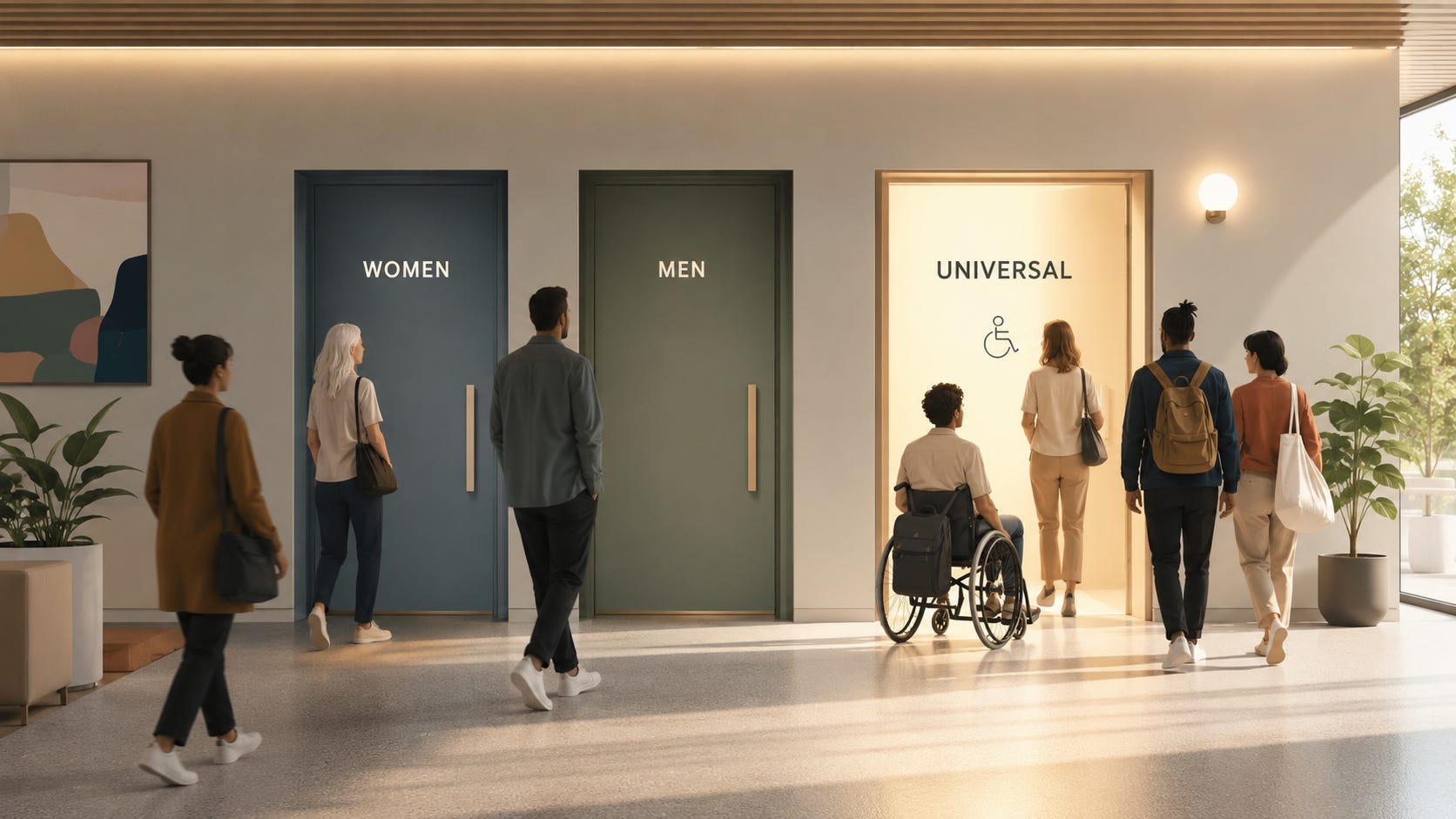
Another place the Code could have been much stronger is in how it framed mixed-sex and universal facilities. There is a lawful and practical path available: provide separate-sex facilities where justified; provide mixed-sex universal facilities where reasonably practicable; ensure every person has timely, safe, dignified access to a usable toilet or changing option; and do not frame universal provision as a special containment area for trans people.
That final point is crucial. The answer cannot become men, women, and trans. That is not inclusion. It is segregation with nicer signage.
Universal facilities should be available to anyone: parents with children, disabled people, carers, people with continence needs, people with anxiety, people with trauma histories, people whose religion or culture means they need additional privacy, nonbinary people, trans people, and anyone who simply wants more privacy. A less harsh Code could have said that mixed-sex or universal facilities should be framed as inclusive provision for all users and should not be described, signposted or operated as facilities specifically for trans people.
That one sentence would have prevented a lot of foreseeable institutional harm, because when organisations create “the trans option”, they create outing by architecture. Every use becomes a disclosure. Every visit becomes a moment of being marked out as different. Every basic bodily need becomes a public negotiation.
That is not dignity.
Employers Can Still Choose Better Practice
Although Schedule 3 applies to services, public functions and associations, employers are now facing similar questions in workplace policy. Workplace toilets are not simply a Schedule 3 issue. They sit within employment law, health and safety, dignity at work, harassment protection, welfare provision, privacy and organisational culture.
Employers cannot safely pretend that For Women Scotland did not happen. But they also do not have to adopt the harshest possible interpretation.
A sensible employer policy could recognise that, following For Women Scotland, sex for Equality Act purposes means biological sex. It could also recognise that trans people are protected under the characteristic of gender reassignment. It could provide separate-sex toilets where appropriate, alongside mixed-sex self-contained facilities where reasonably practicable. Crucially, it could make clear that harassment, intrusive questioning, outing, humiliation and speculative policing of colleagues’ bodies or histories will not be tolerated, and that any concern about facility use must be handled discreetly, case by case, and proportionately.
That is a lawful, practical, human-centred position. It does not deny biological sex as the legal classification. It does not pretend every space is gender-neutral. It does not remove the ability to manage genuinely intimate or high-risk situations. But it does prevent the workplace from becoming a surveillance environment.
Employers should be clear about this: the legal risk is not only from allowing a trans person to use a facility. The legal risk is also from exclusion, harassment, humiliation, outing, denial of access, hostile culture, and management failure. There is no risk-free path here, but there is a more defensible path.
It is called proportionality.
“The safest policy is not the one that excludes the most people. It is the one that can explain, evidence and justify what it does.”
What The EHRC Could Have Written Instead
If I were rewriting the relevant framing, I would have wanted something closer to this:
“Following For Women Scotland, references to sex in the Equality Act 2010, including the separate-sex and single-sex exceptions in Schedule 3, mean biological sex. A service that is provided only to women or only to men for the purposes of those exceptions must therefore be organised by biological sex if the provider wishes to rely on those exceptions.
However, the Act does not require every service or facility to be provided on a single-sex or separate-sex basis. Providers should first decide whether sex separation is necessary and proportionate in the particular context. They should consider the nature of the service, the degree of privacy, undress, vulnerability, trauma, safety risk, religious need, and the practical alternatives available.
Providers must also consider the impact on trans people, who remain protected under the characteristic of gender reassignment. Excluding, challenging, redirecting or questioning trans people may amount to discrimination unless justified as a proportionate means of achieving a legitimate aim.
In relation to incidental facilities such as toilets, routine questioning, monitoring or requiring proof of sex will rarely be appropriate. Providers should normally manage competing needs through design, signage, privacy measures, staff training, anti-harassment policies, and access to universal mixed-sex self-contained facilities where reasonably practicable.
Mixed-sex facilities should be available to all users and should not be framed as facilities for trans people. Providers should avoid arrangements that expose trans users to humiliation, outing, harassment, delay or denial of essential facilities.”
That would have stayed inside For Women Scotland. It would have accepted the biological-sex interpretation. It would still have allowed genuinely single-sex services where justified. But it would have made dignity the baseline rather than an afterthought.
The Real Failure Was Tone And Priority
The issue is not only legal content. It is institutional tone. Guidance communicates what matters. It tells employers, service providers, councils, charities, leisure centres, hospitals and frontline staff where to place their confidence.
A Code can say, in effect, “Here is how to exclude lawfully”. Or it can say, “Here is how to balance competing rights while preserving dignity, safety and practical access”. Those are very different messages, even where they share the same legal starting point.
The EHRC could have chosen the second. It could have made clear that For Women Scotland changes the legal definition of sex in the Equality Act, but it does not authorise routine gender policing, public challenge, forced outing, blanket exclusion, denial of toilet access, speculative complaints based on appearance, treating mixed-sex provision as a trans holding pen, or ignoring the protected characteristic of gender reassignment.
Instead, the framing has left many organisations hearing only one message: be careful, or you might accidentally include trans people.
That is a bleak message from an equality regulator. A better message would have been: be careful, because everyone’s dignity matters, and the law still requires judgement.
The Practical Model Organisations Should Use Now
For service providers and employers trying to navigate this mess, the better approach is not defiance. It is discipline.
Use precise categories. Do not call something single-sex if it is not operated as single-sex. Do not pretend a universal facility is a women’s facility. Do not create a “trans toilet”. Do not allow staff or customers to police other people’s bodies. Do not leave anyone without realistic access to essential facilities.
At the same time, document your reasoning. Train managers. Design better spaces. Distinguish between ordinary toilets and genuinely intimate or high-vulnerability environments. Remember that trans people are not a theoretical edge case. We are already in your workplaces, your services, your venues and your communities.
The task now is not to find a magic phrase that makes the discomfort go away. The task is to build lawful, proportionate, humane systems that can survive legal scrutiny, operational scrutiny and moral scrutiny.
Final Image to leave you with…
There is a version of this moment where organisations respond with fear. They laminate signs, write defensive policies, brief staff to challenge, and turn toilets into checkpoints and colleagues into suspects.
There is another version. They recognise the law. They understand the ruling. They provide separate-sex facilities where genuinely necessary. They build universal provision into the estate. They train staff to handle concerns discreetly. They refuse humiliation as a compliance strategy.
They do not pretend the legal landscape is easy, but they also refuse to make it crueller than it has to be.
That is the line the EHRC could have drawn. It still can. Until it does, responsible organisations will need to draw it for themselves.
“For Women Scotland may have narrowed the legal meaning of sex. It did not abolish proportionality, dignity, or common sense.”
And now what?
If this piece made you pause, reflect, or even disagree, I welcome that.
The point is not that everyone must land in exactly the same place. The point is that we need better conversations, clearer thinking, and less cruelty disguised as certainty.
I write from lived experience, professional practice, and a belief that inclusion is not a slogan. It is a discipline.
If you are an employer, service provider, HR leader, board member, policymaker or inclusion practitioner trying to work through these questions, do not wait until a complaint, tribunal, media pile-on or staff crisis forces your hand.
Do the thinking now.
Ask better questions.
Design better systems.
Protect dignity before harm happens.
Hold the rope.
Joanne Lockwood (she/her)
The Inclusive Culture Expert
Website: seechangehappen.co.uk | Podcast: Inclusion Bites
Creator of The Trans Inclusion Toolkit and Diagnostic and Founder of The Inclusion Bites Academy.
#InclusionBites
#PositivePeopleExperiences
#SmileEngageEducate