Three Doors, One Paradox: What “Dignity and Respect” Really Means After For Women Scotland
5 June 2026
By Joanne Lockwood (she/her) FIEDP FRSA FPSA – Written from lived experience, not from the sidelines.
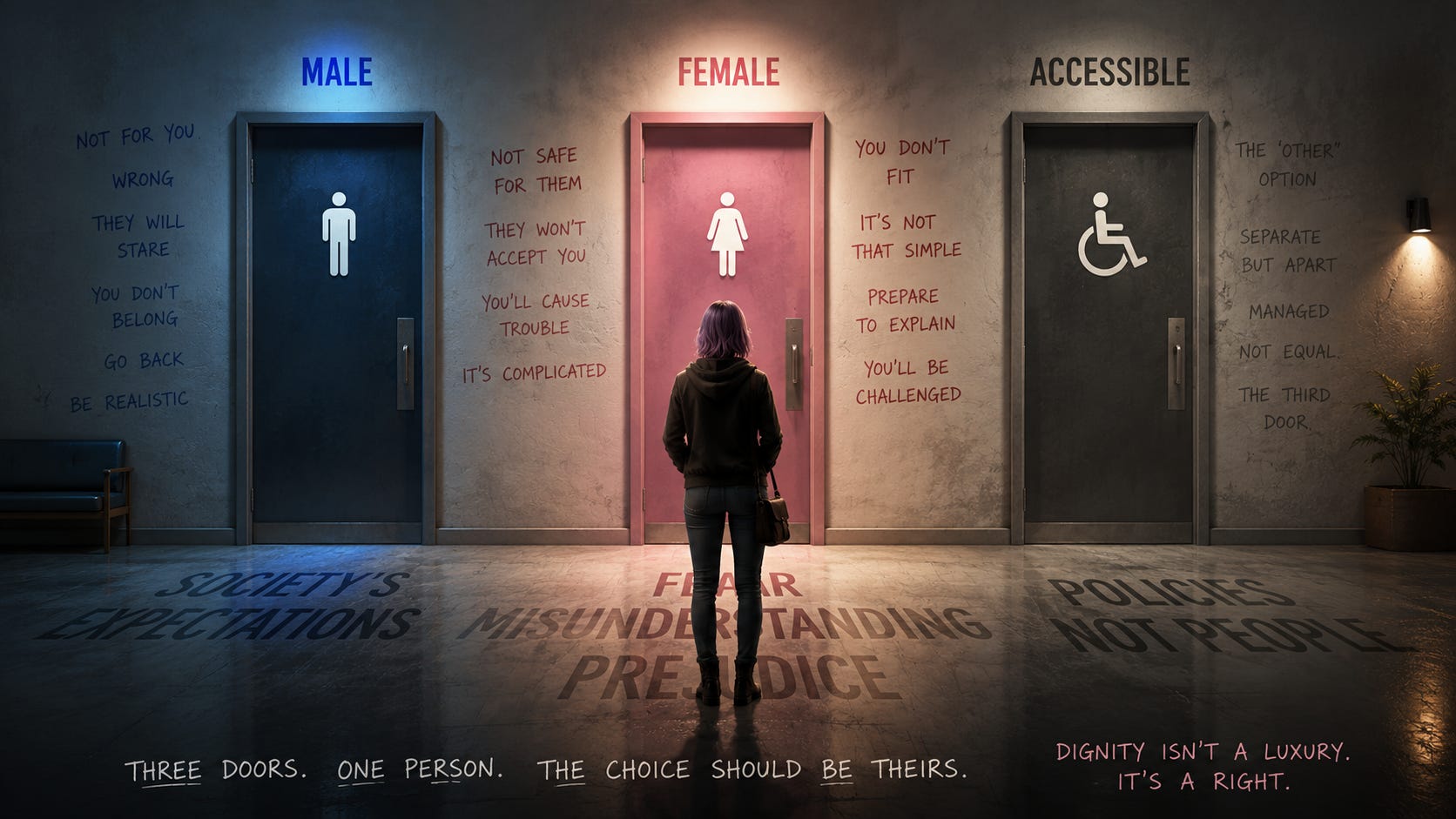
There are three doors.
Male.
Female.
Accessible.
That image keeps returning to me.
Not because toilets are the whole debate—they are not. Rather, they are the visible edge of something much larger. They are where law, policy, public discourse, institutional caution, fear, and human dignity meet in one ordinary, everyday act.
For most cis people, those three doors represent choice.
A cis man will usually use the male door. A cis woman will usually use the female door. If someone needs the accessible facility, they may use that too. The accessible door exists as additional provision: for access, privacy, disability, care needs, parenting responsibilities, medical requirements, or simple practicality.
It is an option.
For trans people, however, the logic increasingly feels different.
What is being offered is not choice, but permission.
And sometimes not even that.
We are told that the first two doors may no longer be available to us. The door that aligns with who we are, how we live, and how we are recognised in everyday life may now be legally, politically, or operationally contested. Instead, we are directed towards the third door.
Accessible. Mixed-sex. Gender-neutral. Alternative.
Separate.
That is the word beneath the more polite language.
Separate.
And we are told this is being done in the name of dignity and respect.
That is the paradox.
The letter that says everything by not saying very much
A recent letter from the Prime Minister’s Office, responding to concerns about the post-For Women Scotland landscape and the EHRC’s updated Code of Practice, illustrates how modern political language often operates.
On the surface, it sounds compassionate.
It speaks of dignity and respect. It emphasises that everyone should be able to be themselves. It reassures readers that trans people remain protected under the Equality Act and repeats the now-familiar point that protection from discrimination and harassment continues under the protected characteristic of gender reassignment.
All of that is true.
The difficulty is that it does not go very far.
The letter is not a substantive defence of trans people. It is a holding position. Its purpose is to signal that the Government accepts the Supreme Court judgment, accepts the EHRC Code being laid before Parliament, and has no apparent intention to intervene, pause, amend, or challenge the direction of travel.
The language is warm, but the substance is cooler.
In effect, the Government is saying: yes, this is contentious; yes, we want to sound compassionate; yes, trans people remain protected in principle; but the legal and policy framework is now centred on biological-sex-based single-sex provision, with trans inclusion addressed through mitigation, alternatives, proportionality, and institutional discretion.
That is not a neutral stance.
It is a political accommodation.
What the judgment did — and did not — decide
One point deserves to be repeated widely:
Whilst the Supreme Court judgment confirmed the legal definition of “sex”, it did not decide that all trans-inclusive services must become single-sex services.
That distinction matters.
Some have treated the judgment as though it instantly invalidated every inclusive practice that existed before it. As though every workplace, leisure centre, hospital, community venue, membership organisation, public service, changing room, and toilet must now reorganise itself around biological sex as the sole organising principle.
That is not what the judgment did.
It interpreted the meaning of sex within the Equality Act.
That is significant. It has serious consequences, unsettled previous assumptions, and created genuine legal and operational complexity. None of that should be minimised.
But it did not eliminate organisational choice.
It did not require every service to become rigidly single-sex.
It did not declare that trans people must be excluded from all facilities aligned with their lived gender.
It did not make dignity and respect optional.
Nor did it remove gender reassignment as a protected characteristic.
Yet many organisations are behaving as though the safest response is to retreat, restrict, and exclude in the name of compliance.
That is where the danger lies.
When institutions become anxious, they often overcorrect.
Rather than asking what the law actually requires, they ask what course of action is least likely to attract criticism.
At present, the easiest way to avoid criticism from one direction is often to place the burden on trans people.
Dignity and respect as holding phrases
Since the ruling, one phrase has been repeated again and again:
“Trans people are still protected and must be treated with dignity and respect.”
It sounds reassuring.
It suggests that something important has been preserved.
But dignity and respect are not meaningful simply because they are repeated. Their meaning depends on how they are applied in practice.
What does dignity mean at the door?
What does respect mean in a changing room?
What does dignity look like when a trans woman is told she cannot use the women’s facilities?
What does respect mean when a trans man is directed to use women’s spaces because of “biological sex”?
What does dignity mean for a non-binary person who is treated as a problem to be managed rather than a person to be accommodated?
And what does respect mean when the only option offered is a separate facility, a longer route, a locked room, a staff toilet, or a whispered exception?
If dignity means anything, it cannot mean being politely misrecognised.
That is not dignity.
It is exclusion delivered with better manners.
The floor of dignity
For me, as a trans woman, dignity and respect begin with recognition.
Being treated as a woman is not the end of the conversation. I understand that the legal position is complex. Organisations have responsibilities to different groups, and there are contexts where privacy, safeguarding, vulnerability, trauma, and proportionality require careful consideration.
But there must be a foundation.
And that foundation is recognition.
It is impossible to say, “We respect who you are,” while designing systems around the assumption that I am not who I say I am.
It is impossible to say, “You are protected,” while removing the practical conditions that make ordinary participation possible.
And it is impossible to say, “You can be yourself,” if that selfhood is only permitted in spaces chosen by others and separated from ordinary provision.
This is where the language of dignity begins to unravel.
Because dignity is not primarily about tone. It is not about whether someone smiles while redirecting you, whether a policy uses kind language, or whether exclusion is accompanied by an apology.
Dignity is about status.
It is about recognition.
It is about whether someone is treated as a full participant in public, professional, civic, and social life.
If I am protected because I have reassigned gender, but not recognised as the gender to which I have reassigned, then what exactly is being protected?
My paperwork?
My medical history?
My transition as an abstract process?
The fact that I exist, but not the reality of how I live?
Protection for gender reassignment becomes hollow if it safeguards the journey while refusing to recognise the destination.
The third door problem
This is why the three doors matter.
Male.
Female.
Accessible.
For most cis people, the first two doors represent ordinary social recognition. The third is additional provision.
For trans people, however, the third door is increasingly presented as the answer.
Not because it is equivalent.
Not because it is always nearby, available, safe, clean, or dignified.
And not because trans people necessarily need accessible provision.
Rather, it allows institutions to say, “We have provided something.”
That word matters.
Because access to a toilet is not the same as access to the appropriate toilet.
Alternative provision is not the same as equal provision.
Mixed-sex provision is not automatically synonymous with dignity.
And directing someone to an accessible toilet is not inclusion if that facility has quietly become the “trans toilet” by another name.
There is another issue too.
Accessible toilets are not spare capacity waiting to be repurposed whenever organisations feel uncertain about trans inclusion.
They exist because disabled people and others with specific access needs require them.
A facility designed to remove barriers becomes a mechanism for managing controversy.
That should concern all of us.
The Prime Minister’s Office letter as triangulation
The letter performs a familiar political balancing act.
It seeks to reassure three audiences simultaneously.
To trans people and allies, it says: you remain protected; harassment is unacceptable; dignity and respect matter.
To gender-critical campaigners, it says: we accept the Supreme Court judgment and biological-sex-based interpretation.
To institutions and service providers, it says: follow the Code, make proportionate decisions, and provide alternatives where possible.
That is triangulation.
The language remains deliberately cautious because a more direct statement would carry political costs.
A more candid version might read:
The Government accepts the Court’s interpretation and intends to proceed with the EHRC Code. Trans people remain protected from discrimination, but access to single-sex provision may be restricted where exclusion is considered proportionate.
That is the substance.
Much of the surrounding language serves to soften its impact.
What is not being said
The omissions are as revealing as the statements themselves.
The Government does not say that trans women with Gender Recognition Certificates should be treated as women for Equality Act single-sex service purposes.
It does not commit to protecting existing access to toilets, changing rooms, hospitals, leisure centres, associations, or other everyday facilities.
It does not acknowledge the risks of outing, humiliation, exclusion, or denial of service.
It does not promise to monitor the impact on trans people.
Nor does it insist that alternatives must be genuinely equivalent, accessible, safe, maintained, and dignified.
It does not challenge the EHRC’s approach.
And it does not propose legislation to restore previous expectations.
Instead, it offers reassurance in principle while accepting restriction in practice.
Protected in theory. Redirected in reality.
The shift from inclusion to mitigation
Before the ruling, many organisations operated from a broadly inclusive assumption: in most ordinary circumstances, trans people could use facilities aligned with their lived gender unless there was a specific and proportionate reason not to.
That approach was not perfect.
But it provided a workable starting point grounded in practicality, dignity, and lived reality.
The emerging framework risks reversing that assumption.
Instead of asking, “How can we include trans people safely and respectfully?” the question becomes:
“How can we mitigate the effects of excluding trans people once biological-sex-based provision is treated as the default?”
That is a profound shift.
It transforms inclusion from a presumption into a problem to be managed.
It asks how best to accommodate those who have already been displaced.
Dignity becomes something added afterwards rather than built in from the start.
That is not good enough.
If dignity only appears after exclusion has occurred, it is no longer dignity. It is reputation management.
The coach and horses problem
The phrase may sound strong, but it feels accurate.
The For Women Scotland ruling drove a coach and horses through many of the assumptions organisations had relied upon when interpreting the Equality Act.
It destabilised the relationship between sex, gender reassignment, legal recognition, privacy, dignity, and practical inclusion.
It created a situation in which a trans person can be legally protected because they have reassigned gender while simultaneously being denied recognition of that reassigned gender for significant Equality Act purposes.
That is not a minor technical adjustment. It is a structural contradiction.
And the people most likely to bear the consequences are not ministers, lawyers, commentators, or campaigners.
They are trans people standing in front of three doors.
What dignity must mean now
If politicians, regulators, employers, service providers, and public bodies continue to invoke dignity and respect, they need to explain what those words mean in practice.
Dignity should mean that trans people are not required to disclose personal history simply to access ordinary services.
It should mean they are not forced to negotiate their identity with receptionists, managers, security staff, volunteers, colleagues, or strangers.
It should mean accessible facilities are not quietly transformed into trans containment spaces.
It should mean that alternatives, where genuinely necessary, are not inferior, distant, locked, unsafe, stigmatising, or humiliating.
It should mean assessing policies according to their human impact, not merely their legal defensibility.
It should mean asking who bears the burden of other people’s discomfort.
And it should mean ensuring that proportionality does not become a polite synonym for exclusion.
Above all, dignity should mean recognising that trans people are not abstractions.
We are not “competing rights” made flesh.
We are not policy dilemmas.
We are not legal thought experiments.
We are people trying to work, travel, volunteer, learn, shop, socialise, access healthcare, attend events, join associations, and move through everyday life without becoming a public controversy.
The question every organisation should ask
The three doors provide a simple test.
When your policy is applied:
Who enjoys ordinary choice?
Who is redirected?
Who is expected to be grateful for a lesser option?
Who must ask permission?
Who must explain themselves?
Who risks being challenged?
Who becomes visible?
Who is treated as the exception?
Who receives dignity as a default, and who receives it only as an adjustment?
Those questions reveal more than policy wording ever can.
Exclusion rarely presents itself as cruelty.
More often it arrives wrapped in language about balance, clarity, practicality, sensitivity, proportionality, and respect.
Those concepts are not inherently problematic. Indeed, they are often necessary.
But they can also become anaesthetic.
They can dull our awareness of what is actually happening.
Someone is being moved.
Someone is being singled out.
Someone is being told: not that door.
This is not just about toilets
I can already hear the objection.
“Why is it always about toilets?”
It is not.
It is about recognition.
It is about whether a trans person’s reassigned gender has social and institutional reality.
It is about whether protection under gender reassignment means more than simply not being harassed.
It is about whether the state can encourage people to “be themselves” while supporting a framework that makes that selfhood conditional.
It is about whether dignity means full participation or merely managed survival.
The toilet door is simply where the contradiction becomes impossible to ignore.
The letter’s real message
Yes, the letter says trans people remain protected.
Yes, it says dignity and respect matter.
Yes, it says service providers should ensure access to essential services.
But its practical message is this:
Biological sex is increasingly being treated as the organising principle for single-sex provision. Trans inclusion is being reframed as a matter of mitigation. Alternatives may be offered where possible. Exclusion is now part of the conversation, with proportionality becoming the key test.
That is the difficult reading.
And it explains why the language of dignity can feel so thin.
Because dignity cannot mean recognition only when convenient.
Respect cannot mean polite redirection.
Protection cannot mean freedom from harassment while ordinary participation is diminished.
And inclusion cannot mean simply being told there is another door somewhere else.
The door chosen for me
For me, dignity begins with being recognised as myself.
Not as a problem.
Not as a risk.
Not as a compromise.
Not as someone to be managed through alternative provision.
As a woman.
That does not resolve every legal question or remove every operational challenge.
But it establishes the foundation.
Without that foundation, everything built upon it becomes unstable.
The real question is not whether trans people remain named within the Equality Act.
The question is what that protection actually protects.
If it does not safeguard our ability to live, work, participate, move through society, and access ordinary services in alignment with who we are, then it risks becoming something technical and fragile.
A protection that exists on paper while dignity is lost at the door.
Final image
Three doors.
Male.
Female.
Accessible.
For most cis people, they represent ordinary choice.
For many trans people, they increasingly represent conditional access.
That is the real test.
Not the press release.
Not the reassurance.
Not the carefully drafted letter.
The door.
Who walks through without explanation?
Who is challenged?
Who is redirected?
Who is told their dignity remains intact even as their recognition is withdrawn?
The Government cannot continue to insist that trans people are protected while accepting a framework that makes recognition conditional, access discretionary, and dignity dependent on which door someone else permits us to use.
Dignity is not a catchphrase.
It is not a comfort blanket.
It is not a line in a ministerial letter.
Dignity is what happens at the door.
And if the only door I am permitted to use is the one chosen for me, then we should at least be honest about what that means.
That is not dignity.
It is exclusion spoken in a softer voice.
If this piece has made you think, pause, or even disagree, I welcome that. These conversations are difficult because they sit at the intersection of law, identity, safety, fear, dignity, and belonging. But difficulty cannot become an excuse for silence, nor should politeness be allowed to disguise harm.
If you are a leader, policymaker, HR professional, service provider, or simply someone trying to understand what this moment means, do not stop at the words “dignity and respect.”
Ask what they require.
Ask who bears the cost.
Ask what happens at the door.
#InclusionBites #PositivePeopleExperiences #SmileEngageEducate
Hold the rope.
Joanne Lockwood (she/her)
The Inclusive Culture Expert
Website: seechangehappen.co.uk | Podcast: Inclusion Bites
Creator of The Trans Inclusion Toolkit and Diagnostic and Founder of The Inclusion Bites Academy.