What Should Transgender People Expect as a Minimum Standard of Dignity and Respect?
8 June 2026
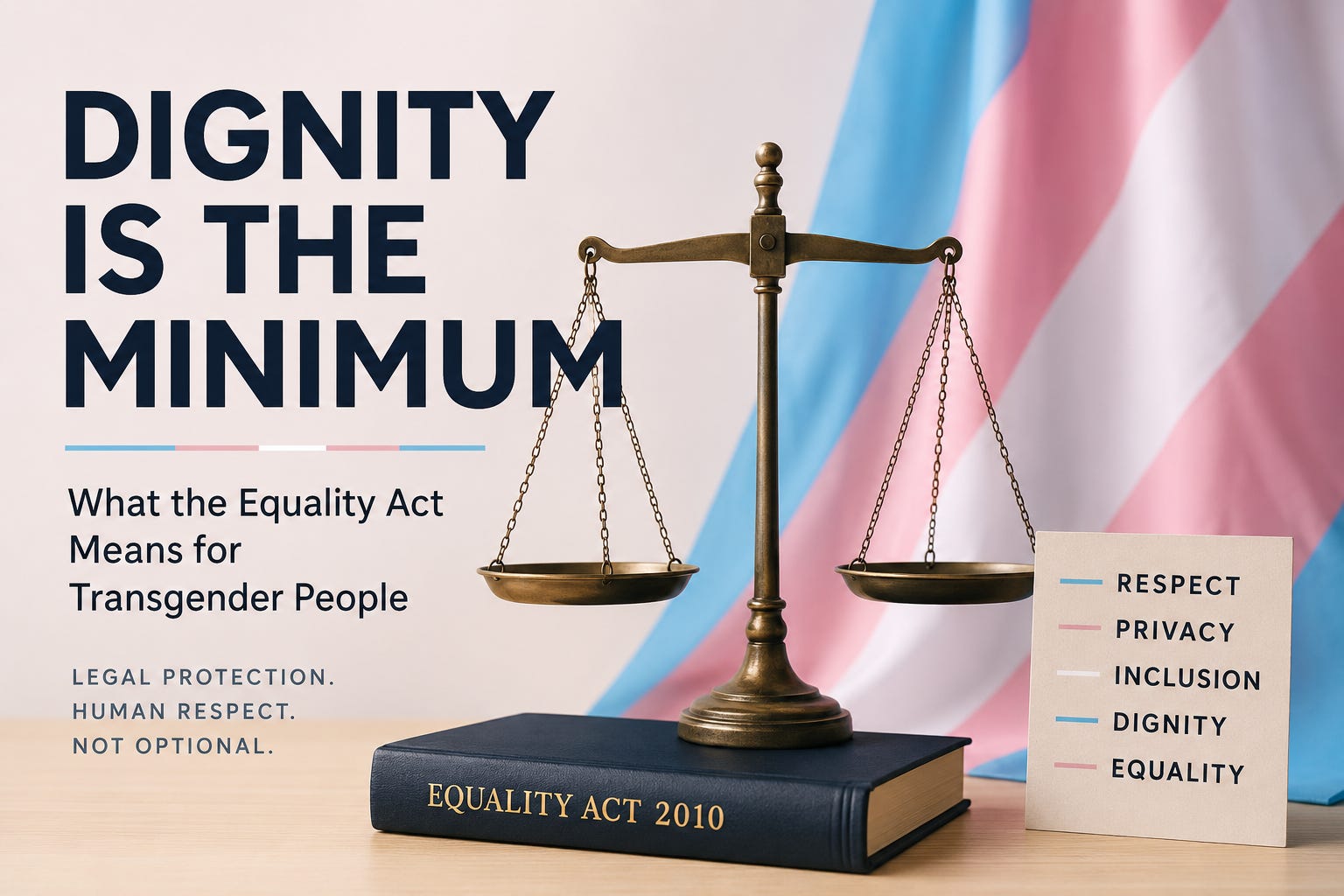
By Joanne Lockwood (she/her) FIEDP FRSA FPSA – Written from lived experience, not from the sidelines.
Under the Equality Act 2010, transgender people are protected through the protected characteristic of gender reassignment.
The legal wording covers someone who is proposing to undergo, is undergoing, or has undergone a process to reassign their sex by changing physiological or other attributes of sex.
Importantly, medical treatment, surgery, or a Gender Recognition Certificate are not required for this protection to apply.
This means that protection applies broadly. It is not limited to people who have taken medical steps, changed documents, undergone surgery, or received formal legal recognition of their gender.
But before considering minimum standards of dignity and respect, it is important to be clear about language.
What Do We Mean by “Transgender” and “Transition”?
A transgender person is someone whose gender identity, lived experience, or social role does not align, or does not fully align, with what they were assigned at birth.
This may include:
a trans woman: someone assigned male at birth who is a woman;
a trans man: someone assigned female at birth who is a man;
a non-binary person: someone whose gender is not exclusively male or female;
other gender-diverse people whose experience does not fit neatly within conventional expectations of sex and gender.
Trans people are not a “third category” separate from men and women.
Some trans people are women.
Some trans people are men.
Some are non-binary.
Some may use other language to describe themselves.
This distinction matters.
If we talk about “trans people” as though they are neither men nor women, we risk creating a misleading third category. That is neither accurate nor dignified.
The Equality Act 2010 uses the protected characteristic of gender reassignment. This is the legal term, but it should not be misunderstood as requiring surgery, medical treatment, or formal legal recognition.
A person is protected if they are proposing to undergo, are undergoing, or have undergone a process of reassigning their sex by changing physiological or other attributes of sex.
In practical terms, transition may include social, legal, medical, or personal steps.
These might include changing name, title, pronouns, clothing, documents, workplace records, appearance, hormone treatment, surgery, or simply living in a way that reflects the person’s gender.
Not every trans person takes the same steps.
Not every trans person wants or needs medical intervention. Some people transition socially. Some transition medically. Some transition legally. Some do a combination of these. Some do none of the above in any formal sense but are still protected if they are proposing to transition or are perceived as trans.
The key point is this:
A trans person should not have to prove medical history, surgical status, legal recognition, or documentary change before being treated with dignity and respect.
This matters because dignity is not dependent on paperwork, anatomy, or someone else’s approval.
The Minimum Standard
At its simplest, the minimum standard is this:
A transgender person should be treated as a person of equal worth, free from discrimination, harassment, humiliation, degradation, victimisation, or unnecessary exclusion because they are trans, are perceived to be trans, or are taking steps to live in alignment with their gender.
That is the baseline.
It is not special treatment.
It is not preferential treatment.
It is not an optional courtesy.
It is a basic legal and human standard.
No Discrimination Because Someone Is Trans
A trans person should not be treated less favourably because they are proposing to transition, are transitioning, have transitioned, or are perceived to be trans.
This applies across the areas covered by the Equality Act, including employment, services, education, public functions, associations, and other relevant settings.
Examples of unacceptable treatment may include:
refusing someone a job, service, opportunity, or promotion because they are trans;
excluding them from ordinary workplace or organisational life;
treating their transition as a nuisance, risk, joke, or reputational problem;
applying rules in a way that disproportionately disadvantages trans people without proper justification.
The central principle is straightforward: decisions should not be driven by discomfort, prejudice, stereotype, gossip, or assumptions about transgender people.
No Harassment or Degrading Treatment
The Equality Act defines harassment as unwanted conduct related to a protected characteristic that has the purpose or effect of violating someone’s dignity or creating an intimidating, hostile, degrading, humiliating, or offensive environment.
For transgender people, this means they should not have to tolerate:
mocking, jokes, slurs, gossip, or intrusive questioning;
deliberate misgendering or deadnaming;
hostility framed as “just debate” when it targets their identity or dignity;
being treated as deceptive, dangerous, unstable, or inappropriate simply because they are trans;
being humiliated in front of colleagues, customers, service users, or peers.
A one-off incident can be enough. It does not necessarily need to be a long campaign of abuse.
This is an important point for employers, service providers, and public bodies.
Harassment is not only about repeated behaviour. A single serious incident may still create an environment that violates someone’s dignity or makes participation unsafe, humiliating, or degrading.
Privacy and Personal Information Should Be Respected
A trans person should not be expected to disclose unnecessary personal details about their body, medical history, surgery, hormones, Gender Recognition Certificate status, or previous name.
In most workplace or service contexts, those details are irrelevant.
A dignity-based minimum standard means:
only asking for information that is genuinely necessary;
keeping any disclosed information confidential;
not “outing” someone as trans;
not discussing someone’s trans status as gossip, curiosity, or “awareness raising”.
This is especially important in workplaces, healthcare settings, education, housing, customer-facing services, and public bodies.
There may be limited situations where specific information is required for a legitimate operational, safeguarding, legal, or administrative reason. Even then, the information should be handled carefully, confidentially, and proportionately.
Curiosity is not a legitimate reason.
Names, Titles, and Pronouns Should Be Respected
The Equality Act does not contain a simple standalone “pronoun clause”.
However, dignity and harassment principles matter.
Persistent or deliberate refusal to use a person’s name, title, or pronouns may contribute to harassment or less favourable treatment, depending on the facts.
The practical minimum standard is:
use the name the person uses;
use the title and pronouns they have made clear;
correct mistakes without making a performance of it;
do not weaponise “belief” as permission to demean someone.
This does not mean every accidental mistake is unlawful.
People make mistakes. In many cases, a brief correction and moving on is enough.
The issue is different where behaviour is repeated, deliberate, hostile, mocking, or used to undermine someone’s dignity.
Organisations should not permit behaviour that humiliates, degrades, or isolates someone because they are trans.
Fair Access to Work, Services, Facilities, and Participation
Trans people should be able to participate in ordinary organisational life without being treated as a problem to be managed out of sight.
This includes recognising that trans people are not a single homogeneous group.
A trans woman is not the same as a trans man. A non-binary person may have different needs again. The correct approach is not to flatten all trans people into one “trans category”, but to make careful, lawful, proportionate decisions based on the actual person, context, need, risk, and rights involved.
Following the Supreme Court judgment in For Women Scotland v The Scottish Ministers on 16 April 2025, the Equality Act definition of “sex” is interpreted as biological sex for the purposes of that Act.
However, the judgment did not remove protection for trans people under gender reassignment.
Gender reassignment remains a separate protected characteristic. Trans people continue to be protected from discrimination, harassment, and victimisation under the Equality Act.
The correct position is therefore:
The 2025 ruling affects how “sex”, “man”, and “woman” are interpreted in the Equality Act. It does not give organisations a free pass to exclude, humiliate, misgender, or mistreat transgender people.
Where single-sex services, facilities, or exceptions are being considered, organisations still need to act lawfully, proportionately, and with proper regard to the rights and dignity of everyone affected.
Blanket humiliation is not a lawful inclusion strategy.
Nor is pretending that trans people have no remaining rights.
No Victimisation for Raising Concerns
A trans person should not be punished, sidelined, mocked, disciplined, excluded, or treated badly because they raise concerns about discrimination, harassment, or dignity at work or in services.
Victimisation is one of the prohibited forms of conduct under the Equality Act framework.
This matters because many people do not report poor treatment unless they feel they have no other choice.
If raising a concern leads to retaliation, exclusion, reputational damage, or being labelled “difficult”, the organisation compounds the original problem.
A minimum standard of dignity requires that concerns are taken seriously and handled fairly.
A Practical Minimum-Standard Statement
For a policy, training slide, staff handbook, or service guidance document, the following wording may be helpful:
Transgender people are entitled to be treated with dignity, respect, and fairness. As a minimum, they must not be discriminated against, harassed, victimised, humiliated, excluded, or subjected to intrusive treatment because they are trans, are perceived to be trans, or have proposed, started, or completed a process of transition. This protection applies regardless of whether they have had medical treatment, surgery, or hold a Gender Recognition Certificate.
This statement is intentionally practical.
It does not require an organisation to resolve every complex policy question in one sentence.
It simply establishes the baseline: whatever decisions need to be made, they must not strip people of dignity.
What “Dignity and Respect” Should Look Like
Language
Use the person’s name, title, and pronouns; avoid slurs, mockery, deadnaming, or hostile commentary.
Privacy
Do not ask intrusive questions or disclose someone’s trans status without need and consent.
Workplace conduct
Prevent bullying, harassment, gossip, exclusion, and humiliating treatment.
Decision-making
Make decisions based on role, need, risk, proportionality, and evidence, not discomfort, stereotype, or prejudice.
Facilities and services
Consider access carefully, lawfully, and proportionately; do not use policy uncertainty as permission for degrading treatment.
Complaints
Take concerns seriously and protect people from retaliation.
Language
Use the person’s name, title, and pronouns; avoid slurs, mockery, deadnaming, or hostile commentary.
Privacy
Do not ask intrusive questions or disclose someone’s trans status without need and consent.
Workplace conduct
Prevent bullying, harassment, gossip, exclusion, and humiliating treatment.
Decision-making
Make decisions based on role, need, risk, proportionality, and evidence — not discomfort, stereotype, or prejudice.
Facilities and services
Consider access carefully, lawfully, and proportionately; do not use policy uncertainty as permission for degrading treatment.
Complaints
Take concerns seriously and protect people from retaliation.
The Legal Minimum Is Not the Same as Best Practice
It is useful to distinguish between three things:
The legal minimum
What an organisation must do to avoid unlawful discrimination, harassment, or victimisation.Good practice
What an organisation should do to create a respectful, safe, and inclusive environment.Culture and leadership
How an organisation behaves when the law is uncertain, contested, or under public pressure.
The Equality Act sets a floor, not a ceiling.
An organisation may be technically focused on legal compliance but still create an environment where trans people feel exposed, scrutinised, excluded, or degraded.
That is not sustainable, and it is rarely good risk management.
The more practical question is not simply:
“What can we get away with?”
It is:
“How do we make lawful, proportionate decisions while ensuring that people are not humiliated, dehumanised, or treated as problems?”
That question is more useful for employers, service providers, HR teams, managers, boards, and public bodies.
Bottom Line
The legal minimum is not “affirm everything without question”.
It is also not “treat trans people as exceptions, risks, or problems”.
The minimum is:
No discrimination.
No harassment.
No victimisation.
No humiliation.
No unnecessary intrusion.
No avoidable loss of dignity.
Anything below that is not just poor practice.
It may be unlawful.
Hold the rope.
Joanne Lockwood (she/her)
The Inclusive Culture Expert
Website: seechangehappen.co.uk | Podcast: Inclusion Bites
Creator of The Trans Inclusion Toolkit and Diagnostic and Founder of The Inclusion Bites Academy.
#InclusionBites
#PositivePeopleExperiences
#SmileEngageEducate