By Joanne Lockwood (she/her) FIEDP FRSA FPSA — Written from lived experience, not from the sidelines.
This is the last piece. Over four days I’ve traced what one Commons committee session revealed about the EHRC’s new Code: an appearance test the regulator invented, an “alternative provision” that often isn’t there, and a framework the regulator declined to draw, leaving the hardest calls to the least powerful people in the chain.
Underneath all of it runs one question, and it’s the one this series has been walking toward: when two groups’ interests genuinely collide, whose harm does the Code actually treat as real?
The Commission’s answer, stated plainly and often, is: both. Dr Stephenson spoke — sincerely, I think — about how “febrile and deeply unpleasant” this has become for everyone, women and trans people alike, and asked us all to “take down the heat.” I agree with her about the heat. But even‑handed language and even‑handed effects are not the same thing. And the effects do not balance.
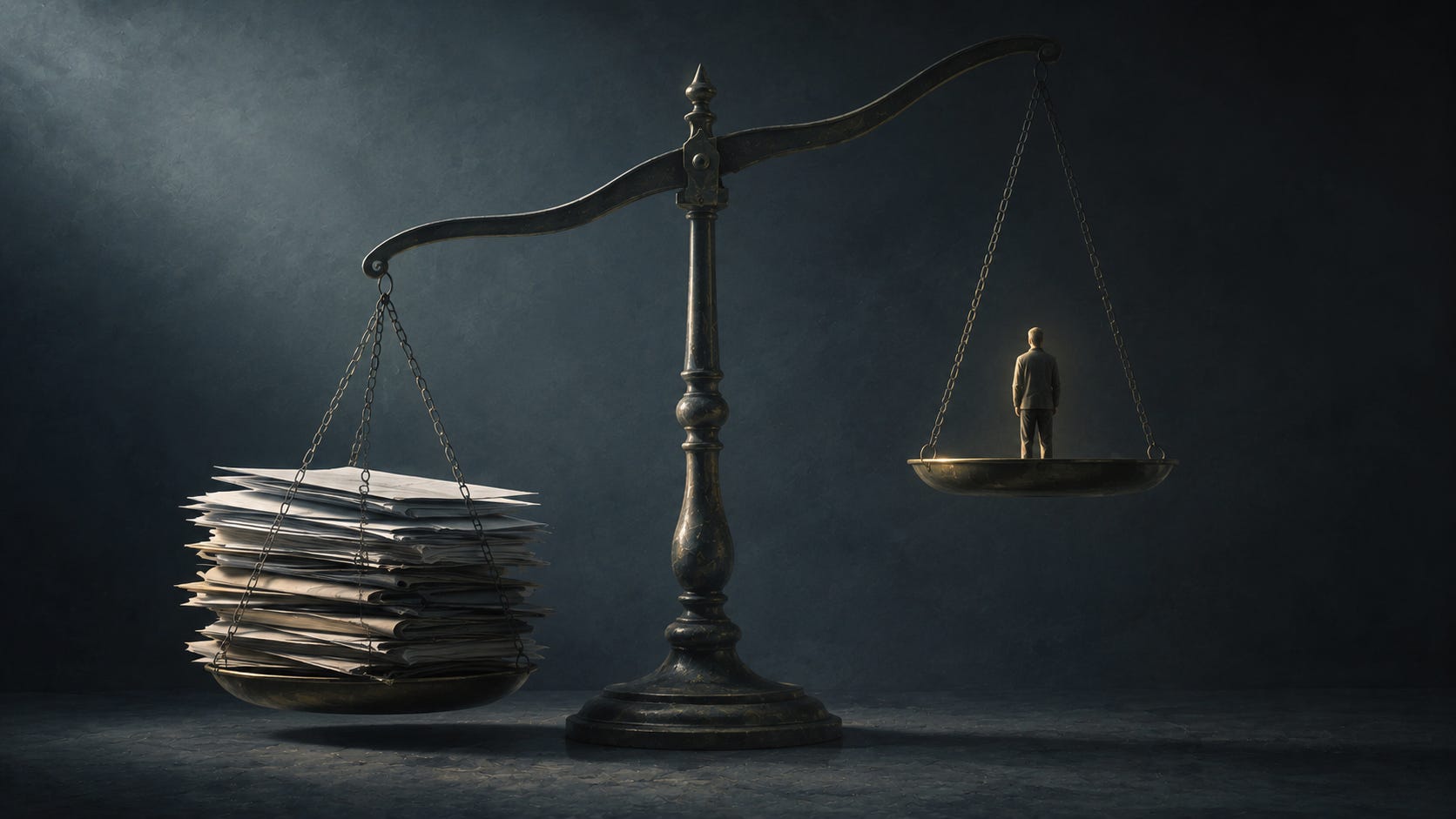
A balance with one pan empty
Watch how each side’s harm is handled when it’s raised.
When trans harm comes up — the violence, the exclusion, the outing — the response is the language of monitoring. We recognise the concern. We’ll keep it under review. It depends on the circumstances. The harm is acknowledged, then filed.
When women’s harm comes up, the response is the language of enforcement. Dr Stephenson was clear that failing to provide single‑sex services “may amount to indirect sex discrimination against women” — a live legal duty, with case law behind it, that a provider can be sued for breaching. That is real, and it is legitimate, and I would not strip a word of protection from a woman in a refuge or a hospital bed to make a rhetorical point.
But notice the asymmetry in the tools. One harm gets a cause of action. The other gets a commitment to watch. One is enforceable today; the other is “kept under review.” The Code speaks of both groups — but it arms only one of them.
One pan of the scales holds enforceable law. The other holds a promise to keep things under review.
The people who weren’t in the room
There is a quieter asymmetry, and once you see it you can’t unsee it.
For two hours, a committee weighed the rights and safety of trans people. Not one trans person gave evidence. The witnesses were the regulator. The affected group appeared only as second‑hand testimony — Emma’s email, read aloud; Teraina’s fear, reported by her MP — never as a voice that could answer back, be questioned, push.
When one side of a balance is in the room giving evidence and the other is a letter being read out, the scales are weighted before anyone speaks. Harm that is reported lands differently from harm that is testified. It becomes an anecdote — a hard case to be sympathised with and moved past — rather than evidence to be reckoned with. The empty chair is not a small thing. It is part of how the dignity gap gets built.
The document that gives the game away
Here is where the series has been heading, and it is the part I most want you to carry away — because it cannot be dismissed as my opinion, or anyone’s activism.
Everything the critics warned about on Tuesday — the heightened risk of violence, the forced outing, the policing of people’s appearance, the disabled toilet pressed into service as the trans toilet — is written down in the Government’s own Equality Impact Assessment for this Code. On gov.uk. In black and white.
The assessment states that excluding trans women from women’s services, and pushing them toward men’s, could expose them to a “disproportionate risk of violence and sexual assault.” It flags the risk of involuntary outing. It flags the policing of gender presentation, catching trans and non‑trans people alike. It acknowledges that turning accessible toilets into gender‑neutral ones reduces provision for disabled people.
This was not unforeseen. It was not an unlucky side‑effect nobody could have predicted. The harm was assessed, documented, and the Code was laid before Parliament anyway.
When Nadia Whittome said the impact assessment showed trans people facing increased risk of violence and sexual assault, the Commission’s reply was that “no evidence was provided” for some of it. But the risk is in the Government’s own paper, and the underlying vulnerability — trans people’s far higher baseline rates of sexual and partner violence — is some of the best‑evidenced data in this entire field. “No evidence” is not an answer to a document you can download.
The harms were not a surprise. The Government wrote them down — and laid the Code before Parliament anyway.
The dignity gap
That is the gap this series is named for. Not the gap between good people and bad people — I don’t think this is a story of villains. It is the gap between what the Code says and what the Code does. Between dignity offered in the preamble and dignity withheld in the operation. Between the harms the state acknowledged on paper and the protection it declined to build in practice.
A balance that speaks of two groups and arms one. A consultation that heard trans people and a hearing where none could speak. An impact assessment that named the danger and a Code that shipped regardless. Each of those is a gap. Together, they are the gap — and trans people are the ones standing in it.
I’ll end where I began this series, and where I’ve argued from the start: the EHRC could have chosen dignity. It could have accepted every word of the Supreme Court’s ruling and still written guidance that did not police people on sight, did not promise doors it would not fund, did not pass impossible decisions to nurses, and did not look away from harms it had already written down. That Code was available. It still is.
Teraina checked herself out of a hospital bed to be heard. Emma is making plans to leave the country she swore an oath to. The least the rest of us can do — while the Code is still not law, while Parliament can still object, while more than a hundred MPs are still asking it to — is refuse to let the gap close quietly over them.
And now what?
This Code is not yet law. It was laid before Parliament on 21 May; the window to object is still open; a motion to reject it already carries more than 110 signatures; and the wider legal question is heading for the Court of Appeal. Nothing about this is settled. That is the point of saying so now, loudly, while it counts.
So — whoever you are:
If you have an MP, tell them what you think of this Code before the window shuts.
If you run an organisation, build the dignity the Code left out — the framework, the real alternative, the trained staff — and don’t wait for a tribunal to teach it to you.
And if you’ve read all five of these, share one. The gap closes in quiet. It stays open in noise.
Do the thinking now. Ask the better questions. Build the dignity in. And refuse to make this crueller than the law requires.
Hold the rope.
Joanne Lockwood (she/her)
The Inclusive Culture Expert
Website: seechangehappen.co.uk | Podcast: Inclusion Bites
Creator of The Trans Inclusion Toolkit and Diagnostic and Founder of The Inclusion Bites Academy.
#InclusionBites #PositivePeopleExperiences #SmileEngageEducate
The finale of The Dignity Gap. Quotations are from the 9 June Women and Equalities Committee session. The risk findings are from the Government’s published Equality Impact Assessment for the draft Code. Thank you for reading all five.