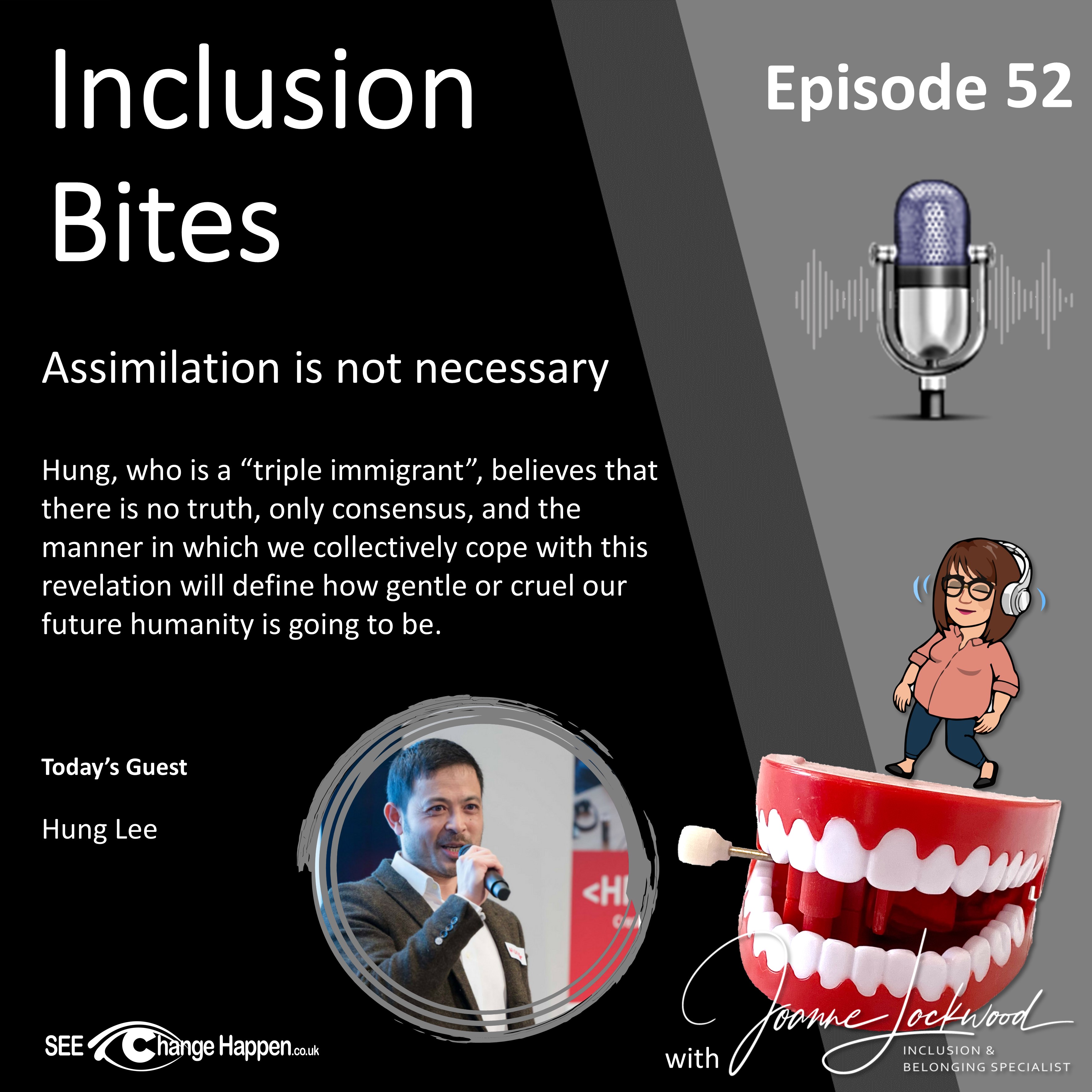
Assimilation Is Not Necessary
with Hung Lee · 16 December 2021
Lived Experience Identity
Hung Lee, curator of Recruiting Brainfood, joins Joanne Lockwood to unpack the pressures many people feel to assimilate when living in a country where their ethnic background is not considered “native”. Drawing on his childhood experiences of bullying and attempts to “fit in”, Hung describes how early rejection can create a powerful drive to belong — and how that drive can lead to two unhelpful extremes: hyper-assimilation or outright rejection of the surrounding culture.
The conversation widens from personal lived experience into how belonging functions in workplaces and societies. Joanne and Hung discuss why organisations can struggle with the promise of being inclusive “for everyone” all of the time, and how polarisation and the “noisy minority” can distort dialogue. They explore ideas like the paradox of tolerance, the role of values and boundaries in any community, and the importance of sustained dialogue rather than defensive reactions when privilege or identity is challenged.
They also reflect on certainty, ideology, echo chambers, and the value of doubt as a tool for healthier debate and better decision-making. The episode closes with Hung sharing how Recruiting Brainfood began as a personal curation habit, and why consistency and community have been central to building an engaged audience over time.
About Hung Lee
One-sentence summary
Hung Lee’s message is a quiet act of self-preservation: you do not have to erase yourself to belong, and you do not have to burn everything down to matter.
---
Synopsis
Hung Lee grew up as a visibly different child in a post-industrial, working-class part of the UK, navigating the kind of playground cruelty many minority children know too well. He remembers being five or six years old, going home and trying to scrub his face “whiter” after being told he was dirty. That memory stayed with him — not as bitterness, but as a fork in the road. He saw how easily a child can overcorrect: becoming “hyper-assimilated”, or turning rejection into hostility. Instead, Hung chose something quieter and harder — accepting that he might never fully “fit”, and deciding that was alright.
What he is trying to change is the pressure to prove worth through total assimilation or total opposition. He believes that the promise of perfect inclusion is unrealistic, and that pretending otherwise only deepens resentment. He wants people — and societies — to move forward without demanding erasure, to embrace progress without revolutions that devour people in the process. For Hung, the work is about protecting dignity: allowing people to live without killing parts of themselves, and encouraging change that is thoughtful rather than vengeful.
---
10 Small, digestible concepts for easy learning
1. Belonging should not require self-erasure.
You can learn the rules of a culture without deleting your own story.
2. Rejection creates crossroads.
Hurt can push you towards imitation or opposition — neither is your only option.
3. Hyper-assimilation is still pain speaking.
Becoming an exaggerated version of your critics rarely heals the wound.
4. Bitterness curdles when there’s no exit.
When people cannot leave a system, resentment hardens.
5. Total inclusion is an aspiration, not a guarantee.
Promising 100% belonging, 100% of the time, sets everyone up for disillusionment.
6. Revolutions have human cost.
Tearing down systems may feel righteous, but someone always pays.
7. Incremental change is not cowardice.
Moving step by step can be wiser, kinder, and more enduring.
8. Extremes are loud, not always numerous.
The most vocal voices often don’t represent the quiet majority.
9. Certainty fuels division.
The more convinced we are that we hold ‘the truth’, the less room there is for others.
10. Ideas are tools, not identities.
When you grip an idea like it’s your name, you stop being able to put it down.
---
The “why” in the story
What they believe is true about people
Hung believes most people simply want to live, love their families, and get on with things. They are not extremists; they are tired, busy, trying. He believes people can change — but rarely under attack.
What they cannot unsee
He cannot unsee the moment a child tries to wash away their heritage. He cannot unsee how quickly rejection breeds radicalisation — how second-generation immigrants, searching for belonging, are more vulnerable to polarity.
What they are no longer willing to tolerate
He is no longer willing to pretend that full assimilation is the price of peace. Nor is he willing to support rage that ignores the human collateral of upheaval.
What they are trying to build instead
He is trying to build spaces for conversation — consistent, steady, open conversations — where people can explore ideas without being shamed for doubt, and where identity doesn’t have to be surrendered to participate.
---
Narrative structure
1. The trigger
Being a young child mocked for his ethnicity, standing at a bathroom sink and trying to scrub away what made him different.
2. The tension
Living in a country he calls home while knowing he may never be fully accepted without caveat. Watching cultural debates harden into extremes. Feeling how easily people retreat into defensiveness when they fear losing status.
3. The insight
“It’s okay not to be fully accepted.” Chasing absolute belonging can distort you. Fighting endlessly against rejection can also distort you. The middle path — imperfect belonging — is survivable.
4. The pivot
Choosing incremental change over revolution. Choosing curiosity over certainty. Treating ideas as tools to test rather than banners to wave.
5. The destination
A society where people can bring more of themselves without pressure to conform completely — and where change happens through conversation, not combustion.
---
Five key takeaways and learning points
1. You do not need to annihilate your identity to earn your place.
So what: You can relax your grip on “fitting in” and focus on contributing as you are.
2. Rejection explains behaviour — it doesn’t justify extremism.
So what: Understanding hurt helps prevent it from escalating into harm.
3. Progress that lasts rarely arrives overnight.
So what: Patience can be protective; steady change avoids leaving casualties behind.
4. Certainty feels powerful but narrows your vision.
So what: Doubt is not weakness — it’s intellectual humility.
5. Belonging grows through conversation, not coercion.
So what: Dialogue, even uncomfortable dialogue, is the bridge.
---
Ten distinct ideas explained
1. Assimilation vs belonging
Assimilation says, “Become like us.” Belonging says, “Sit with us.” The difference is dignity.
2. The child response to exclusion
A child doesn’t analyse racism — they internalise it. That emotional imprint shapes decisions decades later.
3. Radicalisation and rejection
When the place you call home rejects you, anger promises answers. That emotional vulnerability matters.
4. The myth of universal inclusion
Every community has boundaries. Pretending otherwise obscures honest conversations about values.
5. The cost of revolution
Systems can be unjust, but dismantling them can create new suffering. Lives are not theory.
6. The echo chamber effect
When everyone around you agrees, purity becomes a competition and dissent becomes betrayal.
7. Identity entanglement
When your politics become your personality, disagreement feels like erasure.
8. Creative doubt
Growth requires testing your own beliefs, not just defending them.
9. Incrementalism as care
Slow change can respect those who fear loss, even while advocating fairness.
10. Parallel creation
Instead of destroying what resists change, build something better and let it attract support.
---
How people should change as a result
1. Think
- Shift from “How do we fix everything?” to “What is the next fair step?”
- Question whether total inclusion is realistic — and what honest progress looks like instead.
- Notice when certainty is replacing curiosity.
- Separate your identity from your opinions.
2. Feel
- Move from defensiveness to reflection.
- Replace urgency with steadiness.
- Swap bitterness for acceptance.
- Trade righteousness for humility.
- Feel compassion for the child you once were — and for others still navigating that crossroads.
3. Act
- Create space in conversations for disagreement without humiliation.
- Invite voices that are thoughtful, not just loud.
- Challenge discrimination firmly, without dehumanising those involved.
- Support gradual, tangible improvements rather than symbolic wins.
- Reflect regularly on one belief you hold strongly — and expose it to critique.
- Help someone feel seen without asking them to dilute themselves.
---
One thing to remember
You don’t have to disappear to belong — and you don’t have to destroy to be heard.