Autism From An Autistic Parent'S Perspective
with Laurie Morgen · 15 October 2020
Lived Experience Identity
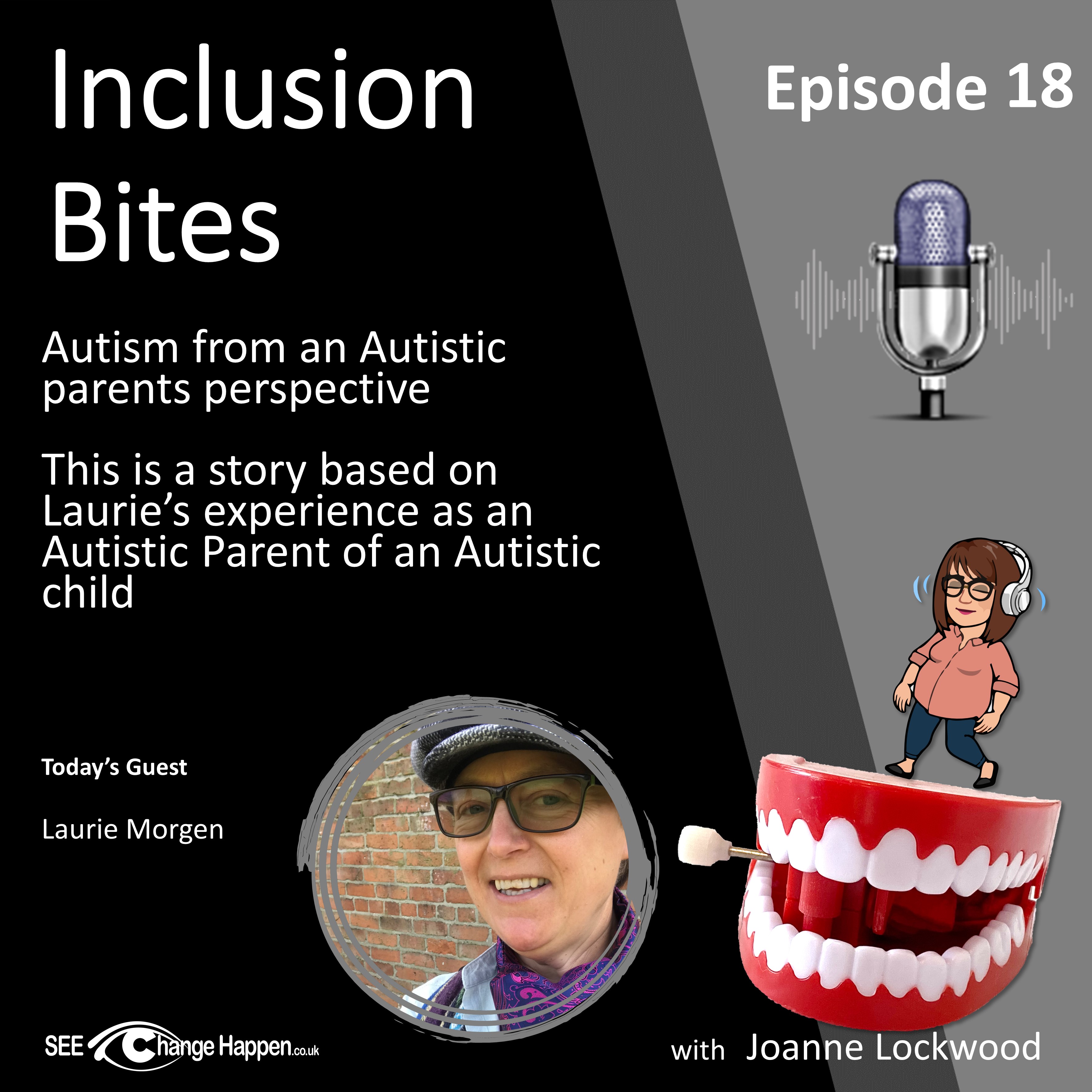
Laurie Morgen joins Joanne Lockwood to talk about autism through the lens that’s often missing from public conversation: being an autistic parent. Drawing on their own family life and the stories shared with them since publishing their book, Laurie explains why “autism parent” is frequently misunderstood and why it matters to recognise autistic people as parents in their own right.
The conversation unpacks common misconceptions that show up in professional settings and everyday life, including assumptions about empathy, relationships, communication, and stereotypes about skills. Laurie discusses how language and vague social conventions can create barriers, especially when professionals expect people to respond to unspoken “tick box” norms. They share personal experiences of navigating school systems, social services, and parenting spaces where indirect communication and judgment can carry real consequences.
Jo and Laurie also explore how workplaces can become more accessible by focusing on the actual requirements of a role, communicating more directly, and reducing overreliance on culture-fit and social performance. Along the way, Laurie reflects on community, isolation during lockdown, and the practical strategies that support their wellbeing, grounding the episode in both lived experience and actionable learning.
About Laurie Morgen
One-sentence summary
Laurie Morgen speaks from lived courage, refusing to let misunderstanding strip autistic parents of dignity, rights or the simple humanity of being believed.
---
Synopsis
Laurie Morgen is an autistic mother and grandmother who was diagnosed at 44, long after she had already raised her children and navigated systems that judged her before they understood her. She has lived through child protection proceedings, professional doubt, social isolation in playgrounds and meetings that spoke around her rather than to her. She describes herself not as exceptional but as representative – a “mouthpiece” honouring a wider autistic community. What shaped her most were moments when she did not understand the coded language around her, when a phrase such as “non accidental injury” carried consequences she could not decode, and when professionals interpreted difference as deficiency.
What she is trying to change is simple but profound: she wants autistic people, especially autistic parents, to be seen as ordinary human beings with the same rights, needs and capacities as anyone else. She challenges the low expectations that are quietly written over autistic children’s futures and the assumptions that autistic adults cannot nurture, empathise or build relationships. For Laurie, this is about protecting families from unnecessary intrusion, protecting autistic people from being stereotyped into “functioning labels”, and protecting children from being “signed off before their lives have even begun”. It matters because misunderstanding does real harm — to confidence, to opportunity, to families.
---
10 Small, digestible concepts for easy learning
1. Low expectations are a quiet form of harm.
When you tell a parent what their child will “never” do, you shrink that child’s future.
2. Difference is not deficiency.
Parenting differently is not parenting badly.
3. Literal language matters.
If you say “non accidental”, someone may hear “not an accident” — not “deliberate violence”.
4. Labels can both open and close doors.
A diagnosis may explain support needs, yet stereotypes may limit opportunity.
5. Autistic does not mean unempathic.
Empathy can look like designing a treasure hunt because you know a six-year-old will delight in it.
6. Direct communication is inclusive communication.
Ask the question you actually want answered.
7. You are employing a person to do a task.
Cultural “fit” can mask unconscious exclusion.
8. Artificial environments distort human reality.
Judging someone in a lab tells you little about how they live at home.
9. “We’re all a bit autistic” erases lived experience.
If everyone has it, no one’s struggle is acknowledged.
10. Belonging starts with belief.
When autistic parents are believed, families are safer.
---
The “why” in the story
What they believe is true about people
Laurie believes people are capable — far more capable than systems often allow. She believes autistic people can love deeply, parent wisely and work competently. She believes clarity fosters fairness.
What they cannot unsee
She cannot unsee the way professionals tell parents their children will “never” achieve ordinary milestones. She cannot unfeel the cold shock of realising nearly a roomful of care workers believed “everyone is a little bit autistic”. She cannot forget a moment when the wrong interpretation of a phrase set off life-altering consequences.
What they are no longer willing to tolerate
She will not tolerate lazy stereotypes about empathy or ability. She will not accept functioning labels that both deny support and deny potential. She will not silently accept systems that misinterpret difference as danger.
What they are trying to build instead
She is trying to build clearer conversations, fairer systems, and a world where autistic parents are not second-guessed by default — where expectation is possibility, not prediction of failure.
---
Narrative structure
1. The trigger
The trigger was twofold: her own late diagnosis at 44, which reframed her entire life, and the experience of child protection proceedings where literal understanding clashed with bureaucratic language. Add to this the constant chorus of professionals telling other parents what their autistic children would “never” achieve, and her commitment hardened.
2. The tension
Laurie repeatedly meets misunderstanding. Professionals assume lack of empathy. Assessors misunderstand autism and Asperger’s. Social spaces — playgrounds, toddler groups — leave her stammering and isolated. In training rooms, she faces rooms full of raised hands agreeing that “everyone’s a little bit autistic”.
3. The insight
Her insight is that many so-called deficits are context-driven. Study a child in a frightening lab and you’ll see fear, not truth. Speak in coded language and you’ll mistake confusion for guilt. Ask vague questions and interpret literal answers as failure. Much of what is labelled autistic “lack” is a mismatch between communication styles.
4. The pivot
Laurie chose to speak. She wrote Travelling by Train: The Journey of an Autistic Mother. She delivers training, busts myths, and uses humour to challenge assumptions. She learned to move conversations on rather than getting trapped — a skill she once honed as a taxi driver protecting her own boundaries.
5. The destination
She wants a future where autistic parents are seen as regular human beings; where children are met with ambition, not pity; where workplaces focus on ability rather than social polish; and where families are supported, not scrutinised, because someone communicates differently.
---
Five key takeaways and learning points
1. Be precise in your language.
Vague or softened phrases can cause real confusion and real consequences.
2. Question your automatic assumptions.
If you picture an autistic person as lacking empathy, ask yourself who taught you that.
3. Raise the bar of expectation.
Assume capacity first — support from there.
4. Judge in context, not in artificial settings.
People behave differently under stress and scrutiny.
5. See the parent, not just the diagnosis.
So what? Families stay together more safely when difference isn’t misread as risk.
---
Ten distinct ideas explained
1. The harm of the “never” narrative
When professionals predict lifelong failure, families internalise fear instead of possibility. Dignity erodes before growth can begin.
2. Functioning labels distort reality
“High functioning” can deny support; “low functioning” can deny ambition. Either way, the person gets boxed in.
3. Late diagnosis is life-altering
To discover at 44 why the world has always felt misaligned reshapes memory, identity and self-forgiveness.
4. Literal interpretation is not wilful misunderstanding
If someone answers the question you asked, not the one you implied, that is difference in processing — not defiance.
5. Social norms are culturally constructed
British indirectness can penalise those who thrive on clarity.
6. Belonging is harder in parent spaces
Playground chatter can be as alienating as any workplace meeting, isolating parents who already feel under scrutiny.
7. Empathy can be practical and imaginative
Digging a hole for buried treasure so grandchildren can feel wonder is empathy in action.
8. Statistics miss the undiagnosed
Many autistic adults are invisible in data, skewing public understanding of capability.
9. Research origins matter
Early autism studies focused on boys in artificial settings, shaping criteria that still affect who gets recognised today.
10. Autistic voice changes perception
When Laurie stands and speaks articulately, she quietly dismantles assumptions simply by being visible.
---
How people should change as a result
1. Think
- From “What’s wrong here?” to “What’s different here?”
- From “Can they cope?” to “What helps them thrive?”
- From stereotypes to specifics about this person.
- From softened language to clear, explicit communication.
2. Feel
- From defensiveness to curiosity.
- From pity to respect.
- From discomfort with difference to interest in perspective.
- From low expectation to hopeful ambition.
3. Act
- Ask direct, clear questions in work and care settings.
- State intentions explicitly rather than implying them.
- Challenge colleagues who say “everyone’s a bit autistic”.
- Focus job descriptions on essential tasks, not social polish.
- Raise aspirations when speaking about autistic children.
- Include autistic parents’ voices when shaping policy or support systems.
- Pause before interpreting behaviour as risk; seek context first.
---
One thing to remember
Autistic parents do not need lowered expectations — they need to be believed, understood and trusted to love their children well.