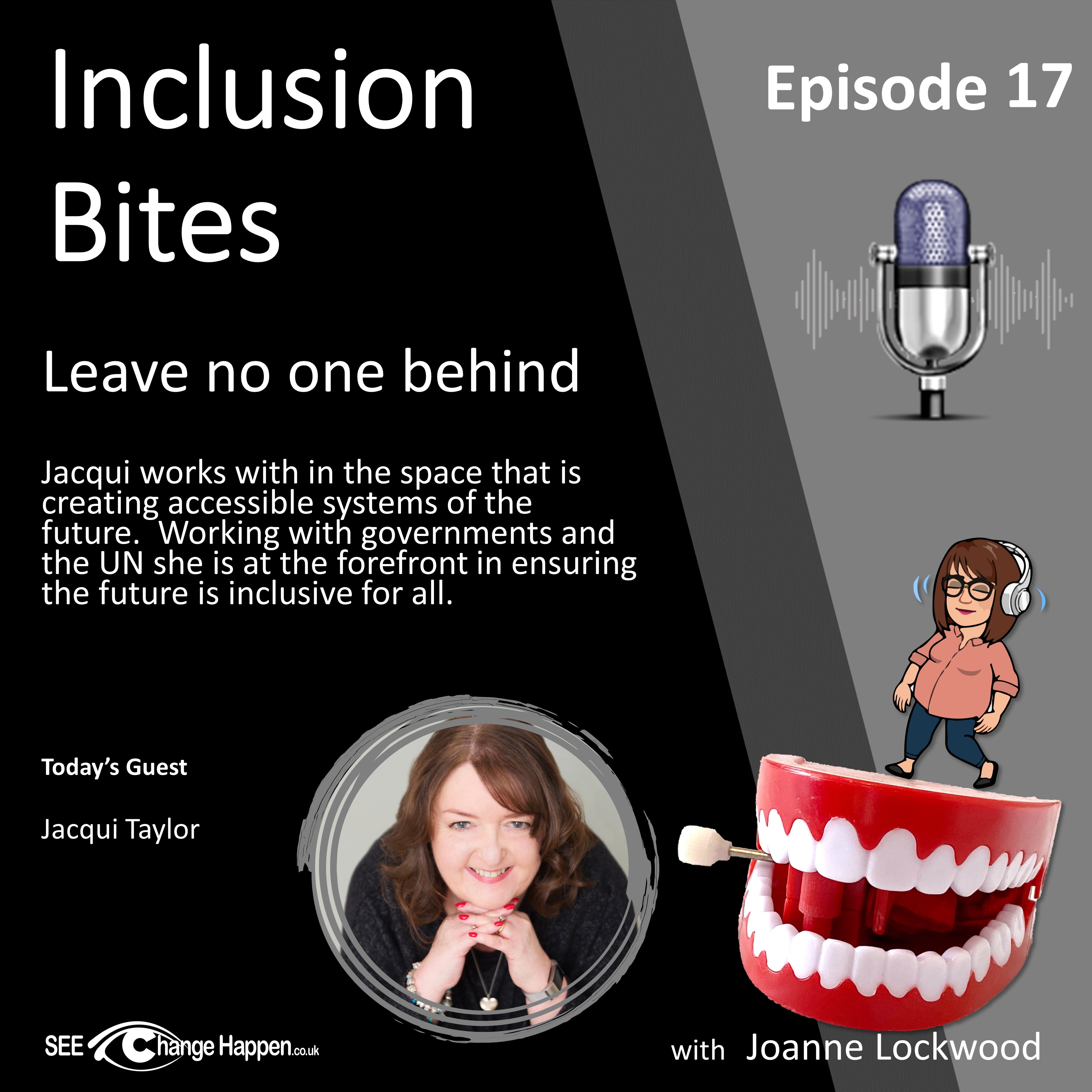
Being Inclusive Means Leaving No One Behind
with Jacqui Taylor · 08 October 2020
Workplace Culture Systems
Joanne Lockwood is joined by Dr Jacqui Taylor, a web scientist and IoT innovator, to explore what “leave no one behind” means in practice as technology reshapes society. Jacqui traces her path from aerospace engineering into deep tech and web science, and describes how the internet’s expansion can unlock opportunity when it is designed to be accessible and inclusive.
The conversation looks at how different generations experience the online world, and why inclusion must account for both the connected and the disconnected. They discuss the risks that sit alongside opportunity, including cybercrime, the dark web, deepfakes and misinformation, and what safeguarding can look like during lockdown and beyond. Jacqui shares work focused on supporting young people’s online safety and mental wellbeing, including the idea of a “social guardian” to help navigate online harm.
They also examine the future of work as automation and AI change entry-level roles, arguing for a model where machines handle repetitive tasks while humans bring judgement, context and diverse perspectives. Throughout, Jacqui frames inclusion as a global, community-by-community challenge, referencing advisory work with governments and international bodies and the need for practical digital skills so that progress does not widen inequality. The episode closes with Jacqui sharing free cyber-safety resources and ways for listeners to connect and learn more.
About Jacqui Taylor
One-sentence summary
Dr Jacqui Taylor’s life has been a refusal to accept closed doors—using technology not to dazzle, but to ensure that talent, truth and human dignity are never limited by geography, gender or circumstance.
---
Synopsis
Dr Jacqui Taylor began as an aerospace engineer, young and brilliant, only to have her path abruptly narrowed because she was a woman and the client “didn’t need” her influencing what flew into the sky. Earlier still, the death of her mother had shattered the sense that life runs on predictable tracks. Those two experiences—personal loss and professional exclusion—shifted her gaze outward. She stopped thinking only about her own trajectory and began asking a wider question: who else is being locked out, and why? What followed was not bitterness but engineering. If doors closed, she would build new systems.
Today, she designs the unseen infrastructures that decide who gets access, who is safeguarded, and whose voice is counted. When she says inclusion means “leave no one behind”, she means it at planetary scale—across governments, across generations, across the 13% who are disconnected and the 80% who could connect but need support. She believes technology should not replace our humanity but amplify it. Her work is about protecting children from harm, ensuring economies centre empathy, and creating a world where a six-year-old feels entitled to reorganise the future—and is taken seriously.
---
10 Small, digestible concepts for easy learning
1. Grief can widen your lens.
Loss pulled her out of her own bubble and made the world’s fragility impossible to ignore.
2. Exclusion leaves a scar—and a mission.
Being sidelined as a female engineer didn’t close her down; it clarified what she would no longer tolerate.
3. Technology is not the point; people are.
“The human at the centre” is the design principle—not speed, not scale.
4. If you can’t solve the problem, you don’t yet understand it.
Inclusion requires listening at scale, especially to those rarely heard.
5. Machines should do the drudgery; humans should do the meaning.
Automation frees us for judgement, care and context.
6. Children expect fairness as the baseline.
Gen Alpha do not see inclusion as radical—it simply makes sense to them.
7. Visibility changes responsibility.
The web didn’t create human behaviour; it made it visible.
8. Communities are different by design.
Global inclusion is not uniformity; it is coexistence.
9. Safety online is a form of dignity.
Protecting young people from hidden harm is an act of care.
10. Inclusion is a growth strategy because people are the growth.
Unlocking talent is not generosity—it is common sense.
---
The “why” in the story
What they believe is true about people
That most people want to do good, want to belong, and want to contribute when the system allows them to.
What they cannot unsee
The way doors quietly close—on women in engineering, on disconnected communities, on children harmed online, on countries deemed “behind”.
What they are no longer willing to tolerate
Linear career paths that waste talent. Invisible online harm. Economic systems that speak of growth but ignore empathy.
What they are trying to build instead
An “empathy economy” where technology expands access, communities choose their own models, and no one is excluded because the system was designed without them in mind.
---
Narrative structure
1. The trigger
Her mother’s death interrupted her early life and revealed how fragile security is. Later, her aerospace work—brilliant and groundbreaking—was sidelined because she was female. The message was subtle but clear: not for you.
2. The tension
She works in rooms of power—governments, global forums—while knowing the real stories sit elsewhere. She faces scepticism about AI, fear about technology, and the constant risk that progress for some widens gaps for others.
3. The insight
The web did not create darkness; it exposed it. Technology is a fabric—what we weave into it determines who thrives. Inclusion cannot be an afterthought; it must be engineered in from the start.
4. The pivot
She stopped chasing a linear engineering career and instead began building “deep tech” systems designed around people. She listens to millions of young voices. She builds safeguards. She reframes growth around empathy.
5. The destination
A world where a rural community, a young coder, a disconnected elder, and a six-year-old visionary all have agency. Where machines lift the burden and humans shape meaning. Where inclusion is normal, not notable.
---
Five key takeaways and learning points
1. Inclusion is preventative, not reactive.
When systems are designed with everyone in mind, harm is reduced before it spreads.
2. Young people are not waiting for permission.
If ignored, they will organise anyway—often more wisely than we expect.
3. Access is power.
The difference between connected and disconnected can decide opportunity, safety and voice.
4. Technology reflects our values.
If empathy is not coded in, indifference will be.
5. You don’t need to be a technologist to influence the future.
Bringing 10% of your value online can widen who benefits from your work.
---
Ten distinct ideas explained
1. Digital exclusion as modern marginalisation
Being offline today is not neutrality; it can mean missing education, services and connection.
2. Advisory AI, not decision-making AI
Machines process scale; humans hold context and conscience.
3. Safeguarding as collective responsibility
Online harm is often unseen, but its emotional cost is real and lasting.
4. The empathy economy
Growth built on care, access and fairness lasts longer than growth built on extraction.
5. Generation as mindset, not geography
Gen Alpha’s expectations of fairness appear globally—not just in the West.
6. Communities over uniformity
Inclusion is not about one right model, but multiple models coexisting without harm.
7. Linear careers as exclusion filters
Traditional pathways quietly remove those who don’t “fit” early enough.
8. Visibility creates accountability
When behaviour leaves a digital trace, society must choose how to respond.
9. Choice versus challenge in disconnection
Some opt out; others are shut out. The difference matters.
10. Early intervention as dignity
Protecting children online says: your safety matters before profit does.
---
How people should change as a result
1. Think
- From “technology is the problem” to “design is the problem.”
- From “young people need guiding” to “young people hold insight.”
- From “growth versus inclusion” to “growth through inclusion.”
- From “that’s just how systems are” to “systems are built—and can be rebuilt.”
2. Feel
- From fear of the future to measured curiosity.
- From defensiveness about change to shared responsibility.
- From overwhelm at global issues to personal agency.
- From nostalgia for simplicity to confidence in adaptation.
3. Act
- Audit 10% of what you do and ask: how can this reach someone currently excluded?
- Teach one digital skill to someone less confident this month.
- Ask young people what isn’t working—and listen without correcting.
- Add a safeguarding check to any online initiative you run.
- Challenge a “that’s just policy” statement if it excludes someone.
- Centre empathy when making decisions about automation or efficiency.
- Support community models different from your own, provided they do no harm.
---
One thing to remember
Inclusion isn’t a slogan for Dr Jacqui Taylor—it’s a promise she made the day she realised how easily the world says, “Not for you.”