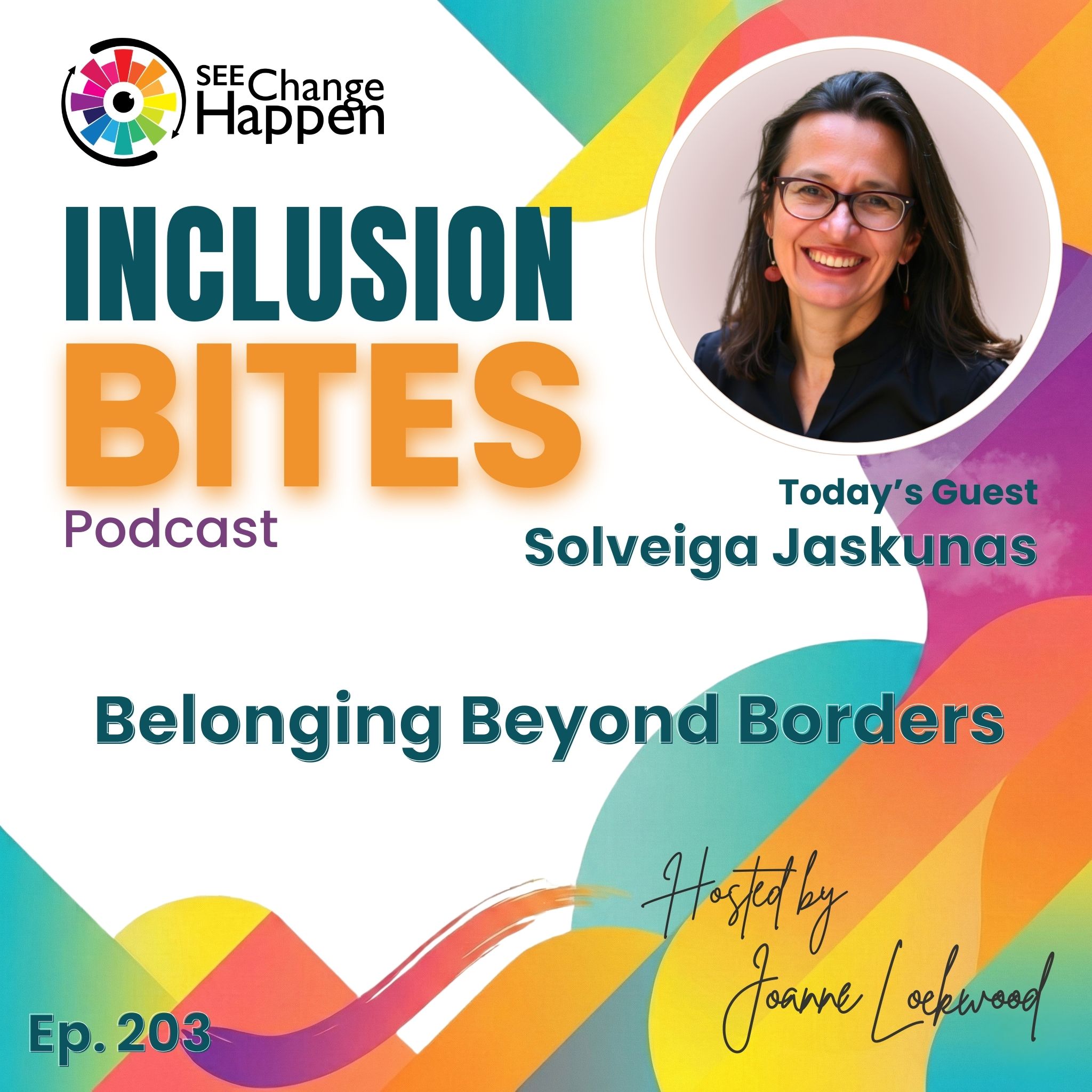
Belonging Beyond Borders
with Solveiga Jaskunas · 03 April 2026
Lived Experience Identity
Joanne Lockwood is joined by HR consultant and keynote speaker Solveiga Jaskunas to explore what “belonging beyond borders” looks like when you build a life and career in a new country.
Solveiga shares her journey from Lithuania to the United States, including the early shock of navigating hiring processes, interviews, and everyday communication while being judged through the lens of accent and assumptions about competence. They unpack how language barriers and stereotypes can crush confidence, and how imposter feelings can follow even after years of success.
The conversation moves from personal experience into practical workplace realities: what organisations get wrong about immigrant and expat talent, how recruiting practices can exclude people before they’re even heard, and why visibility matters—especially when few people in HR and leadership roles “sound like” the communities they claim to include. Solveiga reflects on mentoring, building community outside familiar circles, and intentionally stepping into rooms where discomfort becomes a catalyst for growth.
They also touch on the current climate of political polarisation and how it can make it feel less safe to speak openly, particularly for people without citizenship status. The episode closes with a call to amplify immigrant voices, reframe difference as value, and take deliberate action to create workplaces where more people can belong and thrive.
About Solveiga Jaskunas
One-sentence summary
Even when the world questions your right to belong, you can choose to stand in your full story — accent, history and all — and use it to open doors for others.
---
Synopsis
Solveiga Jaskunas grew up in Lithuania in the shadow of the Soviet regime, in a country where history was whispered and truth was guarded. She discovered only later that her own family carried stories of exile and imprisonment — stories hidden for safety. Independence was not just political; it was personal. When she moved to the United States for love more than twenty years ago, she arrived with degrees, drive and hope — only to face something she hadn’t anticipated: silence. No callbacks. Interviews cut short. Strangers telling her they “didn’t understand a single thing” she said. Her confidence crumbled under the weight of an accent she could never fully lose.
But Solveiga didn’t retreat. She reframed rejection as rehearsal. “I just want to get better,” she told herself before interviews, shifting her focus from being chosen to choosing growth. Over time, she realised that being an immigrant did not shrink her value — it expanded her lens. Now she speaks openly about calling herself an immigrant in rooms where the word feels uncomfortable. She refuses to trade it for something softer. “I feel proud to be an immigrant,” she says. What she is trying to change is not only how organisations treat immigrants, but how immigrants see themselves — not as outsiders apologising for their difference, but as builders of bridges, holders of perspective, and proof that belonging is something we create together.
---
10 Small, digestible concepts for easy learning
1. Rejection can be rehearsal.
Sometimes growth begins the moment you stop trying to impress and start trying to improve.
2. An accent is evidence of courage.
It proves you have stepped outside your comfort zone and survived.
3. Belonging is a journey, not an arrival gate.
It doesn’t happen at passport control; it unfolds over time.
4. Silence shapes identity as much as speech.
Growing up where truth is hidden leaves a lifelong imprint.
5. Confidence grows in uncomfortable rooms.
The spaces where you feel least certain often stretch you most.
6. Visibility invites both loss and alignment.
When you speak clearly about who you are, some leave — the right people stay.
7. Language can feel like a disability.
Struggling to be understood chips away at dignity in ways others rarely notice.
8. You don’t have to dilute your story to be accepted.
Softening the word “immigrant” might win approval — but it can cost authenticity.
9. Progress is personal before it is public.
The biggest shifts often happen quietly, inside.
10. Belonging in two places can feel like both gift and fracture.
You can love two homes and feel slightly outside both.
---
The “why” in the story
What they believe is true about people
People are shaped by their environments but not defined by them. Given encouragement and opportunity, they will grow beyond what they once thought possible.
What they cannot unsee
She cannot unsee the humiliation of being dismissed because of how she speaks — or the quiet shame immigrants carry when they begin to doubt their own worth.
What they are no longer willing to tolerate
She will not accept that accents equal incompetence, that immigrants must prove their goodness, or that political fear should silence human dignity.
What they are trying to build instead
A world of work where immigrant voices are visible, valued and heard — not despite their difference, but because of it.
---
Narrative structure
1. The trigger:
Moving to the US and watching interviews end after one question. Hearing, “I didn’t understand a single thing you said.” Realising her degrees meant little if her voice was dismissed.
2. The tension:
Living between identities — Lithuanian at heart, resident in America. Wanting to speak up in a polarised climate while protecting her safety and family. Wondering whether visibility would help or harm.
3. The insight:
When she stopped measuring herself by others’ reactions and instead tracked her own growth, her confidence began to rebuild. And when she spoke publicly as an immigrant, the right people found her.
4. The pivot:
She leaned into the rooms where she felt she didn’t belong. She started creating videos despite stumbling. She kept the word “immigrant” instead of replacing it with something more comfortable.
5. The destination:
A life where belonging is not conditional, where difference is ordinary, and where children — in any neighbourhood — can look out at the world and see possibility instead of distance.
---
Five key takeaways and learning points
1. Your discomfort may be someone else’s daily reality.
So pause before dismissing an accent or unfamiliar communication style.
2. Growth often begins with a mindset shift.
When you stop asking, “Will they choose me?” and start asking, “What am I learning?”, you reclaim power.
3. Naming your identity is an act of strength.
Choosing to say “I am an immigrant” can be a declaration of dignity, not limitation.
4. Visibility attracts alignment.
Not everyone will agree with you — but clarity helps the right allies step forward.
5. Belonging is fragile in polarised times.
Safeguarding it requires courage, empathy and deliberate action.
---
Ten distinct ideas explained
1. Inherited silence
Growing up without knowing your family’s history creates emotional gaps. When truth finally emerges, it reshapes identity.
2. Cultural whiplash
Seeing Berlin for the first time and realising how grey Vilnius felt exposed both longing and resilience.
3. Interview trauma
When interviews end abruptly because of language, it’s not just professional rejection — it’s personal erosion.
4. Internalised doubt
Imposter syndrome becomes louder when every mispronounced word feels like proof.
5. The immigrant label
Words carry weight. “Immigrant” can feel heavy, but reclaiming it restores agency.
6. Belonging in two worlds
Feeling American in Lithuania and Lithuanian in America reveals identity as fluid, not fixed.
7. Children as mirrors
When students had never heard of the Soviet Union, she realised how limited exposure shapes understanding.
8. Visibility in leadership
When speakers and recruiters all sound the same, difference feels like a flaw instead of representation.
9. Political fear and self-protection
Choosing which battles to fight is not weakness; it’s survival.
10. Hope as discipline
Saying “you can do it” repeatedly — to herself and others — becomes practice, not cliché.
---
How people should change as a result
1. Think
- Stop equating fluency with intelligence.
- Recognise immigration as expansion, not deficiency.
- Understand that belonging is shaped by micro-moments — interviews, classrooms, comments.
- See identity as layered, not binary.
- Question assumptions about who “looks like” an immigrant.
2. Feel
- Move from impatience to empathy when communication takes longer.
- Shift from suspicion to curiosity about difference.
- Replace pity with respect.
- Let discomfort become growth, not retreat.
- Trade fear of saying the wrong thing for willingness to listen.
3. Act
- Resist the urge to interrupt or finish sentences when someone struggles for words.
- Ensure interview processes are fair, not rushed or dismissive.
- Invite speakers and facilitators who sound different from the norm.
- Publicly affirm colleagues whose accents or backgrounds are overlooked.
- Ask someone about their story — and stay present for the answer.
- Challenge stereotypes when you hear them, calmly and clearly.
- Create spaces where people can claim their identity without apology.
---
One thing to remember
An accent is not a weakness; it is proof that someone was brave enough to cross a border and begin again.