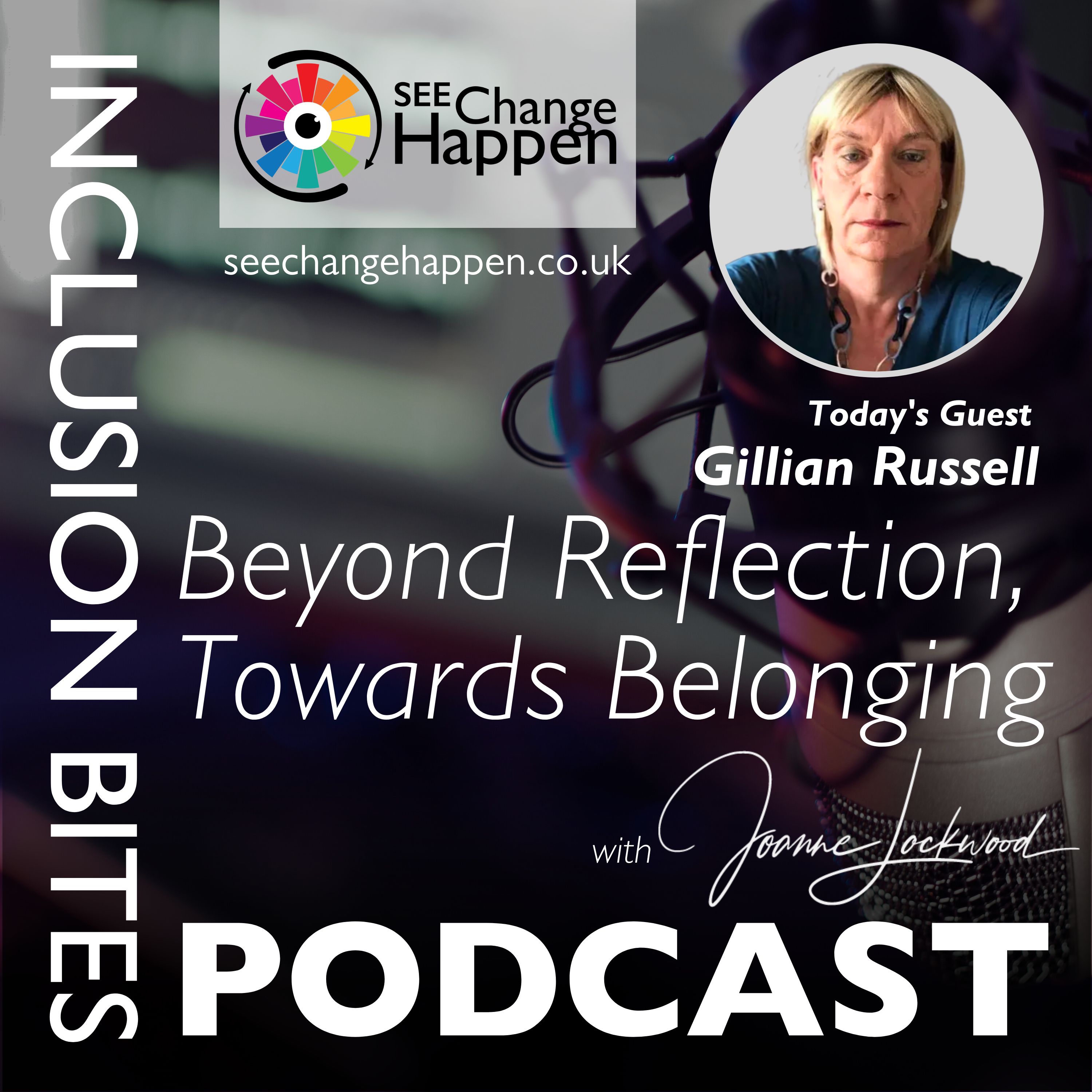
Beyond Reflection, Towards Belonging
with Gillian Russell · 31 October 2025
Lived Experience Identity
Joanne Lockwood is joined by Gillian Russell to explore what it means to move beyond reflection towards genuine belonging, in the context of a UK Supreme Court ruling on the definition of “woman” and its impact on trans people.
They discuss the emotional and practical fallout of the decision, the erosion of rights, and why the trans community can struggle to coordinate fast, strategic action. The conversation covers lobbying, working with allies, and the need for better organised advocacy, alongside the value of cross-community collaboration with other marginalised groups.
Gillian shares her background across the arts, corporate life, charity leadership, and trans advocacy, reflecting on language, identity, and why being trans is only one small part of a person. Together they explore resilience, vulnerability, mental wellbeing, and the importance of robust conversations that educate rather than entrench division.
The episode closes with pragmatic optimism: focus on what can be controlled, seek support when needed, and build the collective capability to adapt, organise, and drive change while continuing to pursue a society where people can belong and thrive.
About Gillian Russell
One-sentence summary
Gillian Russell speaks from the bruised wisdom of someone who waited decades to live openly, determined that the next generation should not have to survive in silence to earn their belonging.
---
Synopsis
Gillian Russell is an elder of the trans community who came of age in a world without language for who she was. Growing up in the North East of England, she found refuge in the arts — a place where performance mattered more than conformity — but privately wrestled with dysphoria long before she had a word for it. She married, built careers, carried white male privilege, and navigated boardrooms with ease. Yet she also lived with the quiet dislocation of looking in the mirror and wondering, “Who’s that?” For years, being trans was unspeakable, misunderstood, or reduced to something sordid. She survived by adapting. She flourished by thinking differently. And she eventually chose to transition later in life, not as a reinvention, but as an alignment.
Now, Gillian is trying to change what it costs to be young and trans. She is fierce about resilience — not as stoicism, but as capability. She wants young people to have language, science, opportunity and courage she did not have. She is angry about rights eroding, yet stubbornly optimistic about human potential. She refuses to be defined only by her transness, and she resists a culture of victimhood as much as she resists hostility. What she is building is not just defence against discrimination — it is competence, confidence and belonging. She wants a generation who do not merely reflect on who they are, but stand comfortably in it.
---
10 Small, digestible concepts for easy learning
1. Resilience is taught, not inherited.
If you’ve survived silence, you can pass on the tools — not just the scars.
2. Identity is the core, not the costume.
People understand belonging when you speak about who they are, not what they wear.
3. Privilege changes your volume in the room.
Gillian noticed how easily she was heard before transition — and how quickly that changed.
4. Belonging is ordinary.
The goal is not spectacle; it is to live a life that feels boringly normal.
5. Minority status requires strategy.
Survival alone isn’t enough — change requires coordination and skill.
6. Anger can coexist with optimism.
You can be furious about injustice and still believe the future is open.
7. Being misunderstood is not the same as being wrong.
Education happens in conversation, not in condemnation.
8. Eldership means stewardship.
Those who fought before must teach those who follow.
9. You are more than the label that makes you visible.
“Trans” is part of Gillian’s story — not the whole of it.
10. Belonging starts between your own ears.
External validation matters, but self-acceptance steadies the ground.
---
The “why” in the story
What they believe is true about people
That people are capable of understanding more than we think — if we speak to their sense of identity rather than shout at their ideology.
What they cannot unsee
The ease with which rights can erode when communities assume victories are permanent.
What they are no longer willing to tolerate
Silence, fragmentation, and a culture that leaves young trans people to fight alone.
What they are trying to build instead
A prepared, resilient, commercially savvy, emotionally intelligent generation who know their worth and can advocate effectively for themselves.
---
### Narrative structure
1. The trigger
Growing up without language for her experience — being seen as deviant rather than dysphoric — and later realising how much white male privilege shaped the way she was treated. That contrast sharpened her understanding of systems.
2. The tension
She meets both external hostility and internal fragmentation: political backlash, community division, and a pull between righteous anger and strategic thinking.
3. The insight
Change does not happen simply because you are right. It happens because you organise, communicate, and understand human fears — including those of your opponents.
4. The pivot
She chose not just to transition, but to mentor, to organise, to lead charities, to advocate, and to invest consciously in the younger generation’s capacity.
5. The destination
A world where being trans is the least interesting thing about someone — where young people grow up with language, support, and the ordinary dignity of belonging.
---
Five key takeaways and learning points
1. Rights unattended can quietly disappear.
So what: Celebrate progress — but defend it with the same energy you used to win it.
2. The loudest narrative is not always the truest one.
So what: Seek real conversations, not headlines, when forming opinions.
3. Identity shapes how we interpret threat.
So what: If you understand identity, you can lower conflict.
4. Resilience isn’t denying pain — it’s deciding what to do next.
So what: Feeling bruised doesn’t mean you’re broken.
5. Community requires coordination.
So what: Shared characteristics don’t automatically create shared strategy.
---
Ten distinct ideas explained
1. Living without language
When there’s no word for your experience, you internalise shame. Language doesn’t create identity; it validates it.
2. The mirror moment
Dysphoria is often not dramatic — it’s a quiet dislocation between self and reflection that erodes confidence over time.
3. The disappearance of privilege
When Gillian transitioned, she felt the abrupt loss of automatic credibility. Visibility changed how seriously she was treated.
4. The arts as refuge
Artistic spaces allowed difference to survive because performance trumped prejudice — belonging formed around contribution.
5. Fragmented community reality
A shared identity doesn’t mean shared politics, personality or perspective — and that complexity is both strength and weakness.
6. Education over scolding
Closing down questions breeds fear; answering them builds allies.
7. Victimhood vs agency
Harm is real — but people still have choices about how they respond and organise.
8. Fear of loss on all sides
Some backlash stems from groups who fought long battles and now fear erosion — even if that fear misidentifies the threat.
9. Ordinary aspiration
The end goal of transition is not transformation into spectacle but comfort in banality.
10. Intergenerational responsibility
Elders carry scars that can become blueprints — if they choose to teach.
---
How people should change as a result
### 1. Think
- Move from “What’s the issue?” to “What does this feel like for someone living it?”
- Understand identity as foundational, not optional.
- Recognise that backlash often masks deeper fears about belonging.
- See resilience as skill-building, not denial.
- Separate headlines from human impact.
### 2. Feel
- Shift from defensiveness to curiosity.
- From fatigue to steady commitment.
- From tokenistic sympathy to grounded solidarity.
- From guilt to responsibility.
- From outrage alone to purposeful calm.
### 3. Act
- Ask someone what identity means to them — and listen without correcting.
- Support organisations offering practical wellbeing support, not just public statements.
- Intervene gently when misinformation spreads; offer facts without contempt.
- Mentor someone younger in navigating systems — share your “how”.
- Build resilience habits: check on someone’s mental health, including your own.
- Challenge reductive labelling — remind people that no one is only one thing.
- Advocate for conversations that include dignity rather than division.
---
One thing to remember
Belonging is not a concession — it is the ordinary dignity of being allowed to be fully yourself.