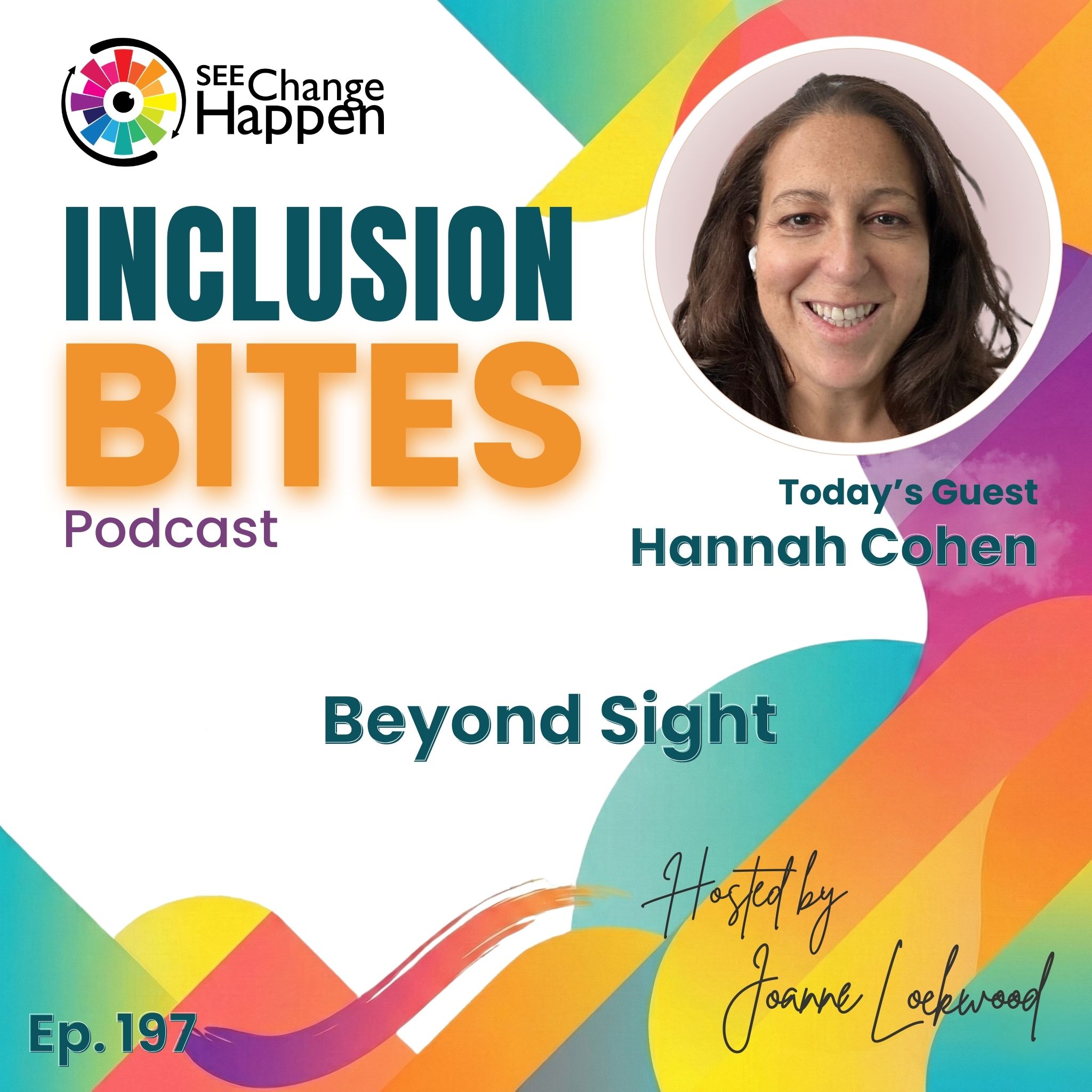
Lived Experience Identity
Hannah Cohen joins Joanne Lockwood to unpack what it means to navigate life with a visual impairment that many people don’t immediately see. Hannah shares how her sight loss developed, what “blindness as a spectrum” looks like in practice, and the constant recalibration involved in work, travel, shopping, and social situations when the world assumes you can see what everyone else sees.
Drawing on her background as a solicitor and her current work as an inclusion coach, Hannah describes the practical barriers that show up in workplaces and everyday systems: inaccessible software, interfaces that don’t work with screen readers, missing descriptions and alt text, and environments that require people to self-advocate repeatedly just to participate fully. Joanne and Hannah explore the tension many people with hidden disabilities experience—wanting independence and not wanting to be patronised, while still needing timely, respectful support.
The conversation also widens to conscious inclusion more broadly, including examples from transport and public services, and reflections on how leaders and colleagues can respond better by asking straightforward, supportive questions like “What do you need to do your job?” The episode closes with a reminder that inclusion isn’t about minimum standards—it’s about creating day-to-day conditions where people are genuinely supported, understood, and able to thrive.
About Hannah Cohen
One-sentence summary
Hannah Cohen’s story is about protecting dignity and independence in a world not built for her — and choosing to turn loss into a deeper commitment to helping others feel seen rather than sidelined.
---
Synopsis
Hannah Cohen did not set out to become an inclusion coach. She trained as a solicitor, built her career, raised two children, and navigated the profound grief of becoming a widow. Then, within a short period of time, her sight changed permanently. “Overnight I couldn’t drive,” she explains — and with that, everyday independence shifted. Registered blind but still able to see in a blurred, peripheral way, Hannah lives in a space that many people misunderstand. She is neither what society imagines as “blind” nor what people assume is “fine”. She jokes about not seeing her wrinkles and misidentifying statues as children, but beneath the humour is constant recalibration: asking for help when needed, resisting patronisation, managing vulnerability, and relearning how to move through the world.
Out of that disruption, something else emerged. Hannah describes herself as “almost blossoming into myself.” What began as coach training to fill time became a calling. She now helps leaders, teams and individuals understand hidden disabilities — not through theory, but through lived truth. What she is trying to change is simple and human: she wants people to ask, to listen, and to design life in ways that do not quietly exclude. Because, as she has learned, the hardest part of disability is not always the condition itself — it is the exhaustion of navigating a world that forgets you are there.
---
10 Small, digestible concepts for easy learning
1. Blindness is a spectrum.
Most people who are blind see something — the danger lies in assuming you understand someone’s experience without asking.
2. Independence and help are not opposites.
You can fiercely value autonomy and still need support.
3. Hidden disabilities create visible exhaustion.
The work of constant self‑advocacy drains energy others never have to spend.
4. Sequential living is hard.
When information must be listened to linearly rather than scanned, everything takes longer.
5. Vulnerability changes ordinary moments.
A grocery delivery or a road crossing can carry emotional weight others never notice.
6. You either live your life or you don’t.
“I just feel like you either live your life or you don’t,” Hannah says — resignation was not her choice.
7. Conscious inclusion is active, not accidental.
Most exclusion is not deliberate — it’s unexamined habit.
8. Ask, don’t assume.
“What do you need to be able to do the job?” can transform a relationship.
9. Context matters in identity.
Sometimes she wants everyone to know she is visually impaired. Sometimes she doesn’t.
10. Loss can reveal purpose.
What began as coping has become work she feels passionate about.
---
The “why” in the story
What they believe is true about people
Hannah believes most people are not malicious — they are unaware. When given understanding, they often want to do better.
What they cannot unsee
She cannot unsee how much the world assumes competence, speed and sight — and how quickly someone can become invisible when they don’t match that norm.
What they are no longer willing to tolerate
She is no longer willing to silently absorb exclusion, inefficiency or misunderstanding to make others comfortable.
What they are trying to build instead
She is building workplaces and relationships where asking is normal, where adjustments are collaborative, and where dignity is preserved.
---
Narrative structure
1. The trigger:
First widowhood. Then sight loss. One eye fading unnoticed, then the other. Hospital admissions, no cure, no reversal. “It’s a new way of learning,” she says — a new way of living.
2. The tension:
She needs help — but does not want to be mothered. She can pass as “normal” — but feels forgotten. She feels vulnerable — yet refuses to retreat. She wants independence for her children — but secretly relies on them for small daily tasks.
3. The insight:
The real barrier is not blurred vision; it is design without consideration. Most systems assume one way of seeing, one way of processing, one way of being.
4. The pivot:
Instead of forcing herself to remain where her energy drained, she leaned into coaching. “The more I learn about it, the more I just want to be doing it all the time.” She stopped trying to prove she could keep up and started helping others rethink the race.
5. The destination:
A world where she does not need a metaphorical T‑shirt explaining herself. Where people ask naturally. Where her children — and everyone else — can move through spaces built with them in mind.
---
Five key takeaways and learning points
1. You don’t have to collapse to be considered disabled.
Many people function in ways that look “fine” while carrying additional effort every hour of the day.
2. Self‑advocacy is labour.
When someone repeatedly has to ask for access, it adds stress you may never see.
3. Kindness without curiosity can still exclude.
Good intentions are not enough if they are not paired with listening.
4. Identity after loss is rebuilt, not found.
Hannah did not simply adapt — she reshaped who she wanted to be.
5. Inclusion starts with a question.
“How can I help?” is small — but it shifts power back to the individual.
---
Ten distinct ideas explained
1. The hidden cost of independence
Stopping driving meant asking for lifts, planning differently, losing spontaneity. Independence is emotional, not just practical.
2. Passing as ‘normal’
Being able to appear sighted can protect from stigma — but it can also erase your needs.
3. Sequential information fatigue
Listening to documents all day removes scanning and speed. Fatigue accumulates quietly.
4. Environmental anxiety
Shops and transport hubs are cognitively heavy when visual anchors are unclear.
5. Tech is liberation — but only when accessible
Screen readers, Apple tools and AI empower her — until websites forget alt text or buttons aren’t labelled.
6. Parenting through change
Her children grew into resilience, taking on responsibility while she guarded their independence.
7. Vulnerability in private spaces
Not disclosing her impairment to delivery drivers is about safety — visibility sometimes increases risk.
8. Humour as adaptation
She laughs about not seeing wrinkles — it is both coping and perspective.
9. Medical vs lived experience
Being “registered blind” does not fully explain her reality. Labels rarely capture complexity.
10. Loss as invitation
Her shift from law to coaching is not just career change — it is a reorientation towards meaning.
---
How people should change as a result
1. Think
- Move from “They look fine” to “What effort might I be missing?”
- Replace “I would help if they needed it” with “Have I made it easy to ask?”
- Understand that disability is often contextual, not absolute.
- See accessibility as ordinary design, not exceptional treatment.
2. Feel
- Shift from discomfort to curiosity.
- From pity to respect.
- From defensiveness to openness.
- From impatience to patience.
3. Act
- Ask directly: “What do you need to do this well?”
- When sharing information, include clear text descriptions alongside images.
- Describe environments briefly in meetings or social settings (“There are steps ahead.”).
- Slow down when giving directions — be specific and practical.
- Build adjustment conversations into onboarding and team check‑ins.
- Notice who is silent in a group and gently invite their input.
- Challenge inaccessible processes early, before someone has to complain.
---
One thing to remember
Inclusion isn’t about grand gestures — it’s about making sure no one has to fight, every day, just to participate.