Building Steppingstones To A Better Future
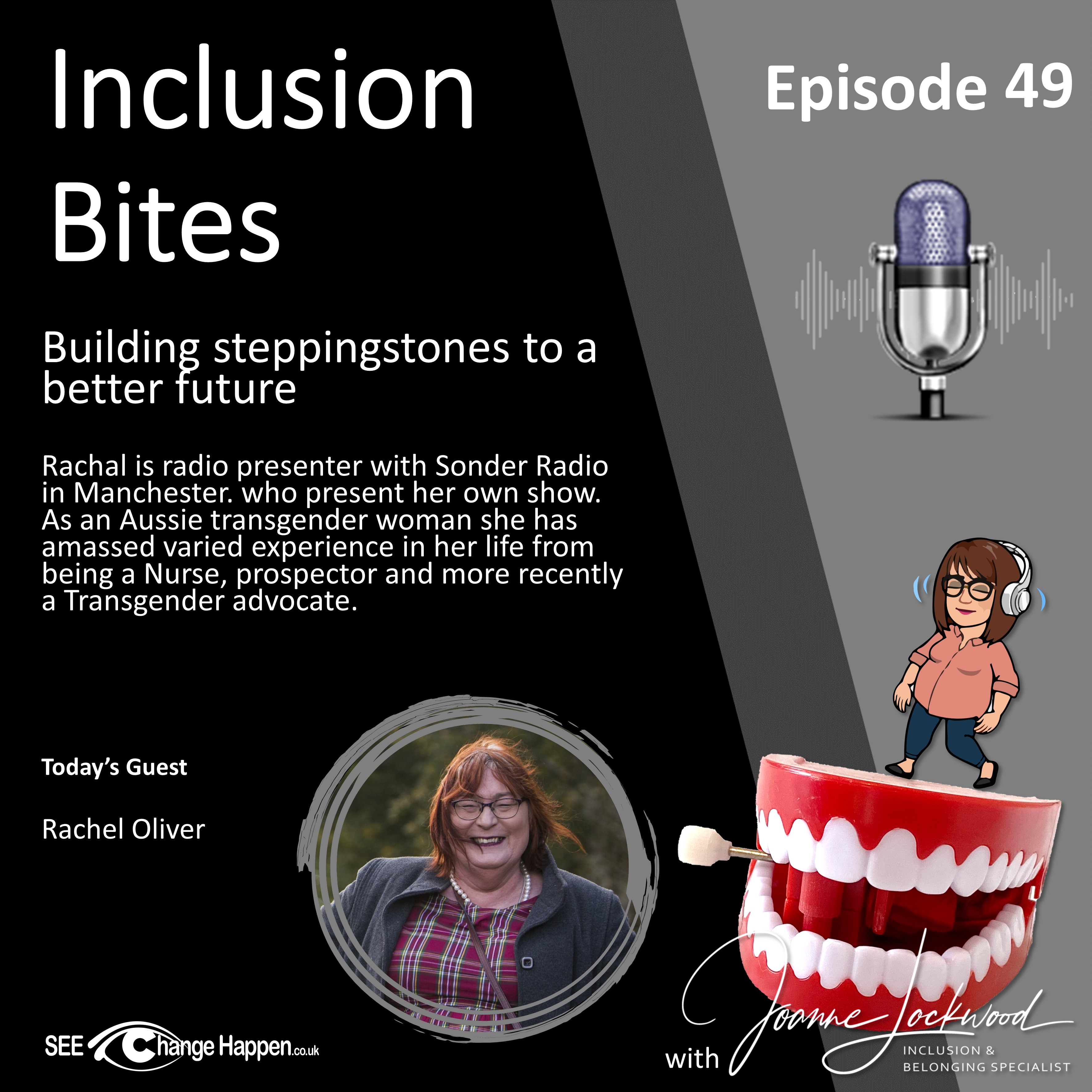
with Rachel Oliver · 26 November 2021
Lived Experience Identity
Joanne Lockwood is joined by broadcaster and presenter Rachel Oliver, a dual UK–Australian national who describes Australia as home and reflects on the winding path that brought her back to the UK. Rachel shares how a background in nursing and an unexpected TV appearance opened a door into radio and podcasting, where she now writes and produces her own shows.
At the heart of the conversation is Rachel’s “stepping stones” idea: how today’s trans people inherit progress built by earlier generations and, in turn, create a safer, fairer future for those who come next. Joanne and Rachel discuss what it can feel like to live under increasing scrutiny, why debates about legal recognition and self-identification matter, and how non-binary people are still constrained by binary documentation systems.
They also explore the personal side of transition and authenticity: the long period many people spend resisting or repressing who they are, the relief that can come with medical transition, and the shift in perspective that follows when privilege changes. The episode closes with practical reflections on navigating the world as a trans person, including travel safety and the everyday anxiety that can arise in public spaces like toilets, alongside a wider call for solidarity across the LGBTQ+ community and for allies to stay engaged.
About Rachel Oliver
One-sentence summary
Rachel Oliver’s life is a testament to the quiet courage of becoming fully yourself — and then using that freedom to make the path gentler for those who follow.
---
Synopsis (two paragraphs)
Rachel Oliver is, first and foremost, a storyteller who has lived more than one life. Born in the north of England, shaped by decades in Australia and time in the Middle East, she carries a blend of cultures, experiences and contradictions. She was a nurse, a bookseller, a military vehicle dealer, a gold prospector, a parent in the school playground proudly calling herself “Mr Mum”. Underneath it all, though, there was a truth she spent years fighting. By her late forties she realised, in her words, she “could not happily live life any longer… being a fake.” Transition was not a whim but the end of a long internal war. When she began hormone therapy, she describes it as a weight lifting, a deep exhale, a coming home: “This is what I should feel like.” Peace replaced noise. One voice replaced conflict.
Now in her sixties, Rachel has turned that hard-won clarity into something outward-facing. Through broadcasting, humour, and straight-talking warmth, she speaks about trans lives not as abstractions, but as human realities. She honours those who came before — icons who “put the level data off and identified the issues” — and feels a responsibility to pass something stronger forward. She has seen progress, and she has felt it slip back. She knows what it costs to defend rights that once felt settled. What drives her is not ideology but dignity: the right to live without fear, to travel without terror, to use the loo without anxiety, to exist without being reduced to a headline. She is building stepping stones — not monuments — so the next generation doesn’t have to fight quite so hard just to be.
---
10 Small, digestible concepts for easy learning
1. Becoming yourself can feel like putting down a lifelong disguise.
Rachel realised she wasn’t changing who she was — she was finally stopping the performance.
2. Freedom is sometimes quiet.
For her, transition meant peace in her own head: “one voice” instead of constant internal conflict.
3. You don’t wake up and choose this life.
“We don’t wake up one morning and say… I think I’ll be a transgender woman.” It is years of wrestling, not spontaneity.
4. Representation is responsibility.
Today’s trans generation is passing something forward, whether progress or retreat.
5. Rights feel different when you have to defend them.
Security is invisible — until it starts to crumble.
6. Identity is one facet, not the whole mirror.
Rachel refuses to be reduced to “trans” before everything else.
7. Perspective can be a gift born of tension.
Living across gendered expectations gave her what she calls a wider, almost 360-degree view of the world.
8. Belonging changes how much you notice.
She moved from barely noticing LGBTQ+ issues to realising how deeply they shape daily life.
9. The world shrinks when you live with risk.
Travel plans become calculations; holidays become negotiations with safety.
10. Humour can hold truth safely.
Jokes about “being paid double” open space for serious conversations about value and insight.
---
The “why” in the story
What they believe is true about people
That people cannot thrive while pretending. That authenticity is not indulgence — it is survival. And that when people are fully themselves, they have more to offer the world.
What they cannot unsee
The fragility of rights. The way safety is uneven across borders. The anxiety embedded in ordinary acts — passports, travel, toilets. And the cost of repression.
What they are no longer willing to tolerate
Being treated as a threat. Watching hard-won recognition quietly erode. Seeing younger generations forced into the same battles fought decades ago.
What they are trying to build instead
A future where trans people are ordinary citizens — multifaceted, sometimes boring, fully human — and where the next generation has firmer ground to stand on.
---
Narrative structure
1. The trigger
Years of suppressing her gender identity culminated in a realisation in her late forties: she could not keep “faking being a man”. Earlier stepping stones — becoming the primary carer, feeling at ease in spaces that didn’t match rigid masculinity — had quietly pointed the way.
2. The tension
Even after transition brought inner peace, the outer world remained unstable. Political debates intensified. Rights once assumed began to be questioned. She found herself defending not just herself, but her community.
3. The insight
Authenticity transforms not only the self but perspective. Transition did not shrink her world internally — it expanded it. What shrank was her physical safety in certain parts of the globe. That contrast sharpened her resolve.
4. The pivot
Instead of retreating, Rachel began broadcasting. She created space for myth-busting, celebration, humour and nuance. She chose to be visible and articulate — not combative, but clear.
5. The destination
A world where travel isn’t frightening, bathrooms aren’t battlegrounds, and trans children grow up with options and safety. A life where being trans is just one adjective, not a warning label.
---
Five key takeaways and learning points
1. Authenticity is not attention-seeking — it is relief.
When someone transitions, they are often moving towards peace, not spectacle.
2. Progress is not guaranteed.
Rights can shift backwards; complacency has consequences.
3. Visibility carries both pride and risk.
Being seen can open doors — and close borders.
4. Identity is layered.
Reducing someone to one characteristic strips away their humanity.
5. Humour can disarm fear.
Laughter makes difficult conversations survivable — and sometimes transformative.
---
Ten distinct ideas explained
1. Internal conflict has physical weight.
Rachel describes transition as lifting a burden. Living misaligned with yourself drains energy that could otherwise fuel creativity and care.
2. Legal recognition is symbolic — and powerful.
A “piece of paper” may not change daily life, but it represents dignity and state acknowledgement.
3. Safety shapes freedom of movement.
For many trans people, international travel is not about wanderlust but risk assessment.
4. Ordinary spaces hold extraordinary anxiety.
A public toilet can feel like a test of legitimacy, not just a basic need.
5. Community can arrive late.
Rachel had to educate herself on LGBTQ+ realities after transition — reminding us how privilege can numb awareness.
6. Cultural memory matters.
Indigenous traditions recognising more than two genders show that rigid binaries are not universal truths.
7. Repression often overperforms masculinity.
Hyper-masculine roles can be a shield for deeper uncertainty.
8. Hormones are not cosmetic — they are cognitive.
For Rachel, oestrogen changed not just her body, but her relationship with her emotions and thoughts.
9. Presence challenges stereotypes.
Being a trans nurse, parent, broadcaster — without apology — disrupts simplistic narratives.
10. Building the future is cumulative work.
Every conversation, every broadcast, every act of calm visibility lays another stone.
---
How people should change as a result
1. Think
- Move from “Is this real?” to “What must it cost to live otherwise?”
- Recognise that rights are not fixed; they require care.
- See gender diversity as historically and globally rooted, not newly invented.
- Understand that for some people, safety calculations shape daily choices.
2. Feel
- Shift from suspicion to curiosity.
- From indifference to solidarity.
- From abstract debate to concern for real lives.
- From fear of difference to respect for lived experience.
3. Act
- Challenge casual misinformation about trans lives in everyday conversations.
- Advocate for safe, inclusive facilities without turning them into culture-war flashpoints.
- Support media and storytelling that centres trans voices rather than speculating about them.
- Check travel, workplace, and policy decisions for unintended harm or exclusion.
- If you are an ally, be visible — don’t leave the speaking to those already under scrutiny.
---
One thing to remember
When someone finally becomes themselves, they are not asking for applause — only the chance to live in peace.