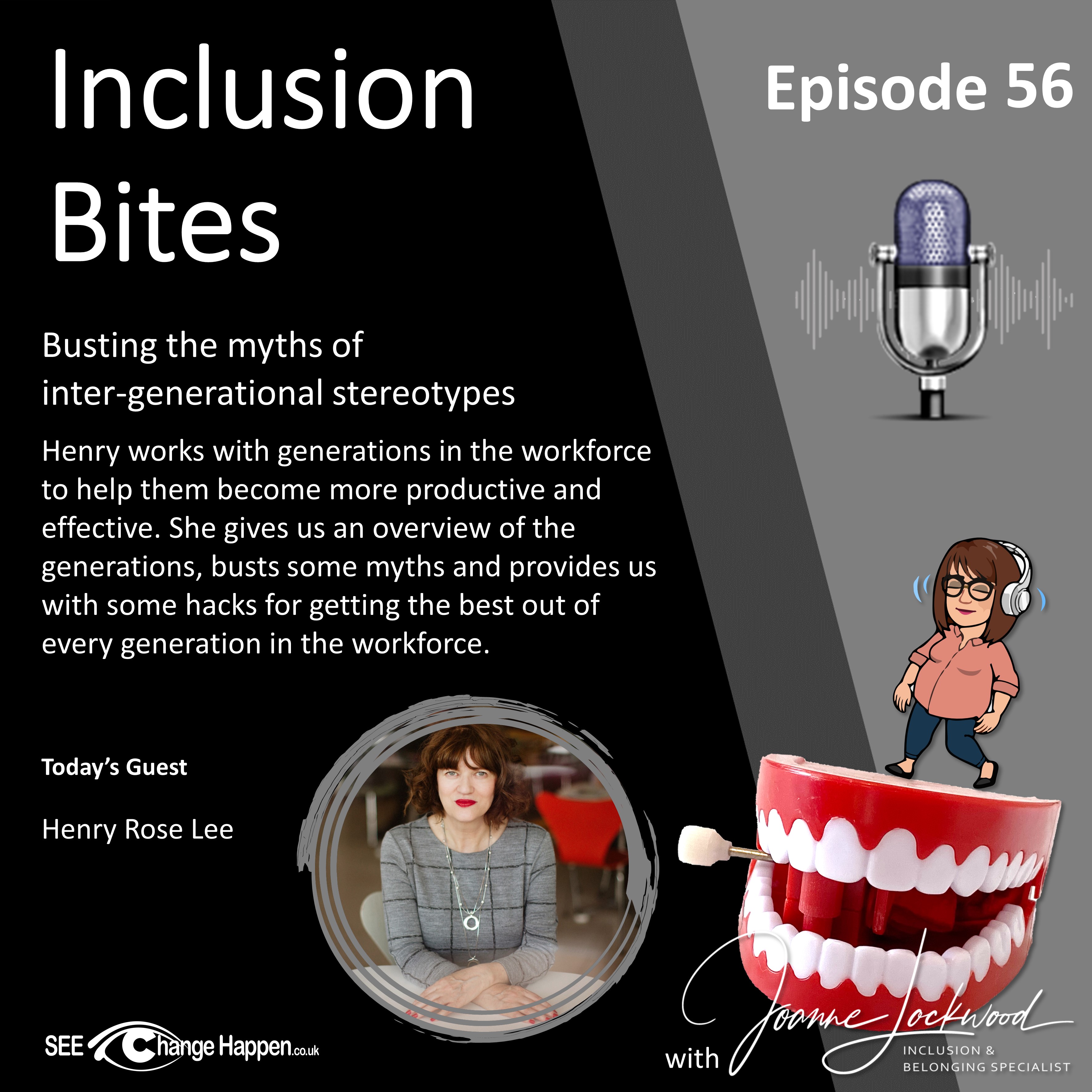
Busting The Myths Of Inter-Generational Stereotypes
with Henry Rose Lee · 13 January 2022
Workplace Culture Systems
Joanne Lockwood is joined by intergenerational consultant Henry Rose Lee to unpack the myths and stereotypes different age groups hold about one another at work. They discuss how labels like “Baby Boomer”, “Gen X”, “Millennial” and “Gen Z” can be useful as learning tools while also becoming limiting when used to pigeonhole individuals.
The conversation explores what drives perceived generational differences, including major “periodic” events (technology shifts, Brexit, Covid) and “cohort” influences (platforms like Snapchat, gaming culture, social media). They look at how these forces affect communication, attention, learning, and the way people build community and loyalty—especially as social media becomes a key reference group for younger workers.
They also reflect on how Covid accelerated changes in working patterns, including hybrid and remote work, and why organisations may need to rethink culture, retention, and alumni relationships. Along the way, they touch on ageism at both ends of the spectrum, the value of older workers’ experience, and the importance of creating workplaces where people can connect and thrive across generations.
About Henry Rose Lee
One-sentence summary
Henry Rose Lee believes that when we stop boxing people into age-based myths and start seeing them with curiosity and respect, we protect dignity across generations and build a future of work that feels human, not hostile.
---
Synopsis
Henry Rose Lee is someone who listens deeply. She describes herself as face blind, a trait that means she focuses less on appearance and more on tone, breath, and the way words are chosen. That feels symbolic of her life’s work. As an intergenerational consultant, she has watched how easily people judge one another based on age — too young, too old, too entitled, too outdated — and she cares deeply about the quiet harm those assumptions cause. What drives her isn’t theory. It’s fairness. She has seen baby boomers written off as obsolete and young people dismissed as feckless. She knows how lazy those narratives are, and how costly.
What she’s trying to change is simple yet disruptive: the way we talk about each other. Henry says, “we’re going to label the hell out of things” in learning spaces — not to trap people, but to understand patterns — and then let those labels fall away when it comes to real human beings. She wants workplaces to move from judgement to awareness; from resentment to flexibility; from rigid ideas about loyalty, culture and retirement to something more generous. Beneath it all is a belief that people ebb and flow like families do — joining, leaving, returning — and that dignity should remain intact at every age.
---
10 Small, digestible concepts for easy learning
1. Every generation stereotypes — not just the older ones.
Assumptions run both ways, and neither side is innocent.
2. Labels are learning tools, not identities.
Use them to understand patterns, then drop them when facing real people.
3. Age brings experience — but youth brings context.
Both are forms of intelligence.
4. Younger workers are not disloyal — they are navigating insecurity.
Feeling poorer changes how boldly you move.
5. Older workers are not outdated — they often hold institutional memory.
When they leave, knowledge leaves with them.
6. Technology changes behaviour before policy catches up.
People adapt first; systems lag behind.
7. Work is splintering — but belonging still matters.
Transaction alone rarely satisfies the human need for connection.
8. Covid drew a line in the sand.
We cannot fully return to how things were, even if we try.
9. Language is organic.
Communication evolves — what matters is being understood and heard.
10. Ageism works at both ends.
“Too inexperienced” and “past your sell-by date” are equally harmful.
---
The “why” in the story
What they believe is true about people
Henry believes people are more complex than the boxes we place them in. She sees work at its best as a kind of family — imperfect, evolving, but rooted in shared contribution rather than age hierarchy.
What they cannot unsee
She cannot unsee the waste. The baby boomers retiring with decades of knowledge. The young people judged for caring about money while carrying the burden of instability. The quiet resentment between age groups that could instead be understanding.
What they are no longer willing to tolerate
She is no longer willing to tolerate lazy ageism — at either end. Nor the nostalgia that insists “it wasn’t like that in my day” as if that settles the matter.
What they are trying to build instead
She’s trying to build awareness first. From there, flexibility. From there, respect. A workplace where someone can leave and return without shame; where older employees are not edged out; where young workers are coached rather than criticised.
---
Narrative structure
1. The trigger
Years of hearing the same refrains: young people are snowflakes; older people can’t innovate. Add to that the shock of Covid, which exposed how differently generations experienced work — and how quickly judgement surfaced.
2. The tension
Older leaders feel loyalty fading. Younger workers feel misunderstood. Organisations fear losing “culture”. Everyone feels slightly disoriented. Henry meets resistance from those who think generational talk is divisive — or those who want tidy answers.
3. The insight
Patterns exist — but people are not patterns. Periods and cohorts shape us, but they do not define our worth. Awareness is the bridge between difference and dignity.
4. The pivot
She chose to lean into nuance rather than pick a side. To say openly that there are differences, but refuse to weaponise them. To advocate for alumni networks, returners, consultancy arrangements, and age-inclusive thinking.
5. The destination
A future of work that feels less brittle. Where leaving isn’t betrayal. Where retirement isn’t erasure. Where young workers are guided into confidence, and older workers are honoured rather than discarded.
---
Five key takeaways and learning points
1. Generational conflict often masks economic reality.
When younger people chase pay, it’s often about survival — not selfishness.
2. Knowledge loss is a silent organisational risk.
Dismissing older workers drains expertise that cannot be quickly replaced.
3. Belonging must be intentional in hybrid work.
Without it, work becomes purely transactional.
4. Change is not moral decline — it’s evolution.
Language, technology and workplace norms are shifting, not collapsing.
5. Awareness precedes fairness.
Once we see patterns clearly, we can respond wisely instead of reacting emotionally.
---
Ten distinct ideas explained
1. Cohort vs life stage
Some differences are about age. Others are about the era you grew up in. Confusing the two flattens lived reality.
2. Economic insecurity shapes behaviour
If you feel poorer, security becomes urgent. Career decisions reflect that emotional state.
3. Retirement as identity loss
Mandatory cut-offs can strip purpose and belonging overnight.
4. Digital community as primary community
For many young workers, their online network feels more immediate than their employer.
5. Hybrid confusion
People want flexibility and connection. Both. The tension is real.
6. Language as inclusion barrier
Cultural references bond some while excluding others.
7. Emotional intelligence grows with time
Experience often deepens regulation and perspective — a powerful asset.
8. Being unseen at either end of age
Young workers feel underestimated; older workers feel overlooked. Both erode dignity.
9. Transactional vs transformational employment
When work is only about money, loyalty fades. When growth is mutual, commitment extends.
10. Work as family (not hierarchy)
Not paternalistic — but supportive. A place where differences are expected, not punished.
---
How people should change as a result
1. Think
- Replace “they’re all like that” with “what shaped them?”
- See job-hopping as context-driven, not character-driven.
- View retirement as negotiable, not automatic.
- Understand that flexibility does not equal laziness.
- Recognise that culture cannot be forced — it must be felt.
2. Feel
- Move from irritation to curiosity.
- Shift from nostalgia to openness.
- Let go of resentment about “how it used to be”.
- Replace defensiveness with empathy.
- Feel protective of dignity — at every age.
3. Act
- Create alumni pathways for returners.
- Pair younger and older employees as co-mentors, not hierarchies.
- Audit policies for hidden age cut-offs.
- Ask younger staff what support would deepen loyalty.
- Offer phased retirement or consultancy routes.
- Have open conversations about economic pressure without judgement.
- Celebrate contribution publicly — not just potential.
---
One thing to remember
Difference between generations is not decay — it’s evolution, and dignity should survive it.