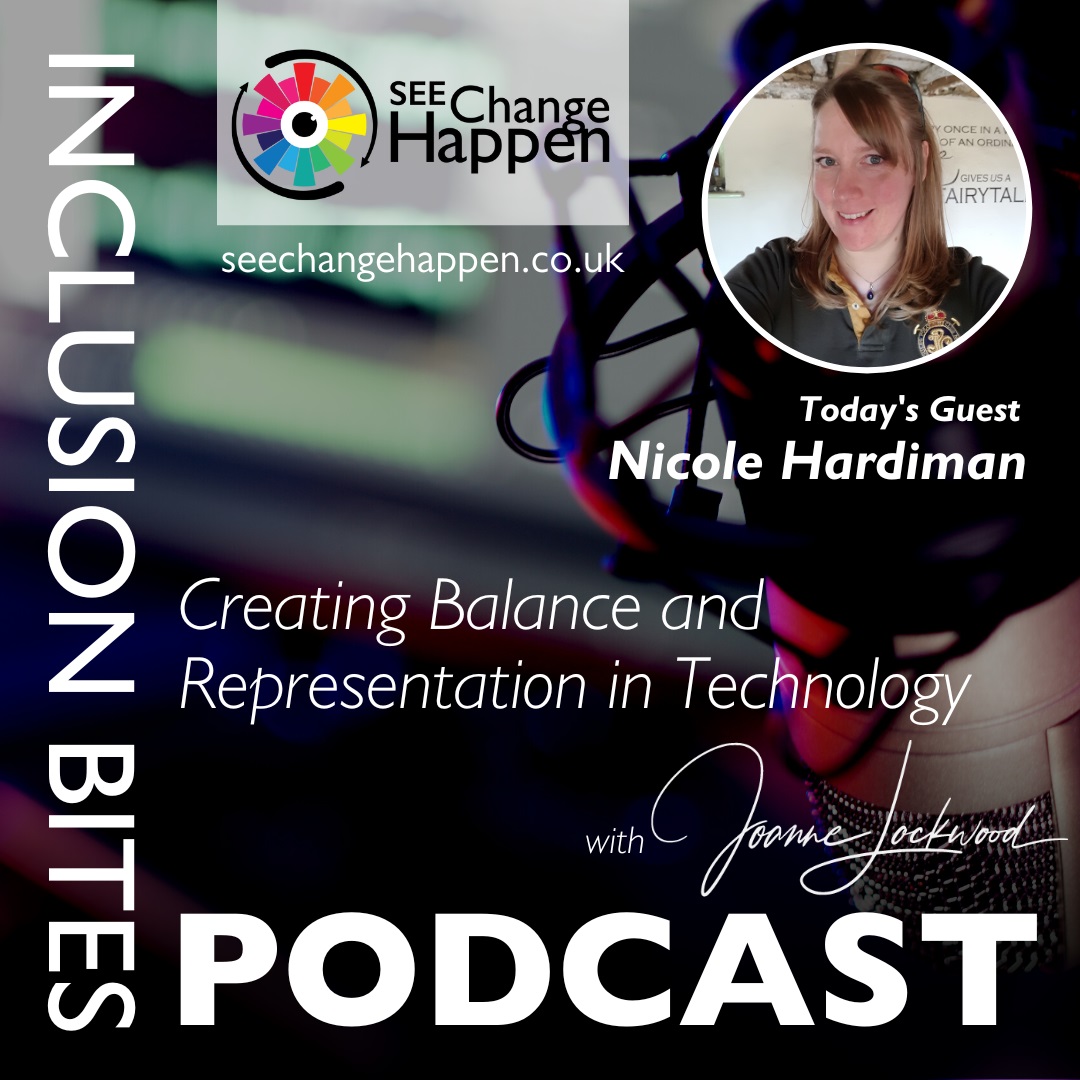
Creating Balance And Representation In Technology
with Nicole Hardiman · 01 September 2022
Workplace Culture Systems
Nicole Hardiman, a software and data engineer, reflects on two decades in tech and the persistent lack of gender balance she’s experienced—often being the only woman in the team, and at times the only woman in the building. She and Joanne Lockwood explore why representation still matters: when teams don’t reflect their users, products and decisions can miss the mark.
They discuss how technology is often portrayed as intimidating, “geeky,” and closed off, and why that framing discourages girls and underrepresented groups from seeing tech as a creative, collaborative career. Nicole shares practical ways the sector can widen the talent pipeline: going earlier into schools, proactively reaching people who don’t see themselves as “tech,” and valuing different routes into the profession.
The episode also explores workplace dynamics that affect retention and progression—bias from men and women, the impact of loud voices dominating meetings, and the importance of psychological safety so people can speak up and be heard. Joanne and Nicole examine the pressures women can face to conform to a leadership “cookie cutter,” and why authenticity and allyship are essential if organisations want lasting change rather than short-lived balance.
Throughout, the conversation keeps returning to one central idea: inclusion must involve everyone, including those with the power to change systems, hiring practices, and culture—otherwise progress will remain slow.
About Nicole Hardiman
One-sentence summary
Nicole Hardiman is driven by a quiet refusal to let another woman feel alone in technology simply because no one opened the door wide enough for her to belong.
---
Synopsis
Nicole Hardiman has spent most of her career as “a lonely lady” in tech. She was on call for the millennium bug; she has sat in meetings where she was asked to take the notes or fetch the coffee; she has worked in buildings where she was the only woman apart from reception. At the time, she says, she didn’t even question it. It was just how it was. But over the years, listening to other women describe feeling isolated, unheard, or drowned out, something shifted. She realised the cost of that loneliness — and that simply surviving it was not the same as changing it.
Now, Nicole is trying to demystify technology and make it human again. She wants girls to see that tech is not an ivory tower for “geeky” geniuses, but a creative, collaborative space where different life experiences make better products and safer systems. She is focused not only on getting more women into tech, but on making sure they stay — especially when family, bias, or outdated expectations quietly edge them out. For her, this work is about dignity: about ensuring no one disappears mid-career because the system was built around someone else’s life.
---
10 Small, digestible concepts for easy learning
1. Loneliness is a signal, not a personal weakness.
When women feel isolated in tech, it’s often a systems issue, not a confidence issue.
2. Demystify to diversify.
The more we present tech as creative and accessible, the wider the door opens.
3. You don’t need to “be one of the guys” to belong.
Authenticity is not a liability; imitation is not the price of entry.
4. Bias lives in everyone.
It’s not a male problem — it’s a human one.
5. Representation shapes design.
If only one group builds the product, only one group’s needs are centred.
6. Maternity shouldn’t equal obsolescence.
Having a child doesn’t erase someone’s technical capability.
7. Inclusion before diversity.
Invite people in, create safety, and diversity follows with more staying power.
8. Early messages run deep.
Pink and blue aisles quietly script career expectations.
9. Leadership doesn’t have a haircut.
There is no single template for who “looks like” a senior woman.
10. If someone has to be first, let’s make it count.
Progress often begins with someone choosing courage over comfort.
---
The “why” in the story
What they believe is true about people
Nicole believes people are already more capable than they think — that many are “doing tech” without calling it that. She believes everyone brings a valid perspective, shaped by life, that can strengthen a team.
What they cannot unsee
She cannot unsee mid-level women disappearing from tech — dropping away after maternity leave, or stepping sideways because they “can’t keep up”. She cannot unsee products designed without the people who use them.
What they are no longer willing to tolerate
She is no longer willing to accept the narrative that tech is only for a certain “type”. Nor will she accept women being tokenised or dismissed as diversity hires.
What they are trying to build instead
A culture where no one feels like the only one. Where men are part of the solution. Where inclusion starts early and sustains people through life’s changes.
---
Narrative structure
1. The trigger
The slow accumulation of stories — women feeling lonely, unheard, edged out. A niece asking, “Can girls do that?” A colleague saying she moved out of technical work because she couldn’t keep up after having children.
2. The tension
Tech still rewards loudness and competitiveness. Quiet voices are talked over. Programmes for “women in tech” risk becoming echo chambers. Meanwhile, progress feels painfully slow.
Nicole describes women feeling they must prove they deserve their roles, particularly when others hint they were hired to “fill a quota”. The emotional labour of constantly having to validate your competence is heavy.
3. The insight
Diversity without inclusion collapses. You can hire for balance, but if culture doesn’t shift, things revert. Bias isn’t held only by men; it sits across the system. Real change requires everyone — especially those with power.
4. The pivot
Nicole stopped trying to fit the “cookie cutter” of senior women in tech. Instead of asking how she could look like them, she realised: “I’m not like them. How amazing is that.” She began actively creating spaces where different voices are encouraged to stay audible.
5. The destination
A future where a woman in tech isn’t unusual. Where a five-year-old on a parent’s lap during a meeting is normal. Where products reflect the hands, habits, bodies and minds of everyone who uses them. Where no one disappears mid-career because life moved forward.
---
Five key takeaways and learning points
1. If someone feels alone in your workplace, something structural is wrong.
Isolation erodes talent quietly; belonging retains it.
2. Demystification is powerful.
When we frame tech as creative and collaborative, more people see themselves in it.
3. Bias doesn’t vanish with education alone.
It requires active interruption and shared responsibility.
4. Life stages need structural support.
Without re-entry pathways and buddy systems, we lose experienced people unnecessarily.
5. Men must be in the room.
Progress stalls when only those affected are asked to solve the issue.
---
Ten distinct ideas explained
1. Tech as creativity, not just code
Nicole keeps a Raspberry Pi next to her cross-stitch. For her, both are creative tools. When tech is framed as artistic and inventive, it becomes inviting rather than intimidating.
2. The disappearance of mid-career women
The pipeline doesn’t leak at entry; it thins at mid-level. Without support during maternity or caring periods, skilled women feel left behind.
3. Loneliness as cultural feedback
Being the only woman in a building doesn’t just feel isolating — it signals a lack of shared perspective.
4. The myth of the quota hire
Being told or implied that you’re hired “because you’re female” forces you into defensive performance instead of confident contribution.
5. Design reflects its designers
When phones, systems or navigation flows suit only a narrow demographic, it’s not an accident — it’s a reflection of who held the pen.
6. The danger of echo chambers
Women-only spaces can validate experience, but cannot fix structures alone if decision-makers are absent.
7. Quiet voices get lost
In fast-paced agile meetings, loud confidence often drowns out thoughtful insight — with real consequences for team trust.
8. The cookie-cutter leader
When senior roles start to look and sound the same, others conclude they must imitate to progress, shrinking authenticity.
9. Cultural norms outlast policy
Schools may remove overt gender labels, but social cues at home still steer children early.
10. Inclusion as shared work
Psychological safety isn’t soft — it’s the precondition for honest conversation and innovation.
---
How people should change as a result
1. Think
- Stop seeing tech as a narrow technical elite — see it as applied problem-solving.
- Recognise that loneliness at work is data about culture.
- Understand that bias isn’t confined to one demographic.
- View career breaks as life experience, not professional decline.
- Question whether “confidence” is your proxy for competence.
2. Feel
- Move from defensiveness to shared responsibility.
- Shift from scepticism about diversity to curiosity about perspective.
- Replace guilt with action.
- Swap comparison for authenticity.
- Let empathy replace assumption when someone speaks up.
3. Act
- Invite quieter voices to finish their thoughts in meetings.
- Create structured re-entry pathways for parents returning from leave.
- Visit schools or youth groups and talk about tech as creativity.
- Ensure hiring panels reflect different viewpoints.
- Challenge “quota hire” comments immediately.
- Offer mentoring to someone unlike you.
- Normalise flexibility when life overlaps with work.
---
One thing to remember
No one should feel like the only one just to do the work they love.