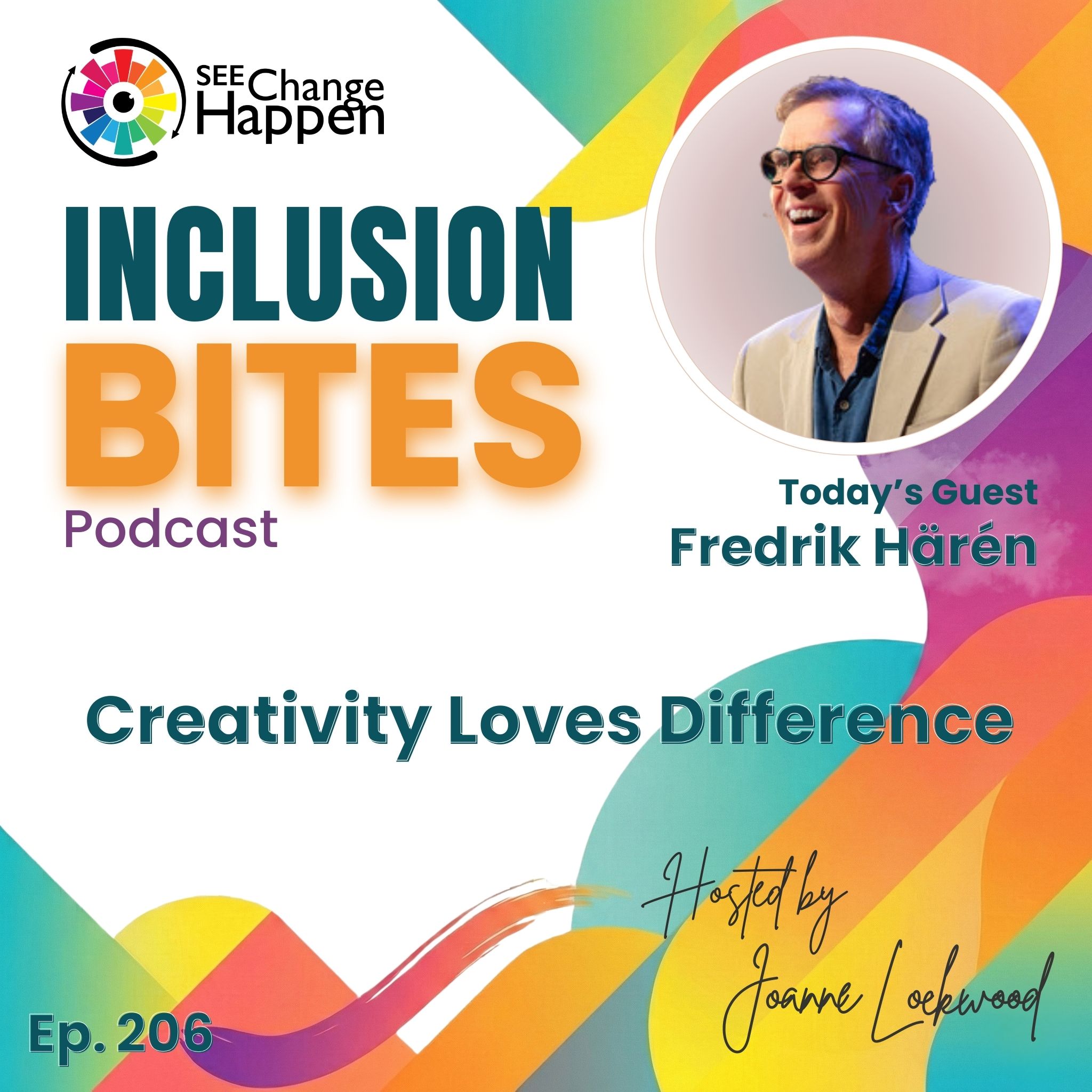
Creativity Loves Difference
with Fredrik Härén · 23 April 2026
Workplace Culture Systems
In this episode of The Inclusion Bites Podcast, Joanne Lockwood speaks with Fredrik Härén about how difference fuels creativity, innovation and better problem-solving. The conversation ranges from cross-cultural travel and multicultural parenting to the value of questioning inherited assumptions and making up your own rules.
Fredrik shares stories from living across Asia, returning to Sweden, and noticing how being outside his own cultural defaults helped him see more possibilities. He argues that curiosity comes before knowledge, that openness to other ways of doing things expands thinking, and that creativity is often less about self-expression in the abstract and more about understanding who you are at a deeper level.
The discussion also explores how communities of interest connect people across borders, why administrative systems can stifle creativity, and how technology and AI can remove low-value work. The episode closes with a call to look beyond local habits, learn from other cultures and remain open to better ideas wherever they come from.
About Fredrik Härén
One-sentence summary
Fredrik Haren’s message is simple and deeply human: when people stay curious about difference, they stop defending sameness and start discovering who they really are.
Synopsis (two paragraphs)
Fredrik Haren comes across as someone shaped by movement, not by certainty. He left Sweden for China with no language and no cultural map, and in that disorientation he found something unexpectedly freeing: the chance to choose for himself. He says that moment made him feel “so pure” and “so myself”, and that feeling seems to have stayed with him ever since. His life across Asia, his mixed family, and his habit of looking for what other places do differently have taught him to see the world as a place full of possible ways, not fixed rules. He is someone who has learned from being unfamiliar, not from always knowing.
What Fredrik is trying to change is the quiet tyranny of “this is how it’s done”. He wants people to stop mistaking habit for truth and to notice how much creativity is lost when everyone is expected to think, eat, learn, and work in the same way. Beneath his stories is a clear concern for human dignity: for children who are given space to become themselves, for travellers who can explore rather than retreat into the familiar, for workers who are not trapped in pointless routines, and for people who are seen as full human beings rather than categories. He is arguing for a world where difference is not tolerated as a burden, but welcomed as the source of insight, compassion and better living.
10 Small, digestible concepts for easy learning
1. Curiosity comes before knowledge.
Fredrik leans on the idea that curiosity is the step that opens the door to understanding.
2. Difference can be liberating.
When no one around him told him how to behave, he found himself more clearly.
3. The familiar is not always the best.
What feels “normal” in one place may simply be inherited habit.
4. Changing your mind is a strength.
He sees flexibility, not stubbornness, as a sign of intelligence.
5. People need space to become themselves.
Creativity grows when identity is discovered, not copied.
6. There is more than one right way.
Parenting, problem-solving and learning all have multiple good forms.
7. Observation matters more than ego.
Real learning starts when you watch before you judge.
8. Admin drains creative life.
Repetitive systems can suffocate imagination and energy.
9. We should steal good ideas without shame.
Fredrik believes wisdom should be borrowed freely across cultures.
10. Being human is a bigger identity than being local.
He sees global connectedness as part of how people are now learning to belong.
The “why” in the story
What they believe is true about people
Fredrik believes people are more flexible, more creative and more open than they are often allowed to be. He believes most of us are carrying rules we never chose, and that underneath that conditioning, people want to find a way of living that feels honest.
What they cannot unsee
He can no longer ignore how often one culture, one habit, or one system is treated as the only sensible option. Once he experienced life outside his own frame, he saw that much of what people call “the way” is simply one way among many.
What they are no longer willing to tolerate
He is no longer willing to accept closed minds, useless admin, or systems that force everyone through the same narrow door. He cannot tolerate the assumption that difference is a problem to be managed rather than a source of intelligence.
What they are trying to build instead
He is trying to build a world where people stay curious, learn from each other, and create from their own deepest truth. In his words, he wants people to find an “inner theme” — something only they can offer — and use that to make the world richer.
Narrative structure
1. The trigger:
Moving to China alone, unable to speak the language, and suddenly having to decide for himself how to live moment by moment. That experience stripped away the comfort of routine and showed him how liberating difference can feel.
2. The tension:
He keeps meeting the human tendency to cling to what is familiar: fixed opinions, cultural habits, defensive certainty, pointless admin, and a fear of being wrong or changed.
3. The insight:
He learned that creativity is not just self-expression; it is self-understanding. When people understand who they are, they stop copying and start contributing something only they can give.
4. The pivot:
He started treating other cultures as teachers, not threats; started looking for better ways elsewhere; started valuing curiosity over certainty; and started helping people find their own inner theme.
5. The destination:
A future that feels lighter, freer and more human: children learning with joy, adults working with purpose, people borrowing good ideas across borders, and difference being experienced as a source of belonging rather than friction.
Five key takeaways and learning points
1. What feels “normal” may just be what you’ve repeated long enough.
So what: you may be defending a habit, not a truth.
2. Curiosity makes difference feel less threatening.
So what: when you ask before judging, you open the door to better ideas and kinder relationships.
3. Creativity grows when people are allowed to be themselves.
So what: pressure to conform can shrink what someone might otherwise create.
4. Good ideas do not belong to one place.
So what: if someone else has found a better way, pride should not stop you learning from it.
5. Systems that waste human energy are not neutral.
So what: boring, slow, unnecessary processes steal time, dignity and attention from things that matter.
Ten distinct ideas explained
1. Curiosity is an act of respect.
When Fredrik talks about curiosity, he is not talking about being nosy. He means being willing to admit that another person, place or culture may know something you do not.
2. Identity becomes richer when it is layered.
He describes himself as Swedish, married into Filipino culture, rooted in Sweden again, and connected globally. Belonging does not have to be single or simple.
3. Difference reveals habit.
Living in China showed him that a lot of what he assumed was “right” was actually just familiar. Difference exposes how much of life is inherited rather than chosen.
4. Children thrive when they are not flattened into sameness.
His story about Montessori illustrates a belief that children do best when learning begins from their own interests and energy, not just the teacher’s agenda.
5. Creativity is not performance; it is discovery.
He resists the idea that creativity is about putting on a show. For him, it is about uncovering who you are and what only you can express.
6. Borrowing from other cultures is a form of intelligence.
Fredrik admires people and societies that look outward, notice what works, and bring it home. He sees that as wisdom, not disloyalty.
7. Admin can quietly crush the human spirit.
His dislike of unnecessary paperwork is not trivial; it reflects a broader frustration with systems that make people numb, busy and less alive.
8. Observation changes what you can see.
Whether it is photography, walking in a forest, or reading body language, he keeps returning to the idea that noticing carefully is a form of care.
9. People are often more loyal to being right than to being real.
He notices how hard it is for people to change their minds, even when evidence or experience suggests they should.
10. Being human should sit above tribe.
Fredrik’s larger hope is that people can keep their local identities without being trapped by them. He imagines a future where our deepest common identity is simply being human.
How people should change as a result
1. Think
- Move from “this is how it’s done” to “what else might be possible?”
- Shift from defending your own way to learning from other ways.
- See difference as information, not as inconvenience.
- Recognise that many systems are inherited, not inevitable.
- Understand that creativity begins in self-knowledge, not conformity.
2. Feel
- From defensiveness to curiosity.
- From certainty to openness.
- From judgement to respect.
- From pressure to belong by copying, to relief in being yourself.
- From cynicism about difference, to appreciation of its value.
3. Act
- Ask someone how they do things where they come from before assuming your way is best.
- Notice one routine in your work or home life and ask whether it still serves people well.
- Give someone space to do a task differently if the outcome matters more than the method.
- Look for one good idea from another culture, sector or country that you could adapt.
- Reduce one piece of unnecessary admin that drains time and attention.
- In conversations, practise listening for the logic behind someone’s view before trying to win.
- Make room for people to learn in ways that suit them, rather than forcing one style on everyone.
One thing to remember
Curiosity is how people stop copying the world and start becoming themselves.