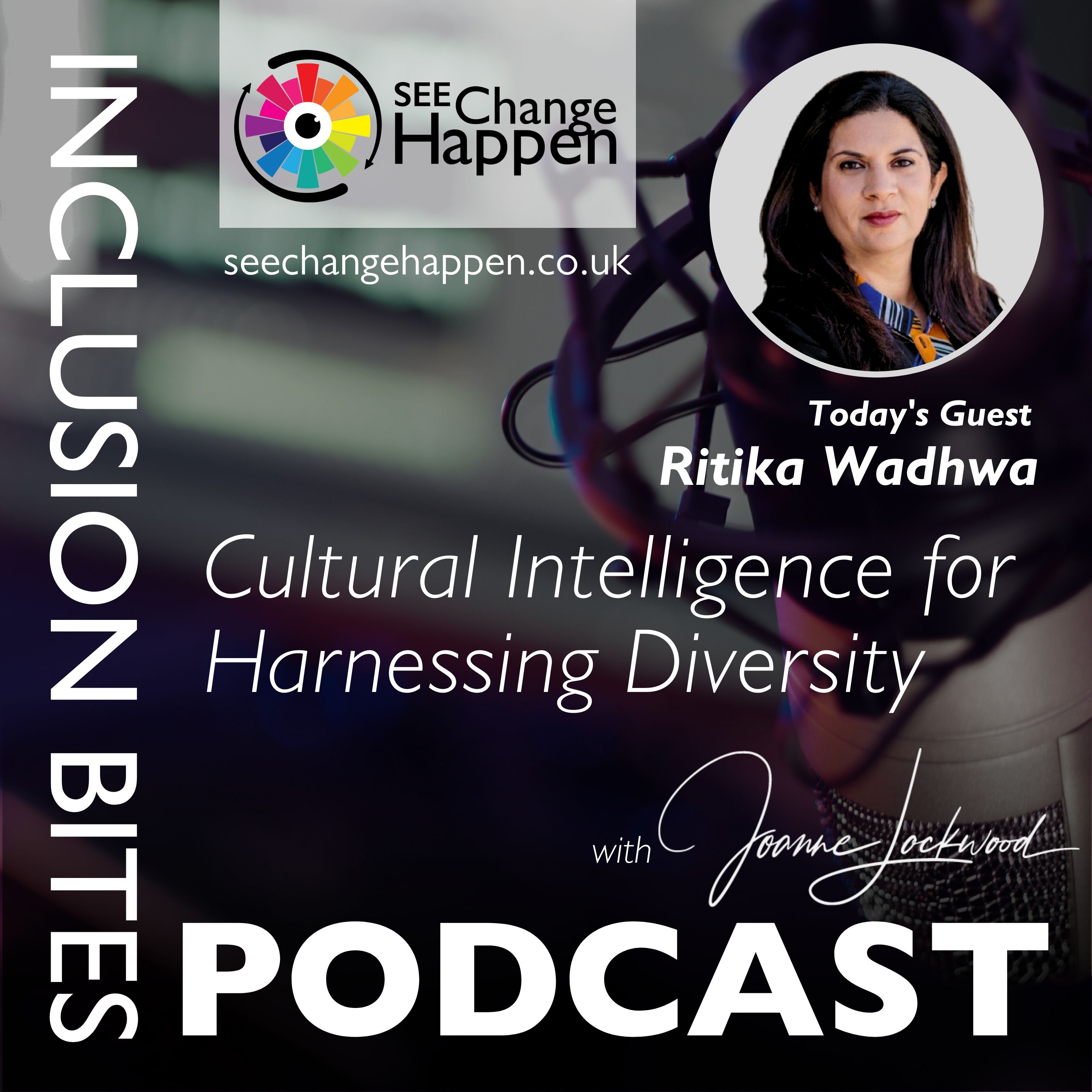
Cultural Intelligence For Harnessing Diversity
with Ritika Wadhwa · 22 August 2024
Inclusive Leadership Management
Joanne Lockwood is joined by Ritika Wadhwa, founder and CEO of Prabhaav Global, for a wide-ranging discussion on Cultural Intelligence (CQ) and why it has become a practical capability for modern leadership.
Ritika breaks CQ down into four capabilities—drive, knowledge, strategy, and action—and explains how the framework moves organisations beyond awareness into accountable behaviour change. Together they explore common inclusion barriers in workplaces, including fear of getting it wrong, passive leadership habits, and the way “one-size-fits-all” expectations can lead to stereotyping rather than better collaboration.
The conversation also draws on Ritika’s lived experience as an immigrant from India, reflecting on the impact of systems, power distance, and post-colonial narratives on how people are treated and how they learn to “fit in”. They discuss what culturally intelligent leadership looks like in practice: being deliberate about communication, understanding different norms around hierarchy and feedback, and adapting without asking others to assimilate.
Listeners leave with clearer language for understanding cultural differences at work, plus practical prompts for developing CQ—starting with clarifying your “why”, expanding your knowledge sources, and using self-reflection to turn intentions into inclusive impact.
About Ritika Wadhwa
One-sentence summary
Ritika Wadhwa’s message is rooted in a lifetime of being made to feel “other”, and her refusal to let the next generation waste decades shrinking themselves just to belong.
---
Synopsis
Ritika Wadhwa is a woman who has lived on both sides of power. Born in India into a patriarchal system, she grew up absorbing messages about hierarchy, deference and colonial gratitude. When she moved to the UK, she became something else: a woman of colour with a “funny accent”, an immigrant whose qualifications were overlooked, whose CV was dismissed, who received rejection after rejection until she started again from scratch. For years, she made herself smaller in boardrooms, softened her edges, tried to please what she calls “powers that wouldn’t be pleased no matter what I did”. Her self-described superpower — resilience — was forged in those moments.
Now, Ritika no longer shrinks. She speaks about impact because, as she says, “what we feel is the impact” — not the intention behind someone’s words. She is trying to interrupt systems that quietly condition people to feel grateful for less, silent in the face of unfairness, or invisible in rooms they deserve to shape. Her work is personal. She wants a different inheritance for those “who look like me”, including her daughters. She wants them to feel proud sooner than she did — proud of their names, their history, their identities — without spending decades fighting for that right.
---
10 Small, digestible concepts for easy learning
1. Intention is private; impact is what people live with.
Good motives mean little if the outcome leaves someone diminished.
2. Resilience is often born from exclusion.
The strength some admire is usually forged by surviving what shouldn’t have happened.
3. Gratitude can mask injustice.
Feeling “lucky to be here” can silence the courage to question unfair systems.
4. Assimilation is not the same as belonging.
Changing yourself to fit in is not the same as being accepted as you are.
5. Curiosity can be learned.
You don’t have to be naturally open to difference — it can be built with practice.
6. Privilege sets the default.
We often assume our way is “normal” simply because it’s centred.
7. Hierarchy shapes who speaks.
Saying “my door is open” means little if someone’s culture tells them not to knock.
8. Dehumanisation starts with labels.
When we replace faces with categories, harm becomes easier.
9. History lives in the present.
Colonialism, partition and migration aren’t past events — they shape today’s power.
10. Legacy is a daily act.
What we model for our children becomes the world they expect.
---
The “why” in the story
What they believe is true about people
Ritika believes people want dignity. They want to contribute fully without sanding down who they are. She believes most harm comes not from malice, but from unexamined assumptions.
What they cannot unsee
She cannot unsee how systems were designed for someone else — from patriarchal rules in India to recruitment bias in the UK. She cannot unfeel the humiliation of rejection letters or the sting of being praised for speaking “good English”.
What they are no longer willing to tolerate
She is no longer willing to make herself small. No longer willing to accept that dominance equals correctness. No longer willing to let leaders hide behind good intent while impact tells a different story.
What they are trying to build instead
She is building environments where leaders flex instead of force, listen instead of label, and where young girls — especially her own — grow up knowing they do not need to earn their right to belong.
---
Narrative structure
1. The trigger:
Migration. Rejection letters. Boardrooms where she softened her voice. Being asked whether people in India had televisions. Two decades of effort before feeling fully proud of who she is.
2. The tension:
Pushback from those comfortable in dominance. Leaders who say they “love feedback” but don’t understand why no one speaks. A world polarised by fear, where difference feels threatening.
3. The insight:
“People fail to get along because they fear each other.” Fear reduces when knowledge increases — but knowledge without action becomes stereotyping. Adaptability is the bridge.
4. The pivot:
She stopped assimilating. She named her company after the Hindi word for impact — even when advised to make it “simpler”. She chose legacy over approval.
5. The destination:
A future where difference is not something to train out of people — but something leaders learn to meet with humility. A world where her daughters don’t need resilience just to be respected.
---
Five key takeaways and learning points
1. You may be mistaking comfort for correctness.
So what: Notice when you assume your way is the standard — and question it.
2. Fear thrives in distance.
So what: Proximity, conversation and curiosity shrink the space where stereotypes grow.
3. Impact outlives intention.
So what: Ask how your behaviour lands, not just what you meant.
4. Hierarchy silences more than it empowers.
So what: If you lead others, take responsibility for creating psychological safety, not just inviting it.
5. Your story shapes your fire.
So what: Your own experiences of hurt or injustice can guide you towards compassion rather than cynicism.
---
Ten distinct ideas explained
1. High power distance cultures
In some societies, authority is respected deeply. Silence may signal respect, not disengagement. If misunderstood, capable voices remain unheard.
2. Assimilation fatigue
When people repeatedly adjust their speech, dress or tone to “fit in”, it drains energy that could be spent on innovation.
3. Presumed identity
Ritika’s daughters are “presumed white” and treated differently as a result. Doors open more easily — showing how perception shapes opportunity.
4. Post-colonial gratitude
Being raised to admire former colonisers can make injustice feel like a favour. This internal conflict sits quietly in many migration stories.
5. Divide and rule legacies
The scars of partition still affect relationships between communities. History is not abstract — it lives in today’s tensions.
6. Assertiveness bias
What one culture calls “confident” another may see as disrespectful. Whose definition are we using?
7. Open-door illusion
Leaders claiming openness may unknowingly reinforce barriers if cultural norms discourage challenge.
8. Identity as wholeness
When people can bring every part of themselves to work, energy shifts from defence to contribution.
9. Curiosity as muscle
Exposure, reading, conversation and reflection strengthen your ability to adapt across difference.
10. Resilience with a cost
Celebrating resilience without addressing the injustice that created it risks normalising harm.
---
How people should change as a result
1. Think
- From “my way is normal” to “my way is one way”.
- From “they need to adapt” to “how can I flex?”
- From “I meant well” to “how did it land?”
- From “I don’t see difference” to “difference deserves attention and respect.”
2. Feel
- From defensiveness to curiosity.
- From guilt to responsibility.
- From indifference to empathy.
- From fear of getting it wrong to willingness to learn.
3. Act
- Ask someone about their background — and truly listen.
- Check in proactively rather than waiting for someone to speak up.
- Reflect after cross-cultural interactions: what worked, what didn’t?
- Audit your assumptions about confidence, competence and communication.
- Diversify whose stories you read, watch and follow.
- Share your positional power consciously — invite contribution in ways that feel safe.
- Teach the next generation about fairness explicitly, not accidentally.
---
One thing to remember
Belonging should not require shrinking — and no one should spend twenty-five years earning the right to take up space.