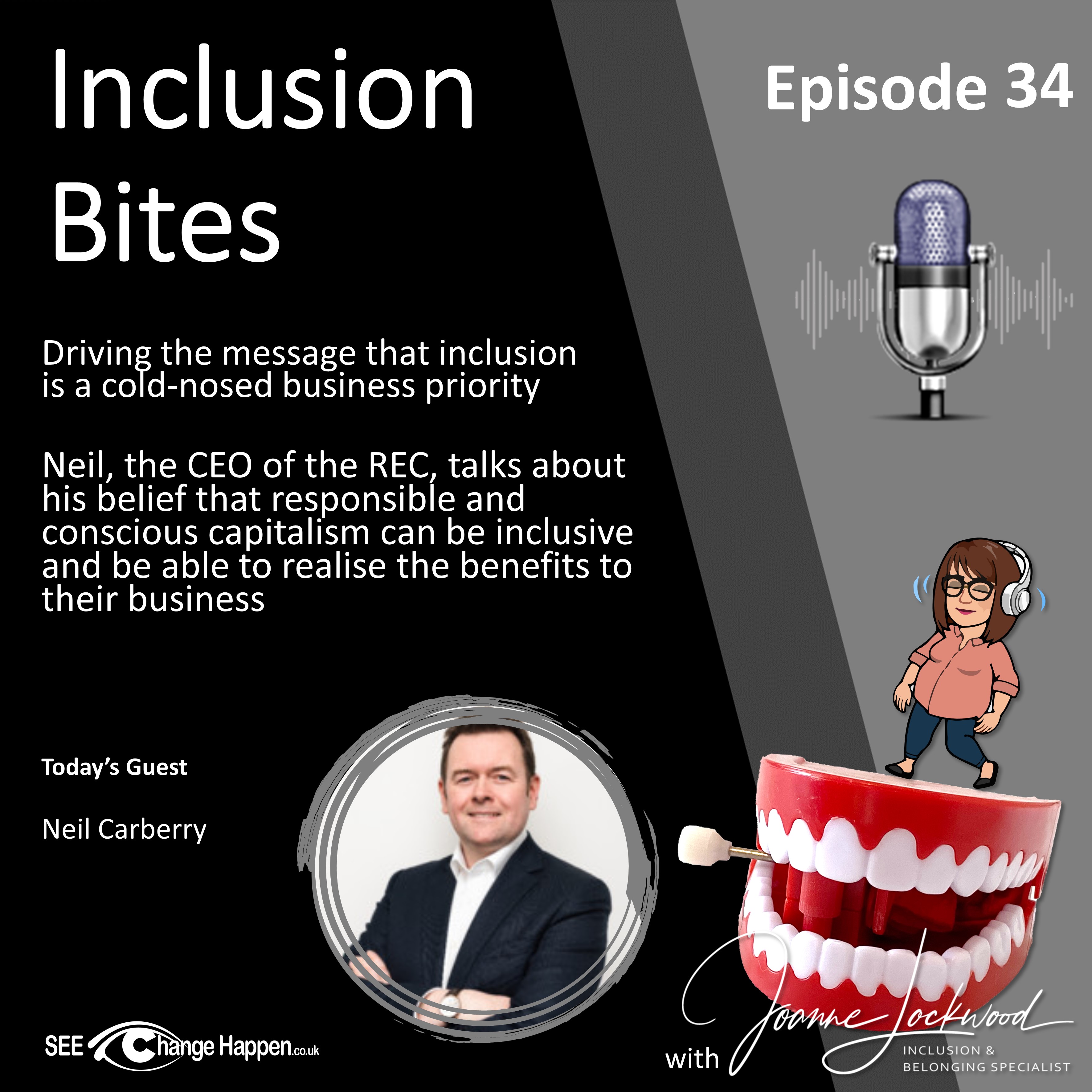
Driving The Message That Inclusion Is A Cold-Nosed Business Priority
with Neil Carberry · 08 April 2021
Inclusive Leadership Management
Joanne Lockwood is joined by Neil Carberry to explore why inclusion should be treated as a hard-edged business priority rather than a “nice to have” HR initiative.
They discuss how business performance, productivity, and reputation link to employees being able to bring their whole selves to work, and why leadership accountability matters more than statements or statistics. Neil shares practical reflections on what shifts behaviour: rewarding the right actions, challenging non-diverse shortlists, and building inclusion into line management and recruitment decisions.
The conversation also looks at post-pandemic working, including flexible and hybrid work as an inclusion tool, and what leaders need to do to listen to different workforce experiences rather than defaulting back to old norms. They touch on allyship and responsibility in the wake of events such as Black Lives Matter and Sarah Everard, as well as structural barriers in senior leadership pipelines and board appointments.
Finally, Neil outlines how the REC is encouraging higher standards in recruitment and advising clients to widen talent pools, challenge unnecessary requirements, and translate inclusion data into sustained action during the economic recovery.
About Neil Carberry
One-sentence summary
Neil Carberry believes that inclusion isn’t a favour to be granted but a responsibility to be owned — because businesses only thrive when people are seen, heard and allowed to bring their whole selves to work.
---
Synopsis (two paragraphs)
Neil Carberry sits at the intersection of business and people. He calls himself a “cold nosed” capitalist without apology, yet his story is threaded with something more personal: a working-class upbringing, a state comprehensive education where he learned to play the steel drum, and a long career watching how opportunity is granted — or withheld. He isn’t romantic about business, nor is he cynical about it. He has spent years observing boardrooms, HR directors and chief executives, asking quietly stubborn questions about why we claim “people are our greatest asset” and then treat them like stationery. What drives him is not trend or ideology, but fairness rooted in productivity: the belief that good work and good business are not opposites.
What he is trying to change is the habit of separation — the notion that business performance and human dignity are somehow competing goals. He wants leaders to stop leaving inclusion to HR and to start seeing it as the way business is done. He has seen the liberation of colleagues who no longer have to hide who they are on Monday mornings. He has watched how rigid hiring habits quietly favour the confident and culturally comfortable. For him, inclusion is about unlocking suppressed potential — and about refusing to build companies that work only for the already powerful. The stakes are economic, yes — but they are also deeply human.
---
10 Small, digestible concepts for easy learning
1. Business and society are not separate rooms.
A company survives only as long as the society around it allows it to.
2. People do their best work when they stop self-editing.
The energy spent hiding who you are is energy stolen from contribution.
3. If people matter, stop managing them like paper clips.
Systems reveal what you truly value.
4. Inclusion is leadership work, not HR homework.
Culture shifts when leaders change the rules.
5. Flexible working was never just for mums.
Inclusion done well benefits everyone.
6. Confidence often looks like competence.
Job adverts can reward boldness over ability.
7. Representation without cultural shift isn’t progress.
Changing faces but not norms keeps power intact.
8. You don’t have to fix everything — but you must signal direction.
Leaders set signposts through what they reward and challenge.
9. You will get it wrong sometimes.
Acting with good intent and listening earns forgiveness.
10. Recovery is a blank canvas.
Moments of disruption are chances to rebuild differently.
---
The “why” in the story
What they believe is true about people
Neil believes people want to contribute meaningfully, and that most underperformance is systemic, not personal. When treated with respect and clarity, people rise.
What they cannot unsee
He cannot unsee how traditional recruitment, governance and leadership pipelines quietly reproduce the familiar — rewarding those already at ease in the room. He cannot ignore the wasted potential of people excluded by confidence tests disguised as competence tests.
What they are no longer willing to tolerate
He is no longer willing to accept passive innocence — the idea that it’s enough to “not be part of the problem”. For him, neutrality is too comfortable.
What they are trying to build instead
He wants businesses that align personal ambition with organisational purpose, where productivity and humanity reinforce each other, and where inclusion is embedded in how decisions are made.
---
Narrative structure
1. The trigger
Years spent in boardrooms where numbers ruled the conversation — and watching talented colleagues hide parts of themselves just to survive those spaces. Hearing a colleague say the day he stopped worrying about “slipping up” about his weekend was liberating sealed it.
2. The tension
Business culture often prizes speed, certainty and numerical proof. Inclusion asks for listening, discomfort and long-term thinking. That friction is constant — especially among leaders trained to act fast and appear sure.
3. The insight
The breakthrough realisation: long-term competitiveness depends on human trust. Businesses with broader perspective, better governance and diverse challenge responded more nimbly to crisis. Inclusion is resilience.
4. The pivot
He began framing inclusion not as morality but as stewardship. He pushes recruitment firms to challenge job briefs. He urges leaders to ask, “Do you really need that requirement?” and to change the rules rather than issue slogans.
5. The destination
A business landscape where leadership feels human without losing rigour. Where young workers, disabled workers, minority workers see real pathways. Where the recovery is not just quick, but fair.
---
Five key takeaways and learning points
1. If you separate profit from people, you weaken both.
Companies that ignore the human dimension eventually erode trust, performance and reputation.
2. Leadership is about signposting, not solving everything.
What you reward, who you promote, and what you tolerate shapes culture more than statements.
3. Don’t confuse familiarity with merit.
Systems that replicate the same profiles limit innovation and opportunity.
4. Discomfort is part of growth.
If you’ve never had to think about an issue, that itself is privilege — and an invitation to engage.
5. Recovery is a moral crossroads.
Growth after crisis can entrench inequality — or address it.
---
Ten distinct ideas explained
1. Licence to operate
Businesses function because society allows them to. Ignoring social expectations risks reputational collapse and loss of trust.
2. Whole self productivity
When employees no longer spend energy masking identity, cognitive and emotional bandwidth is freed for creativity and problem-solving.
3. The myth of neutral structures
Board pipelines and finance-heavy routes aren’t neutral; they advantage those historically present.
4. Reward shapes culture
Inclusion accelerates when leaders visibly reject homogeneous shortlists or biased practices.
5. Confidence gaps are structural, not personal flaws
Over-written job descriptions deter those without cultural ease — often excluding diverse talent.
6. Flexibility as leveller
Remote and flexible work can radically improve access for disabled workers and carers — if maintained intentionally.
7. Anti-neutrality
It’s not enough to avoid wrongdoing. Active participation in fairness changes norms.
8. Listening as leadership muscle
Leaders using their “two ears and one mouth” build psychological safety and better decisions.
9. Long-term capitalism
Responsible business thinking balances shareholder return with societal stability.
10. Inclusion as economic strategy
There is measurable productivity in better recruitment and engagement — but the shift starts with mindset.
---
How people should change as a result
1. Think
- Move from “D&I is a project” to “Inclusion is how we operate.”
- See job requirements as choices, not inevitabilities.
- Recognise that comfort in a room is often inherited, not earned.
- Understand that neutrality maintains the status quo.
- View economic recovery as an ethical opportunity.
2. Feel
- Shift from defensiveness to curiosity.
- From fear of mistakes to courage in learning.
- From guilt to responsibility.
- From cynicism about “woke culture” to awareness of lived experience.
- From urgency for quick fixes to patience for cultural change.
3. Act
- Review a recent job description and strip out unnecessary barriers.
- Ask whose voice is missing before making a decision.
- Challenge homogeneous shortlists — send them back.
- Hold listening sessions before launching initiatives.
- Reward inclusive behaviour in performance reviews.
- Keep flexible working options that widen access.
- Start succession planning earlier to widen board pipelines.
---
One thing to remember
Inclusion isn’t charity — it’s how you build a business that deserves to exist.