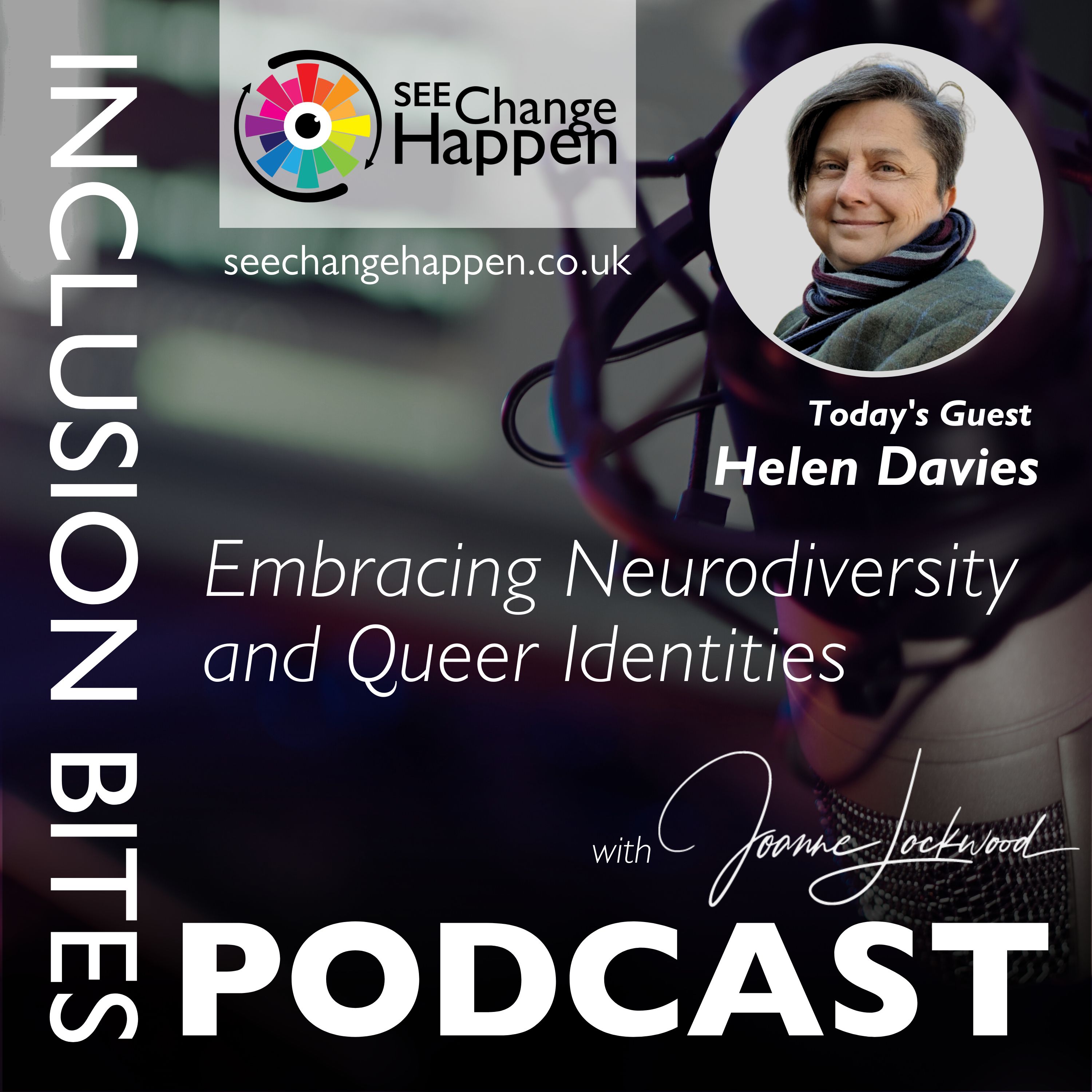
Embracing Neurodiversity And Queer Identities
with Helen Davies · 08 August 2024
Lived Experience Identity
Joanne Lockwood is joined by Helen Davies to explore the convergence of neurodiversity and queer identities, and what it can mean to navigate both at once. Helen shares how common the overlap can be within queer communities, and why visible, safe spaces and informed support matter for people who may be unsure about disclosing or seeking help.
Drawing on her work in healthcare and her lived experience as a gender fluid, neurodivergent person, Helen reflects on barriers people face, from fear of being judged to the practical reality of long assessment waiting lists. The conversation also touches on how institutional approaches can create additional hurdles, including how people can be made to feel they must “prove” aspects of identity in order to access care.
Together, Joanne and Helen discuss how language and symbols such as pronouns and sunflower lanyards can support inclusion, why many people worry about getting things wrong, and how generational shifts are changing everyday understanding. They also explore imposter feelings, confidence, and the importance of community and visibility, including Helen’s work supporting neurodivergent adults and helping organisations become more neuroinclusive.
About Helen Davies
One-sentence summary
Helen Davies is fighting for a world where no one has to prove they are “enough” — trans enough, neurodivergent enough, capable enough — just to be treated with dignity and allowed to thrive.
---
Synopsis
Helen Davies is a nurse of 36 years, a clinical director, a parent, and the founder of a not-for-profit supporting neurodivergent adults — but before any of that, she was a child in the bottom set at school who understood things quickly but couldn’t get them onto paper. She grew up under Section 28, remembers the fear of losing your job for being queer, and nursed patients dying during the AIDS crisis while witnessing homophobia at their bedside. She is dyslexic, has ADHD, and identifies as gender fluid. She came out as queer decades before she felt safe to disclose her neurodivergence. Even now, as a senior leader, she admits, “I still think I’ll be found out soon.”
What drives her is less about labels and more about safety. She has lived the cost of silence — the years of not disclosing, the frustration of unrealised potential, the quiet career calculations. She wants trans young people to have agency over their bodies. She wants neurodivergent adults to feel “validated and heard”. She is building visible signals of safety — a neurodivergent champion scheme, supportive communities, practical tools — because she knows how isolating it feels to think you are the only one. Beneath it all is a simple belief: difference is normal, and no one should have to prove themselves worthy of care.
---
10 Small, digestible concepts for easy learning
1. You can be both.
Being neurodivergent does not invalidate being trans or queer — identities can coexist without causing each other.
2. Proving yourself is exhausting.
Systems that require you to “tick enough boxes” erode dignity and agency.
3. Difference is not deficiency.
Struggling in one format does not erase brilliance in another.
4. Talk is a lifeline.
Helen passed nursing exams through conversation, not textbooks — connection was her learning strategy.
5. Imposter syndrome thrives in silence.
Even senior leaders who help hundreds of people can feel “I’ll be found out”.
6. Validation changes everything.
Being heard can be as powerful as being diagnosed.
7. Bias is human — cruelty is learned.
Awareness is what turns instinct into inclusion.
8. Visibility creates safety.
Knowing who is safe to approach reduces isolation.
9. Young people model what’s possible.
Many under 25 navigate gender and neurodiversity with ease older generations struggle to match.
10. Labels are tools, not prisons.
Use them to find your tribe and access support — not to limit someone’s humanity.
---
The “why” in the story
What they believe is true about people
Helen believes most people are not inherently bad — they may be misinformed, anxious or afraid. She believes difference is expected, not exceptional. She believes people thrive when they feel safe.
What they cannot unsee
She cannot unsee trans young people facing institutional prejudice. She cannot unsee the homophobia of the AIDS crisis. She cannot unfeel the frustration of sitting in the wrong set at school, labelled without support.
What they are no longer willing to tolerate
She will not accept being required to prove she is “trans enough”. She refuses the quiet discrimination that pushes neurodivergent people out of jobs. She is unwilling to let silence swallow potential.
What they are trying to build instead
Communities where people are “validated and heard”. Workplaces that adjust to humans rather than forcing humans into narrow definitions. Visible networks of safety that say: you are not alone here.
---
Narrative structure
1. The trigger:
Growing up queer under repression, working during the AIDS crisis, feeling the rug pulled from trans progress — and recognising, in her twenties, how different her life might have been with earlier dyslexia support.
2. The tension:
Living in a polarised climate. Feeling imposter syndrome despite senior achievement. Watching services strained and philosophies clash over autonomy. Navigating spaces that sometimes question whether she belongs at all.
3. The insight:
Diagnosis alone is not enough. People need validation, practical support and safe community. Inclusion is not about perfection — it’s about awareness and action.
4. The pivot:
She stopped hiding. She publicly named herself a “dyslexic tutor”. She founded a not-for-profit. She created a neurodivergent champion scheme so others can be visibly safe.
5. The destination:
A world where a child doesn’t sit bored in the bottom set. Where a trans person doesn’t have to prove their identity. Where someone can say “I’m neurodivergent” and be met with curiosity instead of caution.
---
Five key takeaways and learning points
1. Hiding costs energy.
When people feel unsafe to disclose, they spend cognitive effort on protection instead of growth.
2. Support changes trajectories.
The right intervention at the right time can unlock potential that has always been there.
3. Belonging reduces burnout.
Feeling validated is often more transformative than being labelled.
4. Fear narrows conversation.
When people are terrified of “getting it wrong”, they say nothing — and change stalls.
5. Visibility matters.
Seeing someone senior, competent and open about being neurodivergent or gender fluid quietly expands what feels possible.
---
Ten distinct ideas explained
1. Agency over your own body
The ability to choose what happens to your body is foundational to dignity. Removing agency communicates distrust.
2. Intersection is lived, not theoretical
Being queer and neurodivergent is not an academic overlap — it shapes how safe you feel in healthcare, work and family spaces.
3. The frustration gap
The larger the gap between someone’s capability and their performance environment, the more disabling the system becomes.
4. Imposter syndrome at the top
Achievement does not silence doubt. Systems that historically excluded people leave residue.
5. Conversation as cognition
Some people think best aloud. Recognising this reframes “chatty” as a learning strategy.
6. Diagnosis without support
A label might explain the past, but practical tools shape the future.
7. Safe signals
Visible markers — whether pronouns, lanyards or champion schemes — reduce guesswork and anxiety.
8. Generational language shifts
Younger generations move fluidly across terms because identity exploration is normalised.
9. Grief after discovery
Late diagnosis can bring mourning for unlived possibilities alongside relief.
10. Bias with awareness
Having bias is human. Naming it is the start of responsibility.
---
How people should change as a result
1. Think
- Move from “Are they legitimate?” to “What support would help them thrive?”
- Replace “This is complicated” with “This is new to me.”
- See diagnosis as a doorway, not a verdict.
- Recognise that proving oneself repeatedly is a hidden tax.
- Understand that inclusion is about reducing friction, not lowering standards.
2. Feel
- Shift from anxiety about mistakes to curiosity about difference.
- From defensiveness to openness.
- From pity to respect.
- From scepticism to empathy.
- From “us and them” to shared humanity.
3. Act
- Ask for pronouns or preferences — and respect the answer.
- Create spaces where disclosure is optional but safe.
- Offer information in more than one format (written, verbal, visual).
- Focus on strengths during performance conversations, not just gaps.
- Signpost visibly that your space welcomes neurodivergent and queer people.
- Check policies that require people to “prove” themselves repeatedly.
- When you don’t know, ask kindly instead of staying silent.
---
One thing to remember
No one should have to prove they are “enough” in order to belong.