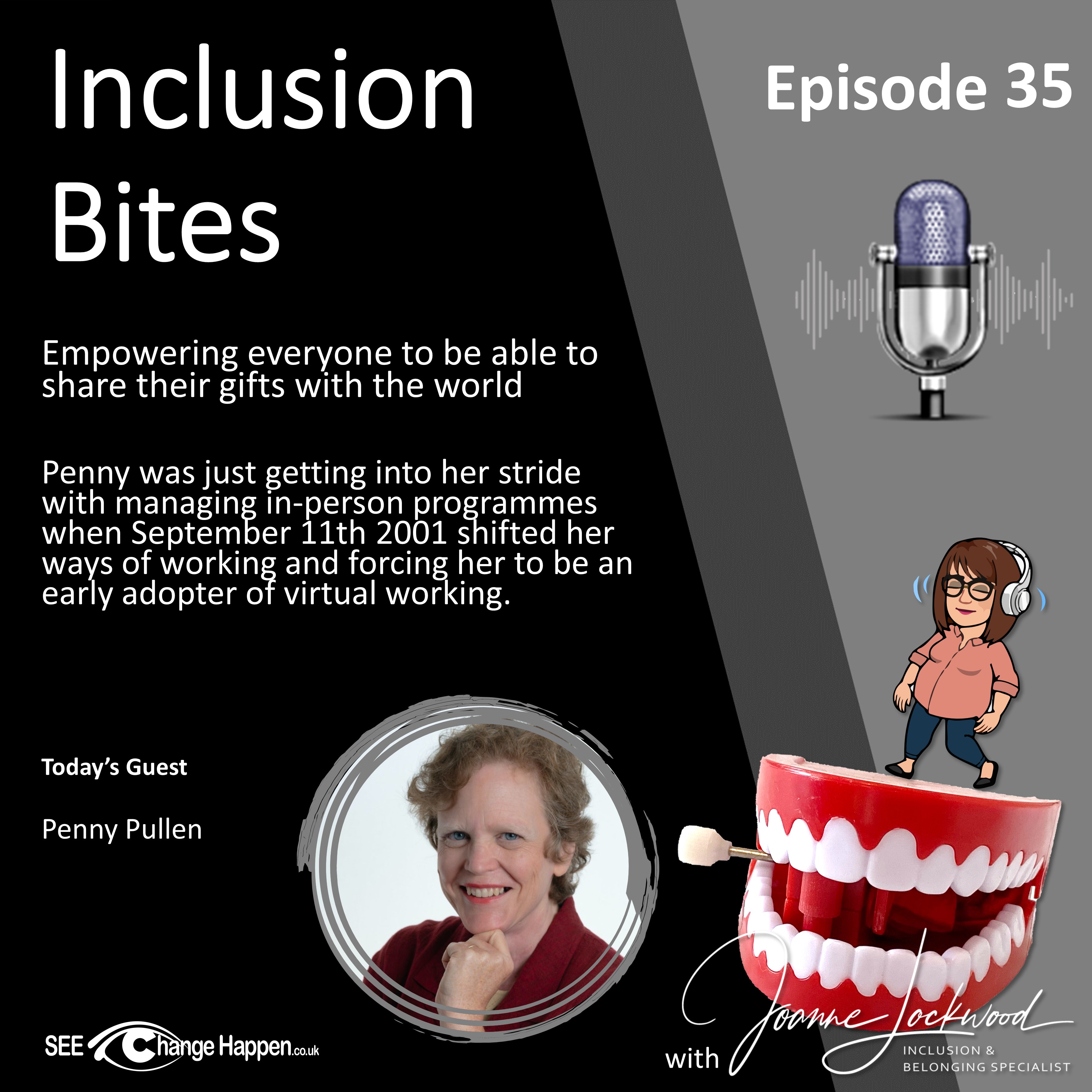
Empowering Everyone To Be Able To Share Their Gifts With The World
with Penny Pullen · 08 July 2021
Workplace Culture Systems
Penny Pullan joins Joanne Lockwood to explore what it takes to design and lead workshops and meetings where everyone can contribute their best work. Drawing on her early shift to virtual working after 9/11, Penny explains why effective virtual collaboration is more than simply stacking video calls, and how asynchronous working and better meeting design can be both more productive and more inclusive.
They discuss practical techniques for reducing the drain of back-to-back meetings, creating the right conditions for participation, and avoiding assumptions about what people need. Penny shares a simple planning approach that starts with purpose, then people, and only then process, plus a “magic six” set of meeting start-up questions to clarify aims, roles, ways of working, breaks, and what happens next.
The conversation also highlights inclusive communication and accessibility considerations, from avoiding culturally specific metaphors to checking for participants’ needs such as subtitles for deaf attendees or adaptations for blind participants. Throughout, the focus stays on making workshops work in person, virtually, or in hybrid formats, so teams can turn discussion into action.
About Penny Pullen
One-sentence summary
Penny Pullan believes that when we truly design with care for who people are — not who we assume them to be — we unlock their ability to share their gifts with the world.
---
Synopsis
Penny Pullan did not set out to become a voice for inclusive collaboration; she began as a project manager who simply wanted things to work. But when her first major programme was halted by 9/11 — her flight scheduled for two days after — she found herself forced to lead virtually, long before remote working was commonplace. In a world without Zoom and with barely-working video suites, she had to rely on careful listening, structure and trust. That disruption shaped her. Beneath the practical tools and books she would later write sits something quieter and more human: a deep respect for people’s differences and a determination to create spaces where each person can contribute at their best.
What Penny is trying to change is not just how meetings run; it is how people feel inside them. She has seen what happens when one voice dominates, when language excludes, when leaders cling to control from fear. She has even caught herself in those moments — shouting “shut up” in frustration and carrying that lesson for years. What she wants instead is simple but demanding: environments where the spotlight moves off the ego of the leader and onto the collective brilliance of the group; where we ask, “What do you need?” rather than “Can you cope?”; where work feels purposeful, humane and alive. For her, empowering people to share their gifts is about dignity — designing conditions where nobody has to squeeze themselves into someone else’s mould.
---
10 Small, digestible concepts for easy learning
1. Design for people, not for process.
Know your purpose, know your people, then build the method around them.
2. Control is often fear in disguise.
When leaders grip tightly, it’s usually anxiety — not authority — speaking.
3. Shift the spotlight.
Move attention from “I must perform” to “We will create this together”.
4. Inclusion begins with a question.
“What do you need?” opens more doors than “Are you okay?”
5. Stories teach better than checklists.
We remember moments of failure and courage more than bullet points.
6. Difference is practical, not abstract.
A right-handed pair of scissors can quietly exclude someone every day.
7. Language carries hidden weight.
Metaphors and idioms can isolate those who don’t share your cultural lens.
8. Energy matters as much as agenda.
Music, layout, breaks — they shape how safe and alive people feel.
9. Asynchronous working is respect in action.
Flexibility honours real lives — school runs, dogs, energy rhythms.
10. Belonging fuels better work.
When people feel considered, their eyes light up — and so does their contribution.
---
The “why” in the story
What they believe is true about people
Penny believes people want to do their best work. Given the right environment, each person has something valuable to offer.
What they cannot unsee
She cannot unsee how small design choices — timing, wording, room layout, who speaks first — either liberate or silence people.
What they are no longer willing to tolerate
She is no longer willing to accept boring, bruising, ego-driven meetings where one voice dominates and others shrink.
What they are trying to build instead
She is building collaborative spaces where difference is anticipated, care is built-in, and collective intelligence replaces performative control.
---
Narrative structure
1. The trigger:
9/11 halted her carefully laid plans and forced her to lead without proximity, authority or precedent. It demanded structure, empathy and innovation.
2. The tension:
The pull between “I must be in control” and “we can do this together”. The fear of losing authority. The reality of dominant personalities, cultural misunderstandings and her own human slip-ups.
3. The insight:
When the leader holds the spotlight, everyone else dims. When the spotlight shifts to the group, energy multiplies.
4. The pivot:
She moved from perfection and control to facilitation and shared ownership — asking the group how to proceed rather than forcing the plan.
5. The destination:
Work that feels collaborative, energising and fair — where people leave not drained, but having contributed something that mattered.
---
Five key takeaways and learning points
1. If you want better outcomes, design for belonging.
When people feel considered, they participate more fully and creatively.
2. Your methods reveal your values.
Breaks, timing and language show whether you respect real lives or just productivity.
3. Inclusivity lives in the details.
From subtitles to nut allergies to left-handed scissors — dignity is practical.
4. Authority works best when shared.
Inviting the room to solve a stuck moment builds trust and momentum.
5. Flexibility is not weakness.
Adjusting for a dog needing a break or a non-native speaker needing clarity is leadership, not compromise.
---
Ten distinct ideas explained
1. Purpose before process
Without clarity on why you’re meeting, structure becomes ritual. Purpose aligns energy and gives dignity to people’s time.
2. People before agenda
When we understand who is in the room — their strengths, needs and differences — the process becomes humane rather than rigid.
3. Psychological load of dominance
One overpowering voice steals both time and permission from others, shrinking collective intelligence.
4. The emotional cost of exclusion
A metaphor not understood, a tool not designed for you — these small moments accumulate into quiet alienation.
5. Permission to be human
Dogs barking, children interrupting — acknowledging life rather than denying it reduces shame and increases honesty.
6. Control as stress response
Leaders clinging to control often operate from fight-or-flight. Recognising this loosens its grip.
7. Visibility and validation
Writing actions where everyone can see them communicates, “You matter enough to be heard accurately.”
8. Energy design
Music, food and physical layout set emotional tone. Thoughtful design signals care.
9. Language as inclusion or exclusion
Idioms and cultural shorthand can close doors unconsciously; simple clear language invites more people in.
10. Shared ownership of direction
Asking, “What should we do?” transforms participants into co-creators rather than passive receivers.
---
How people should change as a result
1. Think
- Move from “How do I deliver this well?” to “How do they experience this?”
- See inclusion as a series of small practical decisions, not a grand statement.
- Recognise control as a feeling, not a necessity.
- Understand that flexibility often increases, rather than reduces, effectiveness.
2. Feel
- Shift from defensiveness to curiosity.
- Replace performance anxiety with shared responsibility.
- Move from unconscious assumption to thoughtful empathy.
- Let go of guilt and move towards intentional care.
3. Act
- Begin meetings by stating purpose clearly in simple language.
- Ask attendees upfront: “What do you need to be at your best today?”
- Start and end meetings with buffer minutes to protect energy.
- Use shared action notes that everyone can see and amend.
- Avoid idioms and metaphors that rely on cultural shorthand.
- Provide different ways to contribute — written, spoken, asynchronous.
- Regularly invite reflection mid-session: “Is this working for us?”
---
One thing to remember
When you design with care for who people truly are, you make room for their gifts to shine.