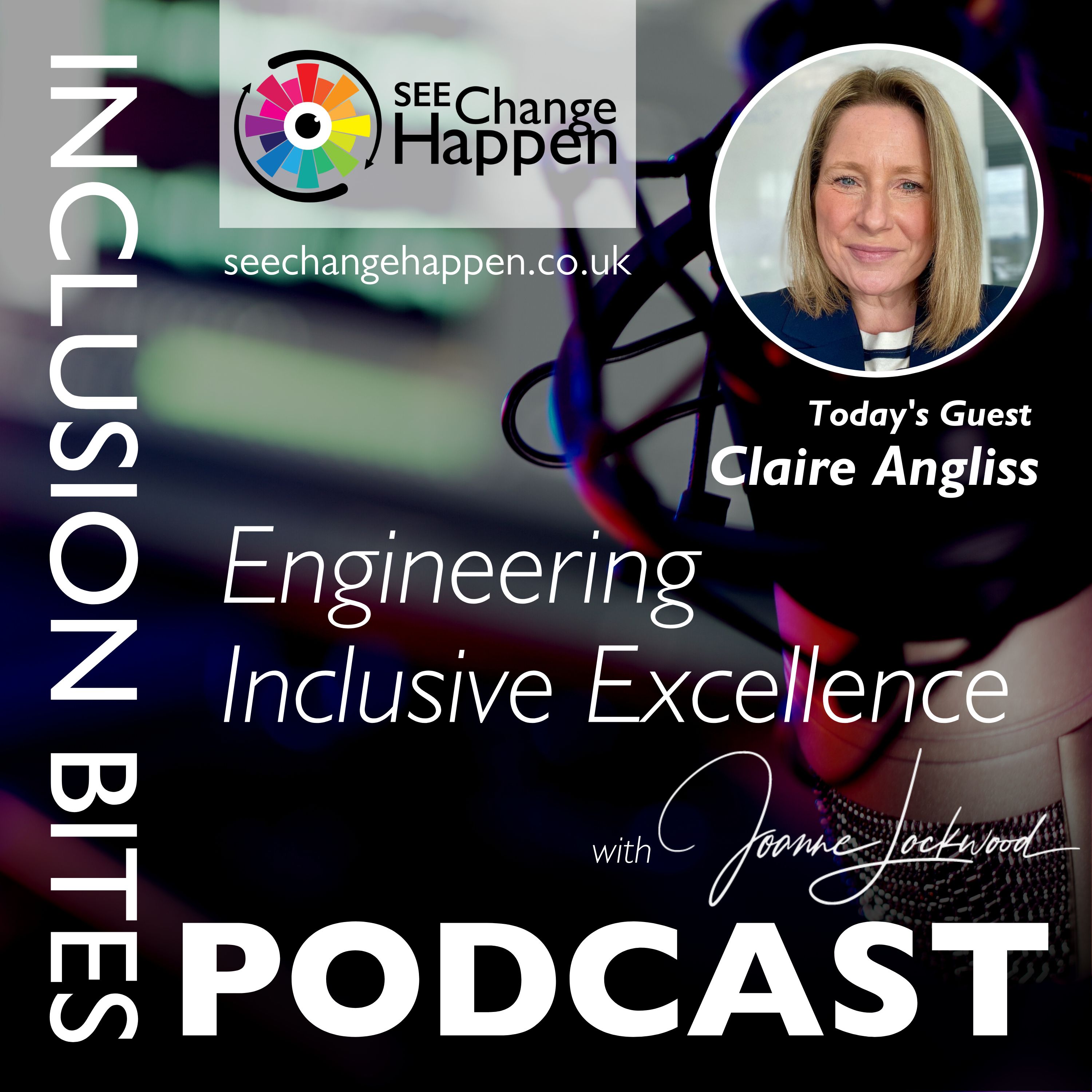
Engineering Inclusive Excellence
with Claire Angliss · 11 January 2024
Workplace Culture Systems
Joanne Lockwood is joined by Claire Angliss, Head of Learning for Thales UK and an inclusive coach, to explore what “inclusive excellence” looks like inside an engineering organisation.
They unpack the real-world tension behind “bring your whole self to work”, focusing on choice, masking, and the cognitive load created when people feel they must sanitise or hide parts of their lives. The conversation also looks at how leaders can respond when someone shares something personal: listening without trying to fix, and creating space where trust can grow.
Claire and Joanne then move into the organisational mechanics of inclusion: shifting from diversity as a headline goal to inclusion as a business-critical capability that improves problem-solving and innovation through collective intelligence. They discuss psychological safety, avoiding tokenism, and the need for robust talent and hiring processes that reduce bias, widen candidate pools, and value capability and growth over narrow “done it before” criteria.
Across the episode, the emphasis is on building cultures, policies, and leadership practices that make inclusion tangible and measurable, while being honest that progress is iterative and imperfect.
About Claire Angliss
One-sentence summary
Claire Angliss believes that true excellence isn’t about perfect policies or polished targets, but about creating workplaces where people are safe enough to be real — and brave enough to let others be.
---
Synopsis
Claire Angliss speaks with the steady honesty of someone who has seen both the awkwardness and the possibility in organisations trying to “do inclusion well”. As a leader of learning in a major engineering business, and as a coach in her own practice, she sits daily at the crossroads of ambition and vulnerability. What shapes her is not ideology but observation: people masking parts of themselves, leaders rushing to fix rather than listen, talented individuals quietly questioning whether they were promoted for who they are rather than what they can do. She chooses her words carefully — especially around authenticity — because she knows that asking someone to “bring their whole self to work” can be an invitation or a burden, depending on how safe the room really is.
What she is trying to change is deeper than representation. She wants leaders to understand that belonging is not a favour offered to marginalised groups; it is a condition that benefits everyone. She refuses to let inclusion become a marketing campaign or a numbers game. Instead, she is building cultures where people are measured with fairness, where difference strengthens decision-making, and where no one feels that the cost of entry is hiding who they are. For her, the stakes are emotional as much as commercial: the quiet weight of impostor syndrome, the fatigue of being “the first”, the damage done when someone’s truth is met with discomfort rather than care. She is not chasing perfection — she is building momentum towards dignity.
---
10 Small, digestible concepts for easy learning
1. Authenticity is a choice, not an obligation.
No one should be pressured to disclose more than feels safe to them.
2. Belonging means not paying a psychological tax.
If masking causes pain, the environment needs to change.
3. Listening without fixing is leadership.
Sometimes the most powerful response is simply, “Thank you for sharing.”
4. Diversity without safety is performance.
Representation means little if people cannot speak freely once inside.
5. Inclusion is everyone’s job.
It is not the burden of marginalised people to change the room.
6. Merit feels different depending on who defines it.
Standards can unintentionally narrow the doorway.
7. Innovation comes from difference, not comfort.
Same backgrounds create same answers.
8. Impostor syndrome often grows in mixed messages.
When inclusion is loud, some people quietly question if they earned their place.
9. Honesty builds trust faster than perfection.
Admitting “we’re not there yet” invites credibility.
10. Culture is revealed in conversation.
How we react when someone shares their truth tells the real story.
---
The “why” in the story
What they believe is true about people
Claire believes most people want to do the right thing — but they often don’t know how. Given clarity, compassion and courage, people rise.
What they cannot unsee
She cannot unsee the emotional burden of masking, nor the quiet doubt of someone wondering if they were promoted only because they ticked a box.
What they are no longer willing to tolerate
Superficial campaigns, token photographs, and “perfect” narratives that ignore lived complexity.
What they are trying to build instead
Workplaces where difference fuels collective intelligence, where promotion feels earned and supported, and where people can speak without fearing they’ve stepped outside the norm.
---
Narrative structure
1. The trigger:
Moments where inclusion was spoken about enthusiastically — yet people still felt they couldn’t fully share themselves. Leaders wanting authenticity, but environments not yet ready for it.
2. The tension:
Balancing commercial realities with human dignity. Wrestling with perceptions of tokenism. Supporting underrepresented talent without reinforcing the myth that they are “second best”.
3. The insight:
Inclusion is not about spotlighting difference; it is about widening the room so difference becomes normal. And excellence improves when perspectives multiply.
4. The pivot:
Embedding collective intelligence into leadership development. Challenging hiring assumptions. Being transparent about gaps instead of hiding them.
5. The destination:
A workplace where walking into a room as “the first” is no longer exhausting — where innovation feels collaborative and people describe their employer with pride and ease.
---
Five key takeaways and learning points
1. Safety isn’t declared — it’s demonstrated.
So what? Your reaction in small moments shapes whether someone ever speaks honestly again.
2. Targets alone don’t build trust.
So what? Without development and sponsorship, representation feels hollow.
3. Question the specification, not just the candidate.
So what? Capability can be grown; gatekeeping talent limits potential.
4. Inclusion includes the majority too.
So what? If people feel excluded from the inclusion conversation, resistance grows.
5. Transparency beats spin.
So what? Admitting imperfection strengthens credibility and attracts believers.
---
Ten distinct ideas explained
1. Psychological safety as shared responsibility
It isn’t owned by HR; it lives in everyday interactions. A careless joke or dismissive tone can close someone down for months.
2. The cognitive load of hiding
Creating cover stories drains energy. When people don’t have to edit themselves, that energy returns to innovation.
3. Impostor syndrome and identity
When promotion follows diversity efforts, some quietly ask, “Was it really me?” That doubt shapes confidence and performance.
4. Collective intelligence
When lived experiences differ, blind spots shrink. Decisions improve because assumptions are tested.
5. Intersectionality as lived complexity
No one is only one identity. Ignoring overlap oversimplifies people’s reality.
6. Honest storytelling in employer branding
People look for truth, not perfection. Admitting where you struggle signals maturity.
7. Challenging meritocracy myths
Criteria built around past patterns protect sameness more than excellence.
8. Inclusion fatigue
Being the “only one” repeatedly is draining. Responsibility must be shared across the room.
9. Development as proof of intent
Real inclusion shows up in training, sponsorship and progression — not just recruitment.
10. Leading from care, not critique
Challenging bias works best when it comes from curiosity and commitment, not accusation.
---
How people should change as a result
1. Think
- Move from “Are we diverse?” to “Do people feel safe here?”
- See job specifications as living tools, not fixed barriers.
- Recognise that excellence grows when perspectives multiply.
- Understand that authenticity cannot be mandated — only enabled.
2. Feel
- Shift from defensiveness to curiosity about bias.
- Move from guilt to shared responsibility.
- Replace fear of “getting it wrong” with willingness to learn.
- Let empathy replace the urge to fix.
3. Act
- When someone shares something personal, respond with gratitude first.
- Review a job description and ask, “Is every criterion essential?”
- Invite different voices into problem-solving meetings.
- Challenge a colleague’s assumptions gently but directly.
- Sponsor someone whose background differs from yours.
- Say openly, “We don’t have this right yet, but we’re working on it.”
- Build development paths, not just recruitment campaigns.
---
One thing to remember
Inclusion is not about spotlighting difference — it’s about widening the room so no one has to shrink to fit inside.