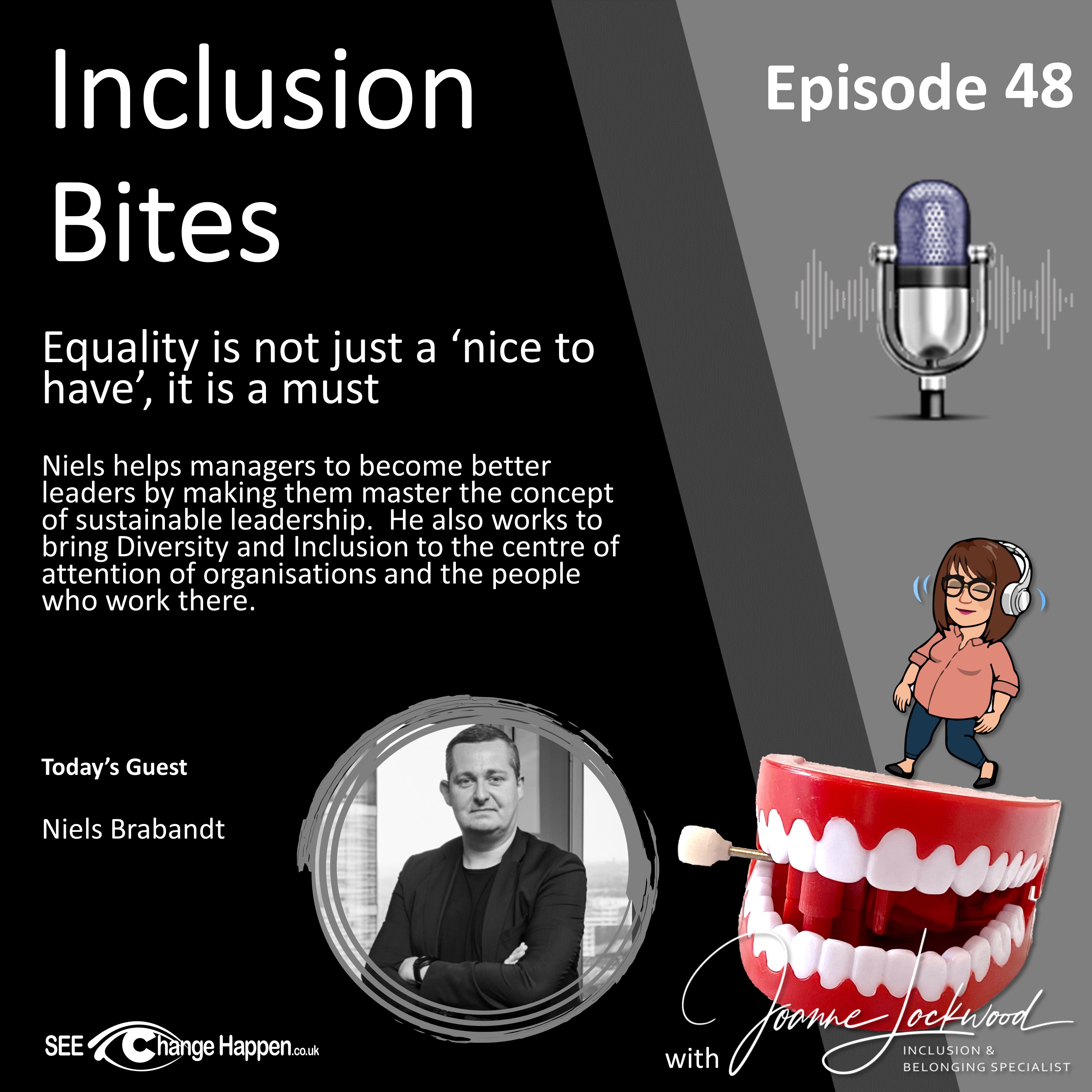
Equality Is Not Just A ‘Nice To Have’, It Is A Must
with Niels Brabandt · 18 November 2021
Inclusive Leadership Management
Joanne Lockwood is joined by leadership and sales specialist Niels Brabandt to challenge the idea that equality, diversity and inclusion is a “nice to have” in organisations. They discuss how EDI is frequently underfunded and treated as a compliance exercise, and why low-budget, click-through e-learning on unconscious bias rarely creates meaningful change.
Together they explore what leaders are accountable for: investing properly in development, creating safe spaces for honest questions, and recognising the business and human impacts of exclusion. They unpack how hiring and promotion practices often rely on networks and perceived “meritocracy”, reinforcing who gets access to opportunity and who is kept out.
The conversation also touches on cultural competence, reputation risk when senior leaders dismiss bias or use harmful language, and why social legitimacy matters more than titles in modern leadership. They close by arguing for practical, ongoing training and leadership decisions that shift systems, not just statements.
About Niels Brabandt
One-sentence summary
Niels Brabandt believes equality is non-negotiable because he has seen how easily power protects itself, and he refuses to accept a world where people’s futures are decided by networks and accidents of birth rather than their true capability.
---
Synopsis
Niels Brabandt is a leadership adviser who speaks with the clarity of someone who has lived on both sides of belonging. He grew up in Germany in a family where university wasn’t a given, where pushing for education felt like a turning point rather than a default. He came out as gay at 19 while building a career as a professional referee, and he watched support quietly recede. Later, as a migrant professional in the UK, he noticed how something as arbitrary as a passport or postcode could shift how seriously he was taken. He has experienced privilege that opened doors — and prejudice that tried to close them.
What drives him now is not abstract policy but accountability. He is trying to interrupt the quiet systems that reward the well-connected, protect the comfortable and punish the different. He wants leaders to stop hiding behind titles, tradition and “the way it’s always been done”, and to understand that when they ignore inequality, they are actively harming their organisations and the people within them. For Niels, equality is not about punishment or replacement — it’s about restoring dignity, credibility and fairness before the damage becomes irreversible.
---
10 Small, digestible concepts for easy learning
1. Privilege is often invisible to the person who has it.
You don’t notice the doors that open easily for you until you watch someone else struggle with the same handle.
2. Meritocracy only works if the starting line is the same.
If opportunities are inherited unevenly, outcomes can’t be called “pure merit”.
3. Equality without investment is just rhetoric.
If there’s no budget, no time and no training, the commitment isn’t real.
4. Silence protects systems, not people.
When leaders say nothing, they quietly endorse the status quo.
5. Titles don’t create leaders — trust does.
People follow those who earn social legitimacy, not those who rely on rank.
6. Ignoring inequality is a choice.
When evidence is clear and action is avoided, that avoidance becomes harm.
7. Education isn’t political correctness — it’s competence.
If you refuse to learn, you choose ignorance.
8. Networks can become gated communities.
What feels like loyalty can quietly become exclusion.
9. Fear of change often masks fear of losing advantage.
Resistance sometimes comes from those who know the system benefits them.
10. Sales is persuasion with responsibility.
If you care about change, you must learn how to influence hearts as well as minds.
---
The “why” in the story
What they believe is true about people
Niels believes most people are capable of fairness — but systems reward comfort and familiarity unless we actively disrupt them.
What they cannot unsee
He cannot unsee how networks, labels and assumptions quietly shape who gets ahead, regardless of ability.
What they are no longer willing to tolerate
He is no longer willing to tolerate leaders who dismiss bias, who hide behind tradition, or who claim things are “going well” while people are locked out of opportunity.
What they are trying to build instead
He is trying to build organisations where leadership is earned socially and ethically, where talent is recognised beyond background, and where equality is treated as foundational — not optional.
---
Narrative structure
1. The trigger
Coming out as a young referee and feeling support shift; moving countries and noticing stereotypes work in his favour; watching senior leaders publicly deny bias. These moments sharpened his conviction that inequality is neither accidental nor harmless.
2. The tension
He repeatedly meets resistance — leaders who plead budget constraints, executives who claim meritocracy is intact, individuals who feel attacked by calls for change. He sees fear dressed up as logic.
3. The insight
Facts alone don’t shift systems. People protect advantage — even when it contradicts evidence — and real leadership requires confronting that truth.
4. The pivot
He stopped being polite about avoidance. He calls it out directly: if you ignore science, if you refuse to train, if you protect unfair advantage, you are unfit to lead.
5. The destination
A culture where no one’s career depends on postcode, passport, gender or inherited networks — where diversity is normal, not defensive, and where leadership feels credible and earned.
---
Five key takeaways and learning points
1. If equality has no budget, it has no priority.
So what: Real care is measured in investment, not statements.
2. Your network should not determine your worth.
So what: Look at who gets access — not just who gets praise.
3. Fear of saying the wrong thing is solved by learning, not silence.
So what: Competence reduces anxiety.
4. Privilege is about barriers you never met.
So what: Someone else’s struggle might include obstacles you never saw.
5. Leadership without accountability becomes damage.
So what: Ignoring bias doesn’t keep the peace — it builds future crises.
---
Ten distinct ideas explained
1. Human rights are not optional extras.
When organisations treat equality as a side project, they subtly signal that dignity can wait.
2. Social mobility is fragile.
Careers are often shaped long before interviews — by education, geography and networks.
3. Unfair advantage demotivates entire teams.
When promotions feel predetermined, effort quietly drains away.
4. Symbols matter.
Statues, leadership line-ups and board photos communicate who belongs and who doesn’t.
5. Intent does not cancel impact.
Clumsy language from powerful leaders carries weight, regardless of motive.
6. Change feels threatening to those benefiting most.
That discomfort is not proof of injustice — it’s proof of adjustment.
7. Evidence doesn’t persuade those protecting power.
Data challenges identity; identity defends itself.
8. Belonging shapes performance.
People who feel seen contribute differently — more boldly, more creatively.
9. Exclusion is cumulative.
It’s rarely one event; it’s a pattern of small gates that never fully open.
10. Accountability protects culture.
When leaders who deny bias face consequences, it resets expectations for everyone.
---
How people should change as a result
1. Think
- Move from “Is this fair to me?” to “Who isn’t here, and why?”
- See privilege as structure, not insult.
- Understand that tradition is not evidence of merit.
- Accept that investing in equality prevents bigger future costs.
2. Feel
- Shift from defensiveness to curiosity.
- Move from guilt to responsibility.
- Replace fear of being wrong with willingness to learn.
- Trade cynicism for long-term care about fairness.
3. Act
- Fund and prioritise live, interactive inclusion learning — not tick-box modules.
- Audit leadership pipelines for patterns of sameness.
- Mentor someone outside your usual network.
- Question promotion criteria that rely on pedigree over potential.
- Interrupt exclusionary language gently but clearly.
- Create spaces where people can ask difficult questions safely.
- Publicly support accountability when leaders cross the line.
---
One thing to remember
Equality is not about taking something from you — it’s about refusing to let unfair advantage decide someone else’s future.