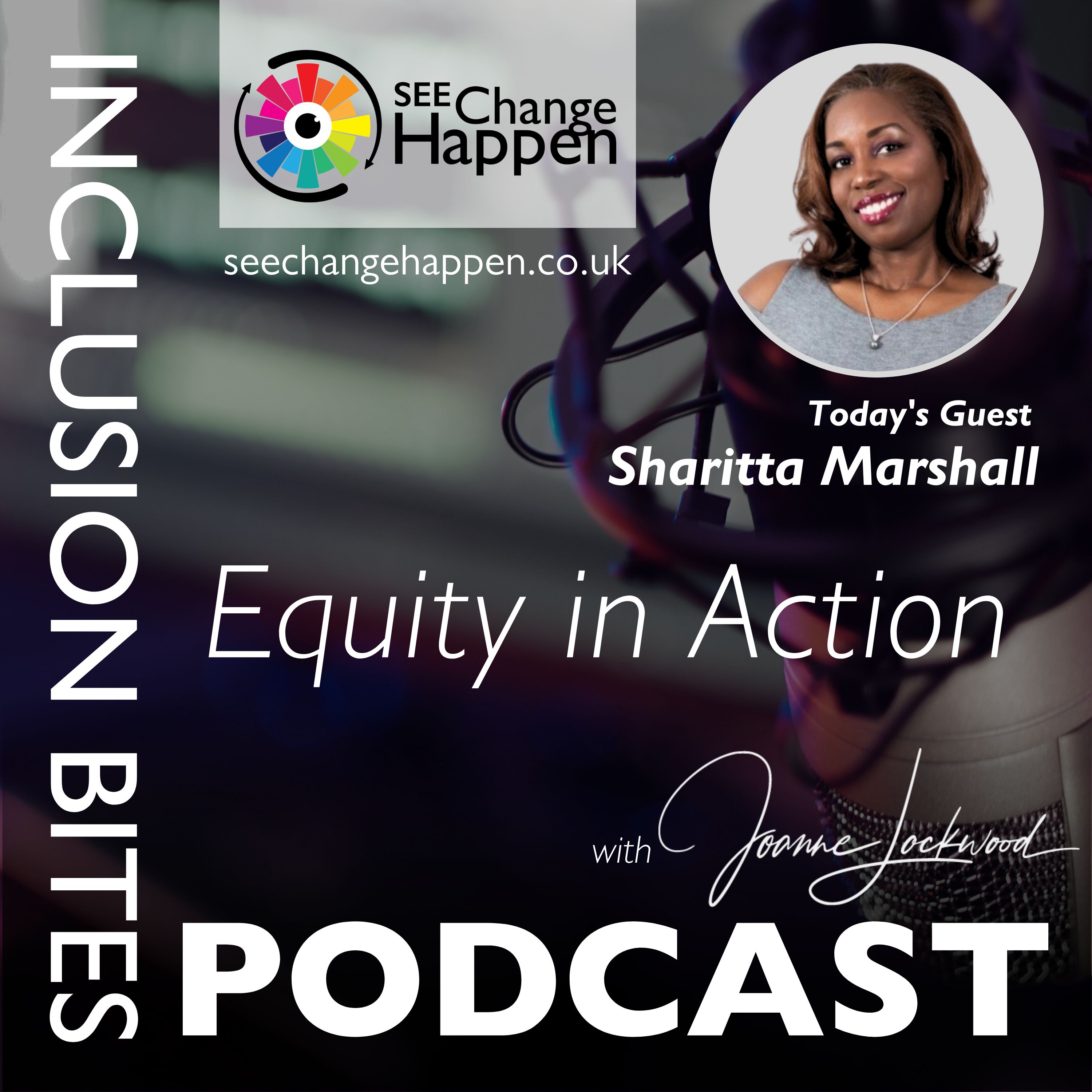
Equity In Action
with Sharitta Marshall · 19 September 2024
Workplace Culture Systems
Joanne Lockwood is joined by Sharitta Marshall, founder of Visionary Development Consulting, for a wide-ranging conversation about what “equity in action” really looks like inside organisations.
Sharitta challenges the myth of meritocracy and unpacks how privilege and systemic inequities shape who gets access to opportunity, resources, and decision-makers. Together they explore why equality-based approaches often fail in practice, and why equity requires intentional plans, appropriate support, and a clearer understanding of diverse lived experiences.
A central focus is the role Employee Resource Groups can play when they are treated as strategic business units rather than social clubs. Sharitta outlines what effective ERG programmes need: alignment to business priorities, clear goals and metrics, proper funding, defined roles and responsibilities, onboarding and succession planning, and executive sponsorship that actively removes barriers and opens doors to spaces, places, and people.
They also discuss the broader political and economic context influencing DEI pushback, including the impact of anti-Blackness and policy trends, and why organisations often only respond when the costs are made tangible. The episode closes with a practical call to quantify the real financial impact of turnover and poor employee experience, and to use that data to sustain meaningful culture change.
About Sharitta Marshall
One-sentence summary
Sharitta Marshall is fighting for a world where no one has to be traumatised to earn a living, and where access to opportunity is not determined by what you were born into.
---
Synopsis
Sharitta Marshall speaks with the steadiness of someone who has seen systems from the inside. A mother to a daughter with dyslexia, a Black woman navigating corporate spaces, and a former global ERG leader who belonged to five networks while leading one, she understands what it means to live at intersections. When she talks about equity, it isn’t abstract. She describes teaching her child to read English — explaining silent letters and contradictory spellings — and realising how easily people say “just learn the language” without grasping the effort required. She has learned, personally and professionally, that hardship and privilege can exist side by side. As she puts it, “Privilege is not the erasure of hardship… it just means there are not systemic inequities you have to deal with on a daily basis.”
What she is trying to change is not only policy, but perspective. She wants organisations to stop treating inclusion as a club, a favour, or a moral accessory — and instead see it as structure, access, and dignity. She refuses the idea that people must be “continually traumatised in order to pay your bills.” Her work pushes leaders to confront the hidden costs of exclusion: churn, mistrust, disengagement, lost talent, lost futures. At the heart of it all is her conviction that “we are all connected” and that liberation is indivisible: “It’s liberation for all or liberation for none.”
---
10 Small, digestible concepts for easy learning
1. Privilege isn’t the absence of pain — it’s the absence of added barriers.
You can struggle and still not face systems stacked against you.
2. Equality gives everyone shoes; equity checks who can actually run.
The same resource doesn’t produce the same outcome.
3. Access changes everything.
“Spaces, places, and people” determine who rises and who remains invisible.
4. Language is power.
When people don’t understand terminology or lived experience, exclusion thrives.
5. Belonging requires structure, not sentiment.
Good intentions without accountability achieve very little.
6. Exit interviews are human stories disguised as data.
Every resignation hints at something broken.
7. Liberation is interconnected.
Harm to one group eventually affects everyone.
8. If people can’t see what’s in it for them, they won’t listen.
Change must connect to people’s lived incentives as well as their values.
9. Representation without sponsorship is symbolic.
Real equity opens doors in rooms you’re not in.
10. You don’t have to traumatise people to make money.
Profit and dignity can coexist.
---
The “why” in the story
What they believe is true about people
People are capable of empathy when they truly understand one another. And when given access, support and visibility, people rise.
What they cannot unsee
That systems quietly advantage some while exhausting others — and that exclusion has a measurable emotional and financial cost.
What they are no longer willing to tolerate
The idea that fairness is a zero-sum game. The normalisation of burnout, churn and quiet harm in the name of performance.
What they are trying to build instead
Organisations where equity is embedded in structure, where sponsorship is active, and where nobody has to shrink themselves or endure harm just to survive.
---
Narrative structure
1. The trigger
Teaching her dyslexic daughter to read English — and seeing how casually people dismiss learning as “just try harder.” Leading one employee network while belonging to five, and understanding how identity overlaps in real life.
2. The tension
Persistent pushback. Political hostility. Budgets cut. The belief that if someone gains, someone else must lose. The fatigue of explaining the same truths repeatedly.
3. The insight
People respond when they see impact. Moral arguments alone rarely shift power; tangible consequences do. “Here is the cost,” she insists — whether that cost is lost talent, disengagement, or reputational harm.
4. The pivot
Moving from abstract arguments about diversity to quantifiable realities. Framing equity not only as right, but necessary — and insisting executive sponsors know their responsibilities.
5. The destination
Workplaces where access is normalised, where ERGs are respected as strategic forces, and where the working class is no longer worn down in service of late-stage capitalism. A world where freedom isn’t selective.
---
Five key takeaways and learning points
1. Hardship and privilege can coexist.
So what: Recognising your advantage doesn’t invalidate your struggle — it clarifies it.
2. Equity is about access, not favouritism.
So what: When people have the tools they need, performance becomes more authentic and sustainable.
3. Unseen harm has real costs.
So what: Disengagement, silence and resignation are signals, not inconveniences.
4. Allyship needs instruction.
So what: Telling people exactly how to help makes action more likely.
5. Change is a long game.
So what: Staying committed, even when progress feels glacial, matters because systems shift slowly — until they don’t.
---
Ten distinct ideas explained
1. Systemic inequity
It’s not about one decision; it’s about daily friction. Barriers that exhaust people before they even begin to compete.
2. Meritocracy myth
People assume the race started equally. It didn’t. Some carry weight others never see.
3. Executive sponsorship
True support means advocating when someone is not present — opening doors beyond visibility.
4. Psychological safety
When people can speak without fear, insight flows. When they cannot, the organisation goes blind.
5. Intersectionality
No one is just one identity. An attack on one part of someone affects the whole person.
6. Capitalism without conscience
Systems can generate wealth while eroding wellbeing. The human cost is often normalised.
7. Data as leverage
Numbers translate human stories into language organisations cannot ignore.
8. Belonging as retention strategy
When people feel seen, they stay. When they feel invisible, they leave — emotionally first.
9. Ally clarity
Ambiguous support leads to inaction. Specific asks create movement.
10. Collective fate
Geography doesn’t isolate us; economic and social consequences ripple outward.
---
How people should change as a result
1. Think
- Move from “Is this fair?” to “Who is this working for — and who is it quietly failing?”
- Replace “I struggled too” with “What barriers didn’t I face?”
- See turnover figures as indicators of culture, not inevitability.
- Understand equity as structural design, not moral charity.
- Recognise that liberation is collective, not selective.
2. Feel
- Shift from defensiveness to curiosity.
- From guilt to responsibility.
- From apathy to quiet urgency.
- From competition to shared fate.
- From fatigue to long-term commitment.
3. Act
- Audit who has access to “spaces, places and people” in your organisation.
- Ask departing employees why they truly left — and act on patterns.
- Clarify expectations for executive sponsors in writing.
- Publicly state how allies can contribute — make it simple and specific.
- Invest in leadership development for those historically overlooked.
- Share lived stories alongside metrics to humanise data.
- Measure inclusion as rigorously as sales.
---
One thing to remember
You do not have to traumatise people to make money — dignity and success can coexist.