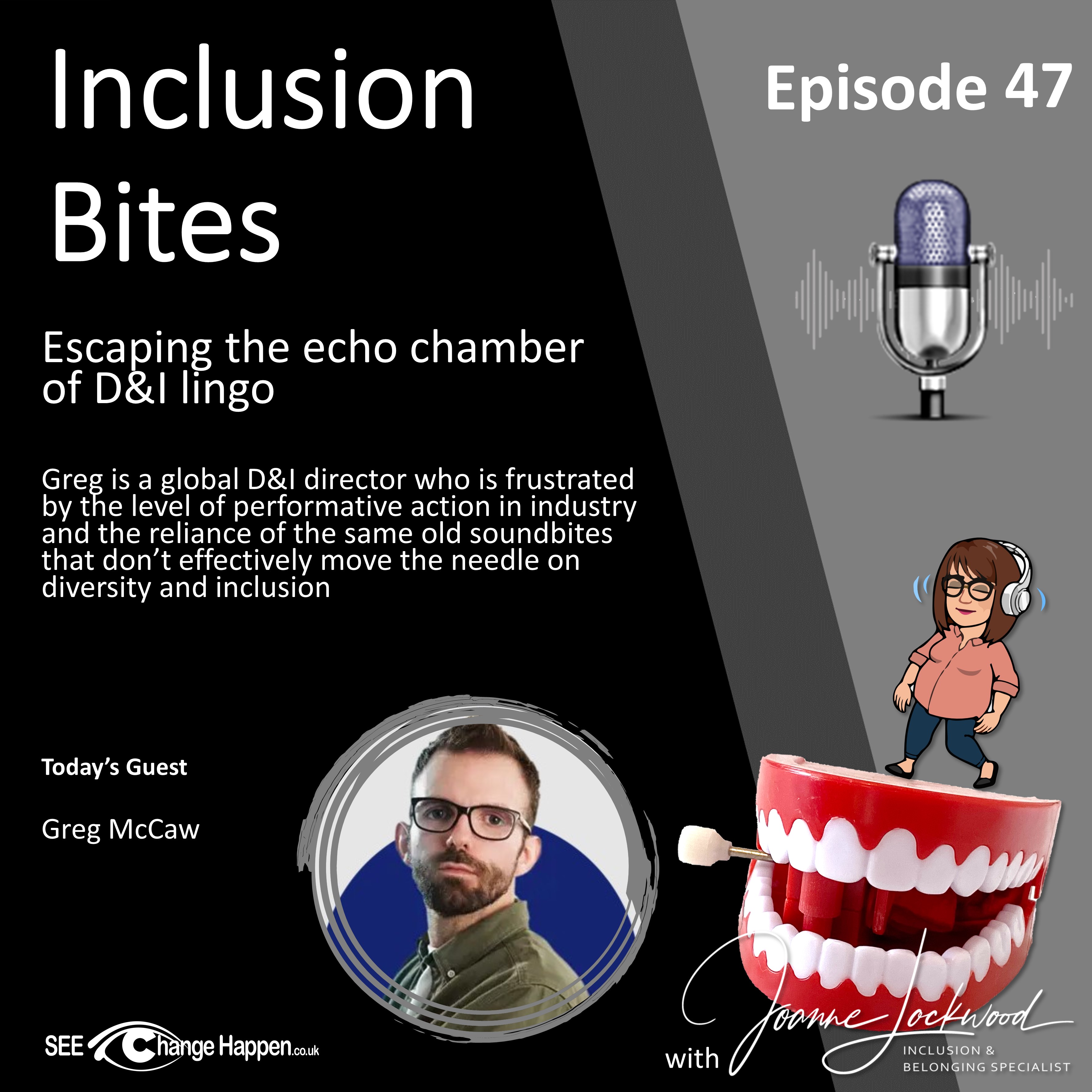
Escaping The Echo Chamber Of D&I Lingo
with Greg McCaw · 11 November 2021
Workplace Culture Systems
Joanne Lockwood speaks with Greg McCaw about how DEI work can get stuck in an echo chamber of familiar phrases that sound positive but aren’t always explained in a way that helps non-specialists take action. They explore common terms such as “bring your authentic self to work,” “allyship,” “intersectionality,” and “psychological safety,” and why organisations need to translate these into clear expectations, behaviours, and measurable signals.
They discuss how culture change happens through everyday decisions rather than one-off training, and why DEI efforts can become performative if external statements and campaigns aren’t backed up by employees’ lived workplace realities. Greg argues for focusing on business outcomes, testing and learning, and building reinforcement mechanisms across the employee lifecycle so progress is sustained.
The conversation also covers using data and engagement insights responsibly: breaking results down across different groups to spot experience gaps, asking uncomfortable questions, and using real-time feedback loops to enable managers and leaders to respond quickly. They close by reflecting on hybrid working and the opportunity to redesign culture and employee experience so remote and in-office colleagues have equitable access to opportunity and connection.
About Greg McCaw
One-sentence summary
Greg McCaw is driven by a simple, stubborn belief: if we’re serious about fairness, we must stop hiding behind polished language and start changing the everyday experiences that quietly decide who thrives and who stalls.
---
Synopsis
Greg doesn’t present as a crusader. He leads with humour, disarming warmth and a steady patience that comes from sitting in rooms where change is both desperately needed and quietly resisted. He has watched well‑meaning organisations cling to big, beautiful statements while the lived reality of their people tells a different story. What shapes him isn’t ideology — it’s the gap. The gap between what leaders say and what colleagues feel. The gap between ambition and action. The gap between “this is for everyone” and the people who still don’t see themselves reflected in opportunity.
What Greg is trying to change is not just policy, but integrity. He wants workplaces where the promise matches the practice — where “bring your authentic self” isn’t a slogan but a system designed to support difference. He cares because he knows what happens when responsibility is pushed onto the very people who are already carrying the weight. He is trying to build organisations where power is engaged, not shamed; where data tells the truth; and where progress is measured by experience, not theatre.
---
10 Small, digestible concepts for easy learning
1. Language without action becomes exclusion.
If people don’t understand the words, they can’t act on them.
2. Authenticity is not a slogan — it is a structure.
You cannot ask someone to be themselves in a system that subtly punishes difference.
3. Privilege is influence — and influence can be used well.
Powerful people are not the enemy; disengaged power is.
4. Don’t outsource change to the vulnerable.
If only underrepresented groups carry the responsibility for inclusion, nothing truly shifts.
5. Data should reveal reality, not protect comfort.
If you can’t see who is thriving and who is stalled, you’re choosing not to look.
6. Grand gestures don’t fix daily friction.
Culture changes in small decisions, not all‑hands applause.
7. Progress beats PR.
External promises must reflect internal truth.
8. One‑off training is a theatre performance.
Change happens when learning is embedded, revisited and reinforced.
9. Different people experience the same workplace differently.
Assuming one shared reality is the fastest route to blind spots.
10. Testing and learning is not weakness — it’s maturity.
Admitting something didn’t work is the beginning of improvement.
---
The “why” in the story
What they believe is true about people
Greg believes most people want to do the right thing — but they cannot act on words they don’t understand or systems they don’t see.
What they cannot unsee
He cannot unsee the disconnect between glossy diversity statements and the quiet, everyday inequities in pay, promotion and opportunity.
What they are no longer willing to tolerate
He refuses to tolerate performative commitment — branding without behavioural change, or strategies copied from elsewhere without understanding lived reality.
What they are trying to build instead
He is building environments where ambition is tied to measurable experience — where leaders continuously ask who is being left out, and fix it.
---
Narrative structure
1. The trigger
Repeatedly witnessing how phrases like “psychological safety” and “authentic self” were used as shorthand — assumed to mean something concrete while behaviour remained unchanged.
2. The tension
The emotional conflict of advocating passionately for equity, while knowing that anger in the boardroom often shuts doors. He has marched outside work — but inside meetings he chooses steady, strategic persuasion over confrontation.
3. The insight
Real change isn’t created by isolating those with power; it happens when they are invited into responsibility. As he puts it, shutting them out pushes the burden back onto those already disadvantaged.
4. The pivot
He moved away from one‑off interventions and headline moments. Instead, he focuses on embedding learning, measuring real‑time experience, and asking harder questions about patterns in progression, pay and belonging.
5. The destination
A workplace where gaps in experience are closed quickly; where someone joining remotely doesn’t lose social capital; where internal truth matches external promise; and where dignity is felt, not declared.
---
Five key takeaways and learning points
1. If you can’t explain it simply, people can’t practise it.
So what: Inclusion should be understandable to everyone, not just specialists.
2. Engage power — don’t antagonise it.
So what: Sustainable change requires those with decision‑making authority to feel responsible, not attacked.
3. Measure experiences, not averages.
So what: The majority’s satisfaction can hide minority harm.
4. Embed learning into systems.
So what: Without reinforcement, intentions fade and habits return.
5. Local realities matter.
So what: A global ambition must flex to cultural nuance, or it becomes irrelevant.
---
Ten distinct ideas explained
1. The danger of echo chambers
When specialists talk only to specialists, language becomes insular. The wider workforce feels confused or excluded, and momentum stalls.
2. Experience gaps
Two colleagues can sit in the same meeting yet leave with entirely different levels of confidence, safety and opportunity. That difference is where injustice hides.
3. Burden shifting
Expecting employee networks alone to fix inequality quietly reinforces inequality. It adds labour to those already disadvantaged.
4. Performative inclusion
Bold website statements without internal change create cynicism. People feel gaslit when branding contradicts reality.
5. Disaggregated data
Looking at overall engagement scores ignores who is unhappy. Breaking data down by identity exposes patterns that averages conceal.
6. Social capital in hybrid work
Remote joiners miss informal bonding. Without intention, their career progression may suffer silently.
7. Iterative culture change
Cultural shifts require experimentation, feedback and adaptation — not rigid playbooks.
8. Shared ambition, local delivery
Principles can unite a global organisation, but methods must respect cultural context.
9. Feedback as a living loop
Listening once every six months is not listening. Ongoing feedback honours people’s evolving reality.
10. Integrity between words and systems
When processes, pay and promotion reflect fairness, trust grows. When they don’t, belief erodes.
---
How people should change as a result
1. Think
- Move from “we have a strategy” to “what are people actually experiencing?”
- Replace “most people are fine” with “who is not fine — and why?”
- Shift from headline commitments to habits and systems.
- Stop assuming shared experiences; start expecting difference.
- See privilege not as blame, but as leverage.
2. Feel
- Less defensive when power is discussed.
- More curious about perspectives unlike your own.
- Less satisfied with surface‑level change.
- More responsible for everyday decisions.
- More patient with the messy, iterative nature of cultural shift.
3. Act
- When reviewing engagement data, always ask who is included in the majority — and who isn’t.
- Break down feedback by demographic where possible and safe.
- Replace one‑off training with sustained learning conversations.
- Invite senior leaders into responsibility, not accusation.
- Check whether internal processes (promotion, pay, recruitment) match stated values.
- In hybrid meetings, explicitly ask remote and in‑room participants about their experience.
- Create simple, ongoing feedback channels where people can speak in the moment.
---
One thing to remember
If inclusion isn’t changing someone’s daily experience, it isn’t inclusion at all.