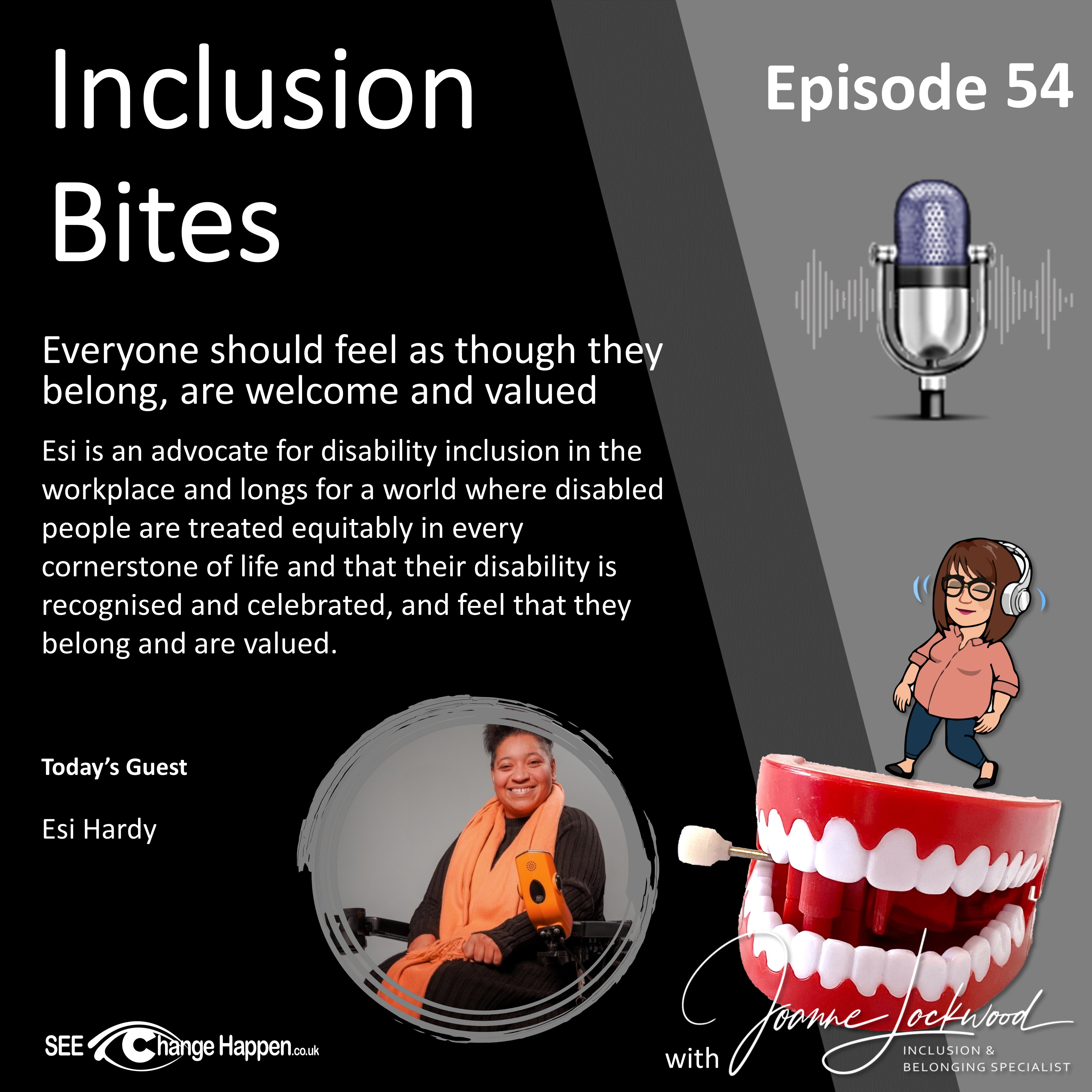
Everyone Should Feel As Though They Belong, Are Welcome And Valued
with Esi Hardy · 30 December 2021
Workplace Culture Systems
Joanne Lockwood speaks with trainer, consultant, and disability inclusion advocate Esi Hardy about what it really means for people to feel welcome, valued, and able to belong. Esi explains that inclusion is a felt experience, shaped by whether environments remove barriers or force people to constantly adapt, self-manage, and compensate.
Drawing on Esi’s lived experience as a wheelchair user, they explore how access is created or denied through everyday decisions: venue layout, toilets, transport, signage, staffing attitudes, and the often-unspoken assumptions that disabled people will be accompanied or will accept being treated as an inconvenience. They discuss how these repeated frictions create exhaustion, limit participation, and can feed internalised ableism.
The conversation widens to the importance of co-producing accessibility with people who have lived experience, and to recognising disability as diverse (including sensory, learning, mental health, and invisible disabilities). They also touch on stereotypes about disabled people’s social lives and interests, intersectionality (including LGBTQ+ disabled spaces through Esi’s work with ParaPride), and why accessibility improvements benefit everyone.
They close by reflecting on the gaps in public strategy and long-term support, and the need for sustained action—not just awareness—to build more equitable workplaces and public spaces.
About Esi Hardy
One-sentence summary
Esi Hardy wants a world where she can enter a room without bracing herself — where her energy goes into living, not managing barriers, and where belonging feels like breathing out.
---
Synopsis
Esi Hardy is a wheelchair user, consultant, advocate and poker player who has learned to read a room long before it reads her. She has lived the reality of navigating cities, venues and conversations that weren’t designed with her in mind. For Esi, disability is not the tragedy — exclusion is. She describes inclusion not as a checklist, but as a feeling: “Inclusion is a feeling that comes from within.” And yet, that feeling is shaped by what the world does — or fails to do — when she enters a space.
She is trying to change more than policy. She is trying to change what it feels like to exist in public. The sigh of a bus driver. The inaccessible toilet behind a crowded table. The subtle assumption that someone like her won’t have much to say. Esi wants a world where disabled people don’t have to carry an invisible backpack of barriers, where belonging isn’t conditional, and where no one has to shrink themselves to make others comfortable. For her, this is about dignity — about being seen as whole, complex and human.
---
10 Small, digestible concepts for easy learning
1. Inclusion is a feeling, not a policy.
You can comply with rules and still make someone feel unwelcome.
2. Barriers steal energy before the day even starts.
By the time some people arrive, they’ve already fought a battle you never saw.
3. Privilege is not having to plan every movement.
If you move through the world without strategising, that is ease others don’t have.
4. Attitudes compound physical barriers.
A ramp helps; a sigh undoes it.
5. Internalised ableism is learnt survival.
When society treats you as the problem, you start to believe it.
6. Accessibility benefits everyone.
A lift doesn’t stop anyone using the stairs — it simply widens the door.
7. Disabled people are not a single story.
Sporty, academic, queer, gambler, fan of Robbie Williams — identity is layered.
8. Representation without reality fixes nothing.
Celebrating elite athletes doesn’t dismantle everyday barriers.
9. Engage, don’t assume.
Real access is co-produced with the people who live it.
10. Allyship is behaviour, not a badge.
Compassion is shown in what you do, not what you call yourself.
---
The “why” in the story
What she believes is true about people
That everyone deserves to feel welcome, equal and able to relax into a space without apology.
What she cannot unsee
The tiny, constant signals that tell disabled people they are inconvenient — the inaccessible routes, the social awkwardness, the exhaustion of self-advocacy.
What she is no longer willing to tolerate
Being reduced to a body or impairment. Being grateful for crumbs of access. Being expected to make others comfortable at her own expense.
What she is trying to build instead
A society where access is assumed, equity is intentional, and disabled people live full, messy, joyful lives — relationships, hobbies, ambition and all.
---
Narrative structure
1. The trigger
A lifetime of entering spaces and immediately calculating: Can I reach the lift? Can I use the toilet? Will they speak to me? The pattern was not one dramatic moment, but accumulation.
2. The tension
The constant negotiation between educating others and protecting her own energy. The pushback that says, implicitly, “It’s not that bad.” The fatigue of explaining how to shake her hand properly ten times a day.
3. The insight
She realised the real cost isn’t just physical inaccessibility — it’s the invisible backpack of emotional and mental labour. And that inclusion only works when environments remove, rather than add to, that weight.
4. The pivot
Esi chose to speak, train, consult and co-produce with organisations. To turn intangible ideas about disability into tangible actions. To claim space — in boardrooms, in venues, even at poker tables — on her own terms.
5. The destination
A future where a new generation is baffled that buses were once hard to board, where accessible toilets are obvious and usable, and where disabled people spend their time living — not mitigating.
---
Five key takeaways and learning points
1. If someone arrives exhausted, ask what it took to get there.
The journey often reveals inequity more than the destination.
2. Don’t assume disability defines desire.
People want careers, love, adventure and hobbies — just like you.
3. Compliance is not care.
Doing the legal minimum rarely creates dignity.
4. Energy is a hidden currency.
When systems drain it, talent and participation shrink.
5. You don’t have to understand every detail to act justly.
Listening and adjusting are often enough to begin.
---
Ten distinct ideas explained
1. The Invisible Backpack
Beyond visible barriers lies accumulated emotional labour — anticipation, self-advocacy, risk calculation — carried daily without recognition.
2. Attitudinal Barriers
A raised eyebrow or dismissive tone can wound more than a step at the entrance.
3. Internalised Ableism
When exclusion is constant, disabled people may adapt by minimising their own needs to survive socially.
4. Equity vs sameness
Equal experiences require different adjustments; fairness is not treating everyone identically.
5. Intersectionality in lived terms
Disability intersects with race, gender, sexuality — shaping how someone moves through the world.
6. Token visibility
Moments like sporting events raise profile but can mask everyday neglect.
7. Design without consultation
“We didn’t think” is often the root cause. Without lived experience at the table, access is guesswork.
8. Disability and identity
Being disabled does not eclipse personality, ambition, sexuality or humour.
9. Energy depletion and opportunity
When access takes extra time and effort, lateness and fatigue are misread as incompetence.
10. Belonging as relaxation
True inclusion feels like breathing out — like being able to focus on the conversation, not the exit route.
---
How people should change as a result
1. Think
- From “we’re compliant” to “does this feel welcoming?”
- From “it’s not that difficult” to “what am I not noticing?”
- From “one solution fits all” to “every experience is different”.
- From “this doesn’t affect me” to “this reflects who we are”.
2. Feel
- From defensiveness to curiosity.
- From pity to respect.
- From guilt to responsibility.
- From indifference to empathy.
- From awkwardness to openness.
3. Act
- Visit your own venue or workplace as if you couldn’t use stairs or lift your arms above shoulder height.
- Ask disabled people to co-design processes — and pay them for their expertise.
- Remove physical clutter that blocks accessible routes.
- Avoid speaking about someone when they are present — speak to them.
- Check whether accessible facilities are actually usable and private.
- Challenge dismissive comments, even subtle ones.
- Make inclusion about everyday practice, not special events.
---
One thing to remember
Belonging happens when no one has to apologise for taking up space.