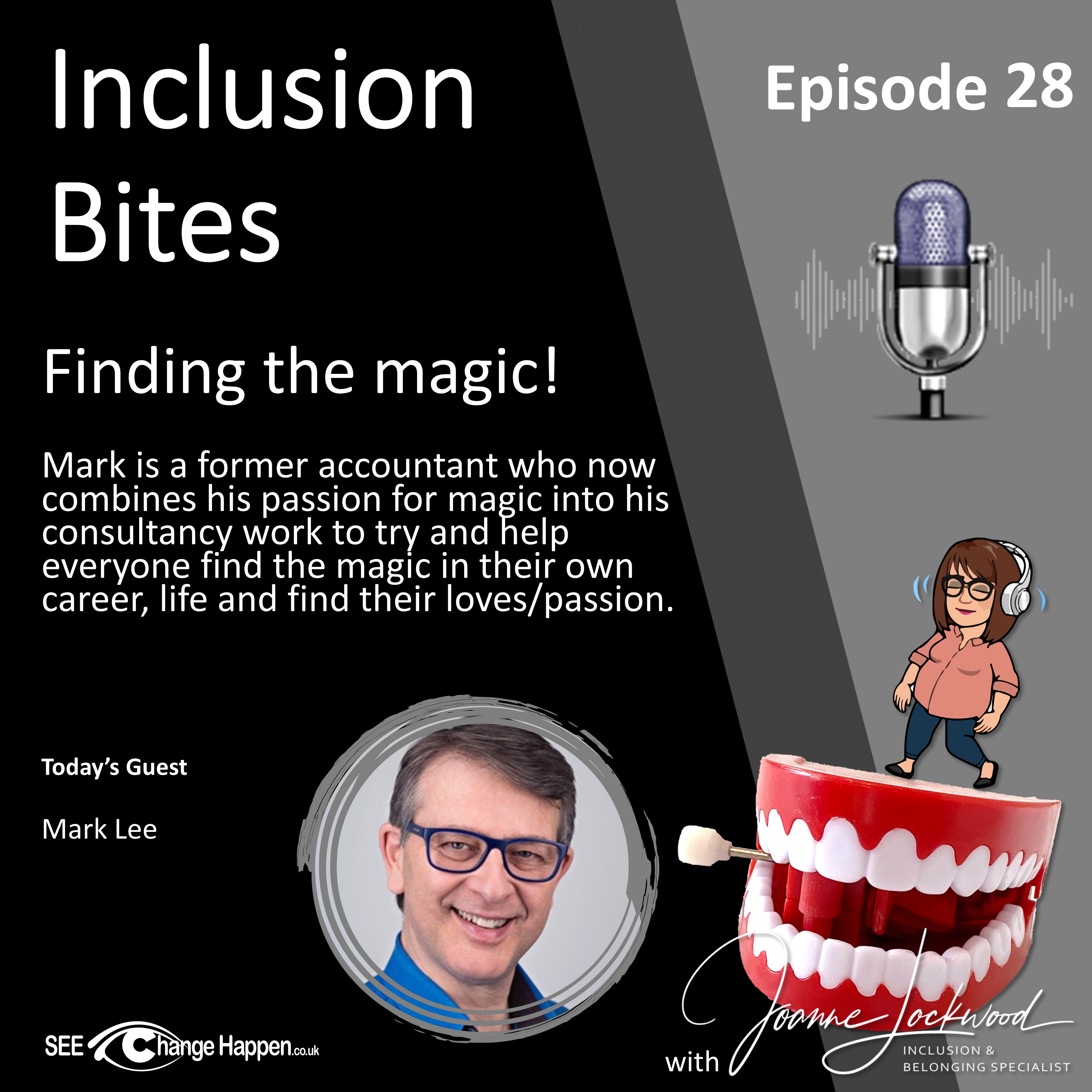
Lived Experience Identity
Mark Lee, a chartered accountant and long-time member of the Magic Circle, reflects on how he spent years hiding his love of magic from clients because he feared it would undermine his professional credibility. Through stories of awkward moments and perceived stigma, he explores how small signals about who we are can shape trust, bias, and whether we feel safe to be fully seen at work.
As Mark moved from accountancy practice into a career focused on speaking, writing, and mentoring, he became more open about his passion and began using magic as a tool to help audiences remember ideas and connect with him as a person. The conversation expands into inclusion more broadly, including gender and representation in magic and accountancy, the impact of stereotypes, and how visibility can filter out prejudice.
Joanne and Mark also discuss identity and discrimination more directly, including Mark’s experience of being Jewish and Joanne’s experience of being transgender. Together they reflect on racism, bias, allyship, and the value of meeting people outside our usual circles to challenge assumptions and create more inclusive environments.
About Mark Lee
One-sentence summary
Mark Lee’s message is simple but quietly brave: when we stop hiding the parts of ourselves that feel risky, we create space for others to do the same — and that’s where the real magic lives.
---
Synopsis
Mark Lee grew up loving magic — performing at children’s parties as a teenager, charging his first professional fee of £1, and eventually joining the Magic Circle. Yet as he built a respected career as a chartered accountant and tax adviser, he quietly hid that side of himself from clients. A single raised eyebrow in a job interview and a teasing question from a client — “Should we take tax advice from this guy?” — planted doubt. He worried that creativity might undermine credibility. Over time, those small moments shaped a habit of caution: protect the professional image, keep the passion backstage.
But redundancy, maturity and self-reflection shifted something in him. Mark realised that people don’t connect with technical competence alone — they connect with the person. Gradually, he stopped separating “serious accountant” from “magician”. He began encouraging others to reveal what makes them distinctive, to stand out rather than blend in. His awareness of prejudice runs deeper than profession; as a Jewish man who is “white on the outside”, he knows what it means to benefit from passing while also understanding the sting of bias. That dual awareness fuels his refusal to tolerate unfairness and his quiet commitment to widening doors for others — even if it costs him speaking opportunities himself.
---
10 Small, digestible concepts for easy learning
1. Professionalism isn’t personality neutrality.
Competence doesn’t require you to erase what makes you interesting.
2. What you hide shapes how you feel.
Concealing passion slowly chips away at confidence.
3. Most people love humanity more than perfection.
A shared story often builds more trust than polished credentials.
4. Standing out is safer than we think.
The fear of being judged is often louder than the judgement itself.
5. Passing is protection — and pressure.
Being able to blend in doesn’t erase the awareness of prejudice.
6. Bias grows in small, unchallenged circles.
We default to people who look and think like us unless we disrupt it.
7. You don’t have to win every opportunity.
Sometimes progress means stepping aside to widen the stage.
8. Visibility filters values.
When you show who you are, the wrong people deselect themselves.
9. Practice makes permanent.
What we repeat — confidence or caution — becomes our habit.
10. Magic is about connection, not trickery.
The point isn’t deception; it’s shared delight.
---
The “why” in the story
What they believe is true about people
Mark believes people want to connect with authenticity. He believes most prejudice comes from lack of exposure rather than inherent cruelty. And he believes that when people feel seen and relatable, barriers soften.
What they cannot unsee
He cannot unsee how subtle bias shapes opportunities — the offhand remark, the cautious glance, the default to the “old white bloke”. He also cannot ignore that he can “pass” in ways others cannot, and that this brings responsibility.
What they are no longer willing to tolerate
He is no longer willing to hide parts of himself out of fear. Nor is he willing to quietly accept unfairness in speaker line‑ups, professional spaces or communities that exclude by default.
What they are trying to build instead
He is building spaces — in business, on stages, in networks — where individuality is an asset, not a liability. Where difference isn’t edited out but welcomed in.
---
Narrative structure
1. The trigger:
A job interview where his interest in magic was met with suspicion, and a client’s joke that momentarily made him question his credibility. Small incidents that lingered.
2. The tension:
The pull between credibility and creativity — and later, the discomfort of seeing homogenous panels and knowing he benefited from the bias he opposed.
3. The insight:
People remember stories and character, not just qualifications. Hiding doesn’t protect you as much as you think — it limits you.
4. The pivot:
He began integrating magic into his talks, openly sharing who he is, and encouraging event organisers to diversify who gets the spotlight — even when it meant fewer invitations for himself.
5. The destination:
A professional world where nobody feels they must shrink to fit the mould — where life feels lighter because you don’t have to separate your passion from your profession.
---
Five key takeaways and learning points
1. You are more than your job title.
So what: Let people see your interests — it builds trust and memorability.
2. Visibility can be a protective filter.
So what: Being upfront about who you are saves time and emotional labour.
3. Bias thrives on familiarity.
So what: Actively widen your network beyond those who mirror you.
4. Credibility and creativity coexist.
So what: You don’t have to choose between being serious and being yourself.
5. Fairness requires intention.
So what: If you’re the organiser, decision-maker or gatekeeper — diversify deliberately.
---
Ten distinct ideas explained
1. The quiet cost of hiding
When you suppress part of yourself, you may stay safe — but you also feel smaller.
2. Stereotypes shrink possibility
The “boring accountant” trope limits both how others see the profession and how professionals see themselves.
3. Passing isn’t privilege-free
Appearing to fit the majority shields you — yet it also heightens your awareness of those unshielded.
4. Humour can mask fear
A joke can feel harmless, yet it can ignite real anxiety about belonging.
5. Stages shape culture
Who we invite to speak becomes who we consider credible.
6. Exposure reduces ignorance
Conversations with people outside our comfort zone soften rigid thinking.
7. Identity is layered
Race, religion, gender — they intersect, compounding exclusion in ways not everyone sees.
8. Authenticity attracts alignment
The right clients and collaborators are drawn to the real you.
9. Confidence grows with practice
Repeating courage makes courage easier.
10. Belonging is built, not assumed
It appears when people are deliberately welcomed, not just tolerated.
---
How people should change as a result
1. Think
- Move from “professional means polished” to “professional includes personal”.
- Replace “different equals risky” with “different creates value”.
- Shift from “I treat everyone the same” to “I notice who isn’t being seen”.
- Understand that small comments can carry large emotional weight.
2. Feel
- From defensiveness to curiosity.
- From fear of judgement to comfort with visibility.
- From passive fairness to active responsibility.
- From stereotype-driven assumptions to openness.
3. Act
- Share one genuine interest about yourself in your professional spaces.
- If you organise an event, actively seek speakers outside your usual circle.
- Start conversations with someone who doesn’t resemble your typical network.
- Use photos and honest profiles that reflect who you are.
- Interrupt biased remarks — gently but clearly.
- Ask yourself who is missing in the room and why.
---
One thing to remember
The magic isn’t in the trick — it’s in the courage to let yourself be seen.