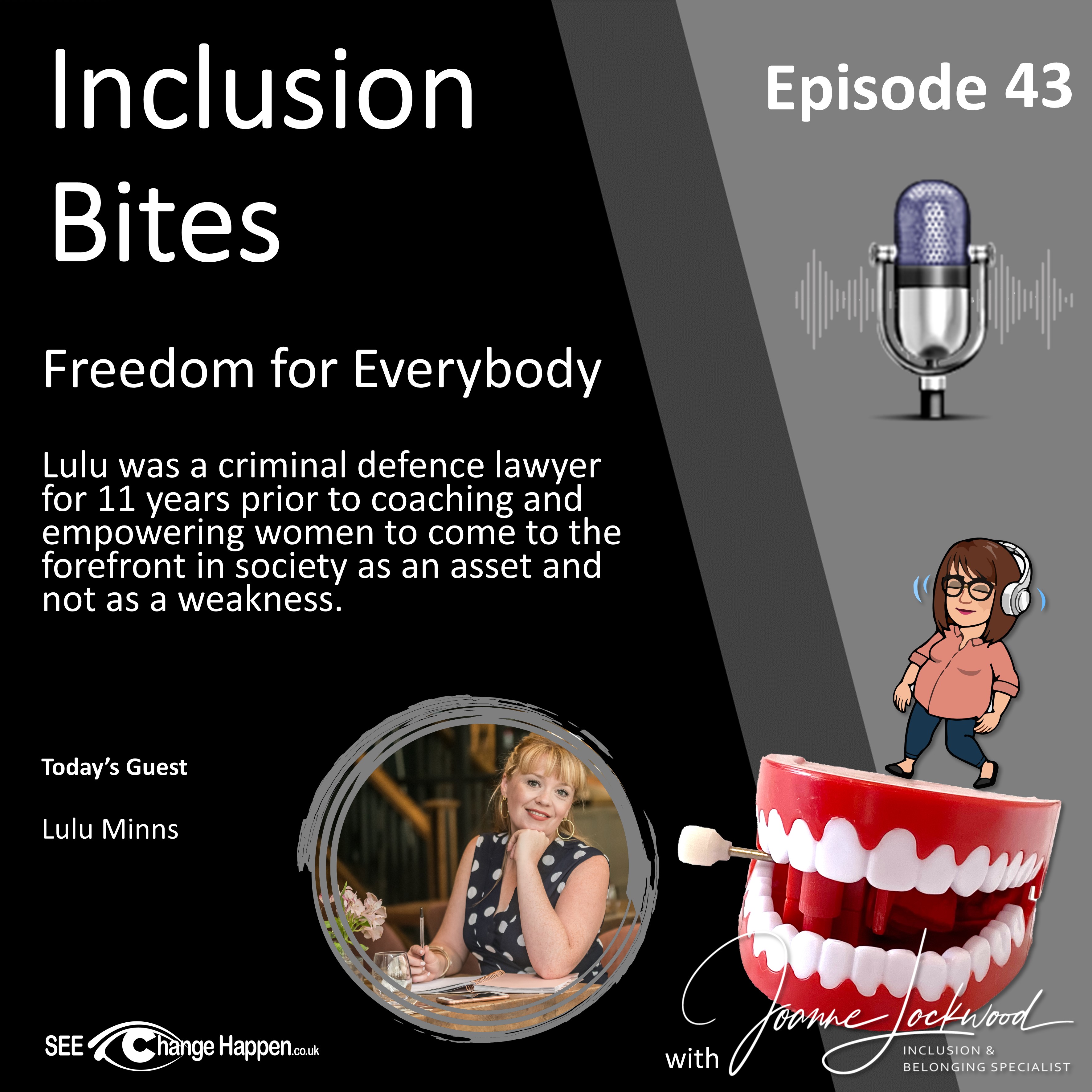
Freedom For Everybody
with Lulu Minns · 02 September 2021
Workplace Culture Systems
Joanne Lockwood is joined by coach and retreat specialist Lulu Minns to explore what “freedom for everybody” really means, and why it matters for inclusion.
Lulu reflects on her former career as a criminal defence lawyer and the frustration of working inside systems shaped by privilege, bias, and entrenched gender expectations. Together, they discuss how women are often expected to tone down assertiveness, how everyday sexism shows up through behaviours like mansplaining and unwanted physical cues, and how that cumulative pressure can be exhausting.
The conversation moves into what freedom looks like in practice: creating time and space to think, recover, and create. Lulu shares why retreats can be transformational for women and why confidence, permission, and self-trust are often the real barriers—not capability. They also explore how leadership and workplace norms could shift by valuing listening as much as speaking, making room for diverse opinions, and moving away from rigid “command and control” approaches. The episode closes with reflections on how cultural change—at home, at work, and in society—requires rewriting inherited rules so that more people can thrive.
About Lulu Minns
One-sentence summary
Lulu Mintz believes freedom is not a personal indulgence but a shared responsibility — and she has reshaped her life to protect it for herself and for others.
---
Synopsis
Lulu Mintz calls herself a rebel, but not for the sake of noise — for the sake of freedom. Raised in a creatively unconventional family in Brighton, surrounded by artists, music, and strong female presence, she felt early on that she didn’t quite fit neat expectations. Ironically, her rebellion led her into one of the most traditional professions: criminal defence law. For eleven years she stood in courtrooms and prisons, advocating for people’s literal freedom. Yet behind her professional success she was absorbing something quieter and more corrosive — the weight of patriarchal systems, the exhaustion of being told to “tone it down”, and the relentless emotional labour of holding everyone else together.
Leaving law wasn’t just a career pivot. It was an act of self-preservation. Lulu had begun to notice the armour she put on each morning — the energy required to be assertive, respected, and safe in spaces that subtly resisted her. Over time, she refused to assimilate into a system that required her to shrink or harden herself. Now, through coaching, retreats, and her work with women leaders, she is trying to change something deeper than career trajectories. She is creating space — literal and emotional — for women to reclaim time, voice, and self-trust. For Lulu, freedom isn’t about dominance or defiance. It is about dignity, creative expression, and making sure no one has to abandon themselves just to survive.
---
10 Small, digestible concepts for easy learning
1. Freedom is a value, not a luxury.
It shapes the choices you make long before you realise you’re protecting it.
2. Being told to “tone it down” is rarely neutral.
It often means: shrink yourself so others stay comfortable.
3. Empathy is power — even if it isn’t always rewarded.
Lulu’s sensitivity was once hidden; now it is her greatest strength.
4. Double standards create double exhaustion.
When women break rules, they’re judged for the act and for breaking gender norms.
5. If it’s not in your diary, it’s not going to happen.
Self-care is intentional, not accidental.
6. Space creates transformation.
Insight rarely comes from busyness; it emerges in pauses.
7. Authority can be internal.
Self-authorising is revolutionary for those taught to seek permission.
8. Listening is as powerful as speaking.
We celebrate speeches; we overlook deep listening.
9. Creativity isn’t artistic talent — it’s aliveness.
Cooking, designing a programme, asking better questions — all are creative acts.
10. Freedom for me must mean freedom for you.
Feminism that excludes others recreates the very imbalance it resists.
---
The “why” in the story
What they believe is true about people
Lulu believes people are inherently creative, intuitive, and capable of answering their own questions — if given the space and permission to do so.
What they cannot unsee
She cannot unsee how systems reward dominance over empathy, how women’s authority is questioned, and how much unseen labour women carry every day.
What they are no longer willing to tolerate
She is no longer willing to dilute her voice, harden her nature, or participate in environments that require women to suppress their feminine strengths to succeed.
What they are trying to build instead
She is building spaces where women can self-authorise, reconnect to nature, trust their decision-making, and experience freedom without apology.
---
Narrative structure
1. The trigger:
Years in courtrooms and prisons taught Lulu how systems operate — not just legally, but culturally. Being repeatedly told her assertiveness was “too much” slowly revealed the gendered rules she hadn’t previously named.
2. The tension:
She is a challenger by nature, yet systems reward compliance. She values inclusivity, yet sees growing division in society. She wants men involved — but not dominating the room. That balance is hard.
3. The insight:
The world overvalues traditionally masculine principles — control, hierarchy, division — and undervalues listening, connection, and space. Without rebalancing that, we remain stuck.
4. The pivot:
Lulu left the legal profession rather than mould herself to it. She began coaching, running retreats, and teaching women to become “self-securitised, self-authorised and self-expressed”.
5. The destination:
A world where freedom feels like time in the morning to think, where leadership includes empathy, where women don’t need armour — and where disagreement doesn’t erase belonging.
---
Five key takeaways and learning points
1. You may not realise you’re wearing armour until you take it off.
The cost of constant self-protection is exhaustion; reclaiming softness can be transformative.
2. Confidence is often permission, not bravado.
When people self-authorise, they stop waiting to be chosen.
3. Burnout is rarely about workload alone.
It’s about carrying invisible emotional labour and constant vigilance.
4. Freedom requires boundaries.
Whether that’s scheduling yoga first or leaving a career, freedom demands structure to protect it.
5. Inclusion without listening is performance.
Real change happens when voices are heard — not just invited.
---
Ten distinct ideas explained
1. Armour at work
Many women learn to toughen their tone or stiffen their posture. The emotional cost is a gradual disconnection from softness and joy.
2. Emotional labour in professional roles
Lulu wasn’t just a lawyer; she became social worker, confidante, and stabiliser. Systems reward output but rarely recognise this invisible care.
3. Double deviance
When women assert themselves, they are seen as breaking professional rules and gender rules — increasing scrutiny and fatigue.
4. The privilege of time
Genius requires space. When much unpaid labour falls on women, potential goes undeveloped.
5. Self-authorisation
Many women are taught authority lives outside them. Reclaiming it internally changes how decisions are made.
6. Masculine versus feminine principles
Division and hierarchy have value, but without inclusion and collaboration, systems become brittle and harmful.
7. Listening as leadership
When leaders speak less, others think more. Belonging grows when voices are not interrupted.
8. Nature as recalibration
Stepping outside hierarchy-based spaces reconnects people with rhythm, perspective, and creativity.
9. Creativity as survival
Creative expression prevents stagnation; without it, systems harden and people shrink.
10. Freedom as collective
If liberation only benefits one group, it isn’t freedom — it’s a reshuffle of power.
---
How people should change as a result
1. Think
- Shift from seeing freedom as selfish to seeing it as foundational.
- Recognise that systems are designed — and can be redesigned.
- Understand that empathy and listening are strategic strengths, not soft extras.
- Notice where “that’s just how it is” may hide inequity.
2. Feel
- Move from defensiveness to curiosity when challenged.
- Shift from guilt to responsibility.
- Replace exhaustion with self-compassion.
- Trade competition for collaboration.
- Allow permission where there was pressure.
3. Act
- Put one non-negotiable wellbeing activity in your diary first each week.
- Practise asking open questions without offering your solution immediately.
- Notice and redistribute unseen labour in your household or workplace.
- If you’re in a dominant group, consciously share airtime before speaking.
- Create a small pocket of space — a walk, a pause, a retreat — and protect it.
- Encourage someone else to self-authorise instead of seeking your approval.
---
One thing to remember
Freedom is only real when you no longer have to armour yourself to belong.