Freeing Women From Being Prisoners Of Their Pain
with Diksha Chakravarti · 15 July 2021
Mental Health Wellbeing Trauma
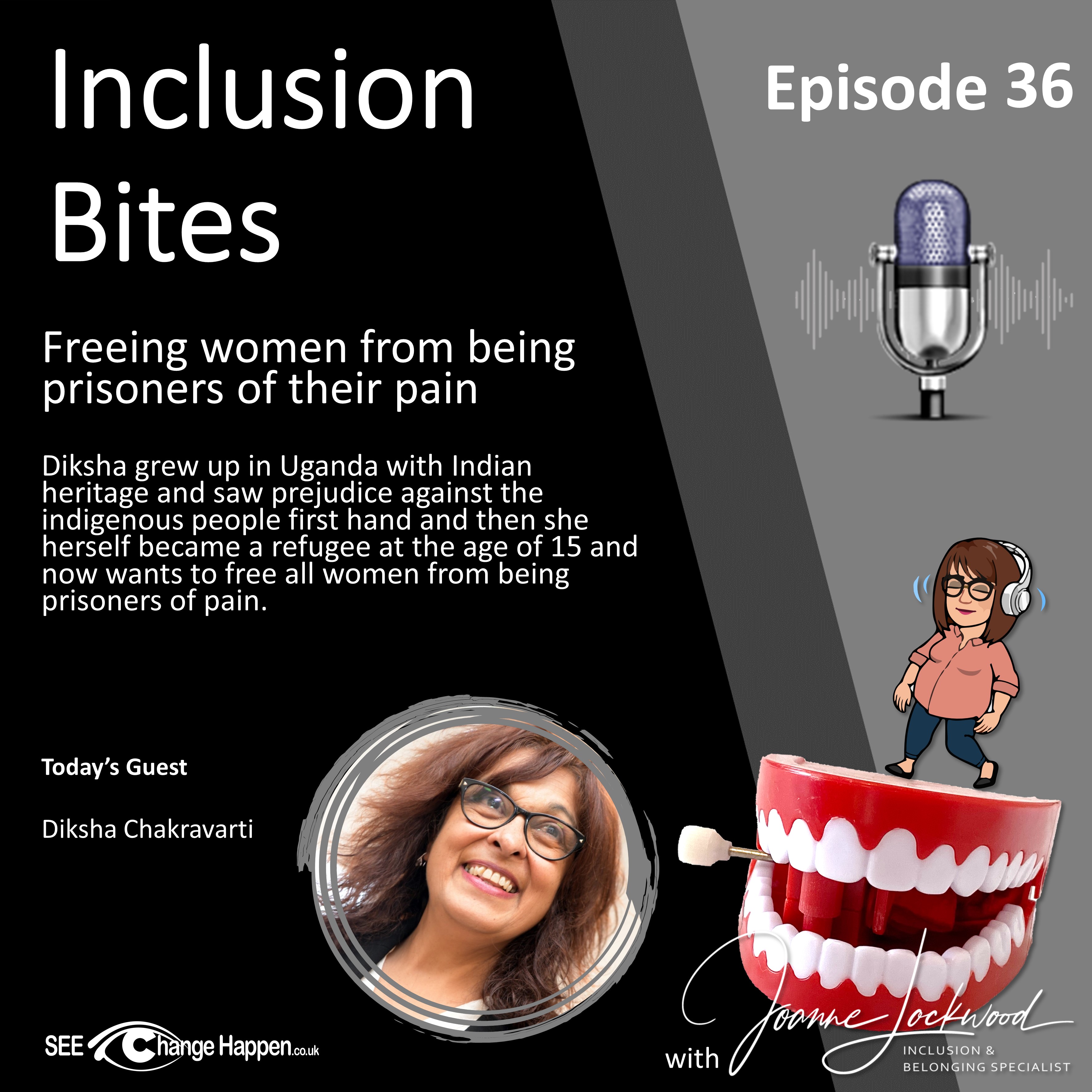
Diksha Chakravarti, a long-practising therapist, explains how she uses “pain” as a wide lens that includes physical discomfort alongside emotional, mental, societal and spiritual suffering. She describes an integrated approach that brings together bodywork, mindfulness and hypnotherapy to help women meet their pain directly, understand what sits beneath it, and find a way through rather than around it.
The conversation explores how fear can keep people stuck, how vulnerability is often misread as weakness, and how confidence grows when someone is able to live more authentically. Joanne and Diksha also discuss the pressures created by patriarchal expectations, internalised competition between women, and the ways status and achievement can become substitutes for self-worth.
Diksha shares significant parts of her own story, including leaving Uganda during Idi Amin’s expulsion of Asians, experiencing dislocation and bullying, and later navigating racism in the UK. She reflects on how trauma and disconnection shaped her early life, and how resilience, spirituality, and support networks have influenced her work and mission to help women feel less alone and more able to ask for help.
About Diksha Chakravarti
One-sentence summary
Diksha Chakravarti’s life has been a long journey of displacement and self-doubt, and she now works to ensure other women do not die carrying pain that was never theirs to bear alone.
---
Synopsis
Diksha Chakravarti’s story begins in beauty and rupture. Raised in Uganda in a life that felt charmed, she was uprooted at 15 when her family were forced to leave under threat and violence. She left her country alone, frightened, watching her parents disappear into darkness at an airport she might never see again. From Uganda to India to the UK, she moved across continents carrying a quiet question: where do I belong? She was the outsider everywhere — Bengali but not quite Indian, African-born but not African, British but not fully accepted. Added to that were family violence, cultural expectations, racism, displacement, a marriage that did not fit, and years of depression that left her feeling as though she was “walking through treacle”. For a long time, she believed she was a failure and tried to fix that feeling with achievement, qualifications and relentless striving.
What she is trying to change now is that silent suffering. She calls pain “physical, emotional, mental, societal, spiritual” — and she refuses to treat it as something to suppress. She says, “Unless you go through this dark tunnel… you’re not going to find the light at the end of it.” Her mission is not to cure women, but to help them face what they have endured, honour it, and find their own strength beneath it. She cannot bear the thought of women living as prisoners to fear, money shame, cultural expectation or toxic relationships. She believes freedom is possible — not through perfection or status, but through truth, vulnerability and support. Above all, she wants women to know: “You don’t have to do this alone.”
---
10 Small, digestible concepts for easy learning
1. Pain is layered, not simple.
It shows up in the body, in identity, in culture and in silence — and it deserves to be understood, not dismissed.
2. Fear blocks generosity.
When we are afraid, we cannot welcome others; we close in to protect ourselves.
3. Everything we want is on the other side of fear.
Growth requires stepping into discomfort rather than running from it.
4. Belonging shapes the nervous system.
When you feel like an outsider everywhere, your body never fully rests.
5. Achievement does not heal shame.
Bigger goals cannot plug a hole created by feeling “not enough”.
6. Disconnection numbs pain — and joy.
Shutting down keeps you safe, but it also keeps you small.
7. Vulnerability is strength in disguise.
“It’s okay to say I’m struggling.” Strength begins there.
8. Letting go is a form of freedom.
Clinging to what is failing creates suffering; release creates space.
9. Support changes everything.
Healing quickens in trusted relationships.
10. Don’t die with the music still in you.
Your truth deserves expression before time runs out.
---
The “why” in the story
What they believe is true about people
That women already carry strength inside them — it is simply buried under fear, conditioning and unprocessed pain.
What they cannot unsee
What happens when women live disconnected from themselves — staying in toxic dynamics, shrinking in leadership, believing they are failures.
What they are no longer willing to tolerate
Silence around suffering. The myth that asking for help is weakness. The fragmentation of care that treats symptoms but ignores the whole person.
What they are trying to build instead
Spaces of trust where women can sit with their pain, be vulnerable without shame, and reconnect with their authentic selves.
---
Narrative structure
1. The trigger:
Forced exile at 15. A violent farewell. Watching her childhood disappear. Years later, recognising she had spent much of her life feeling like an outsider — even to herself.
2. The tension:
The drive to achieve versus the persistent whisper, “I am a failure.” Cultural expectations versus personal truth. Strength on the outside, exhaustion within.
3. The insight:
“Unless you sit with the pain, you cannot move through it.” Avoidance prolongs suffering; facing fear creates freedom.
4. The pivot:
She stopped chasing worth through status and qualifications alone. She trained more deeply, integrated body and mind work, and began telling women: it’s okay to be vulnerable.
5. The destination:
A world where women live their truth rather than one imposed on them — where they feel safe, supported and unashamed of their needs.
---
Five key takeaways and learning points
1. Belonging is not a luxury — it is survival.
When people feel they don’t belong, they fragment internally and disconnect from their own needs.
2. You cannot heal what you refuse to face.
So what: avoiding pain keeps it active; naming it begins to loosen it.
3. Achievement without self-acceptance is exhausting.
So what: chasing status will never stabilise inner shame.
4. Asking for help is an act of courage.
So what: support accelerates healing and restores dignity.
5. You are allowed to define success differently.
So what: living someone else’s definition traps you; choosing your own frees you.
---
Ten distinct ideas explained
1. Exile leaves invisible scars.
Forced displacement disrupts identity. The body remembers abrupt loss long after safety returns.
2. Cultural hybridity can erode certainty.
Being “between worlds” without validation creates chronic self-questioning.
3. Family violence trains hypervigilance.
Growing up around fear teaches children to disconnect rather than feel.
4. Money stories shape self-worth.
If money is labelled “bad”, earning it feels morally compromising.
5. Toxic relationships thrive on fear.
Fear paralyses decision-making and convinces women they cannot cope alone.
6. Patriarchal structures create scarcity mindsets.
If women believe there is only one seat at the table, they protect it defensively.
7. Integrated care honours complexity.
Physical pain, trauma and anxiety are interwoven; separating them misses the point.
8. Shame fuels overachievement.
More qualifications become armour against feeling inadequate.
9. Support is a corrective experience.
Being listened to without judgement restores trust in self.
10. Freedom often begins with a small choice.
A conversation. A boundary. A call for help. These are not dramatic acts — but they are revolutionary.
---
How people should change as a result
1. Think
- Move from “What’s wrong with her?” to “What has she survived?”
- See pain as information, not weakness.
- Recognise that fear distorts behaviour — including your own.
- Understand that belonging is foundational, not optional.
- Accept that strength and vulnerability can coexist.
---
2. Feel
- From judgement to compassion.
- From shame to permission.
- From defensiveness to curiosity.
- From resignation to possibility.
- From isolation to solidarity.
---
3. Act
- Ask someone gently, “Are you really okay?” — and wait for the real answer.
- Offer support without trying to fix.
- Create safe conversational spaces at work and at home.
- Examine your own fear before reacting defensively.
- Encourage women to access consistent, trusted support rather than fragmented fixes.
- Share stories of vulnerability to normalise struggle.
- If you are struggling, reach out — even if your voice shakes.
---
One thing to remember
You don’t have to carry your pain alone — your freedom begins the moment you turn towards it instead of away.