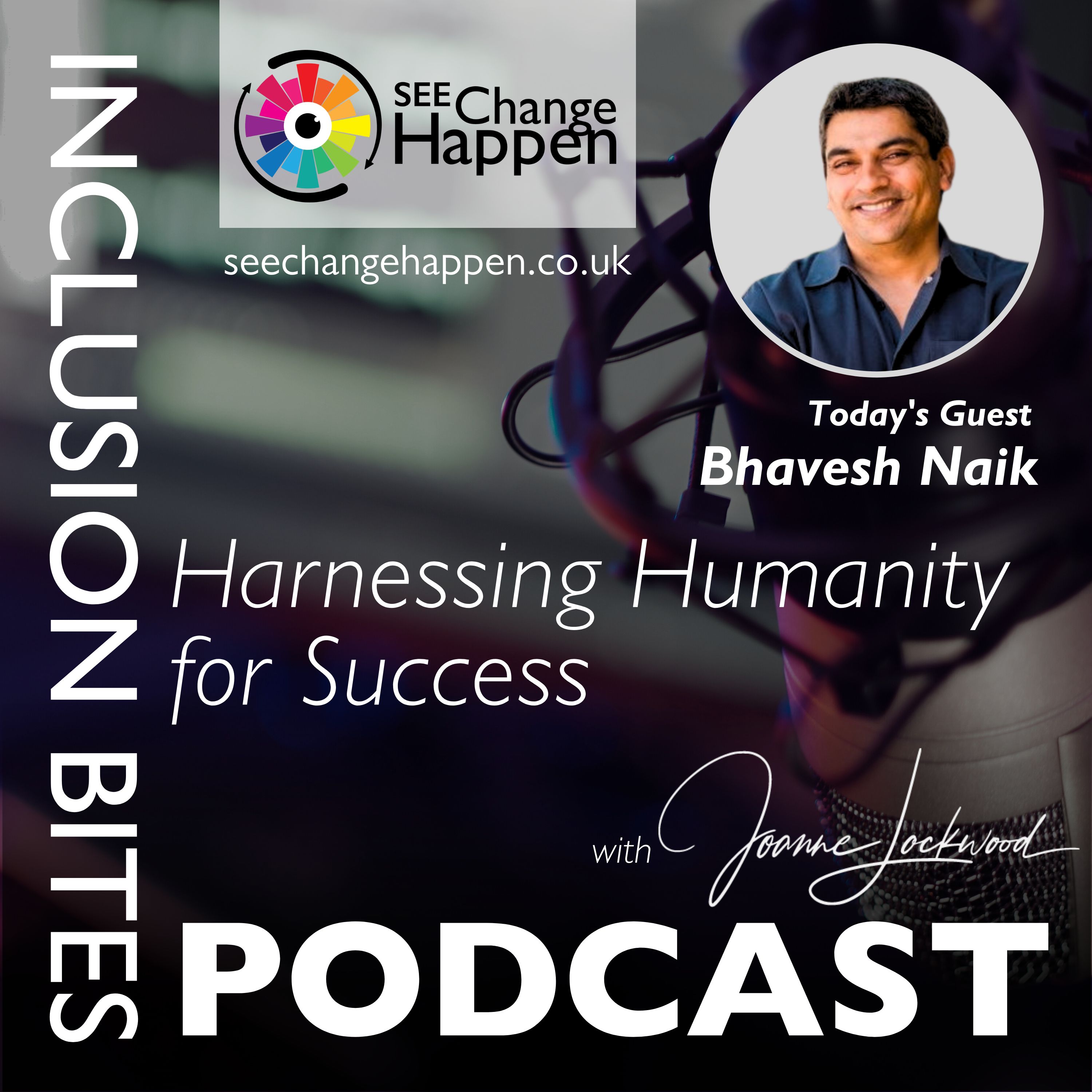
Harnessing Humanity For Success
with Bhavesh Naik · 26 June 2025
Inclusive Leadership Management
Joanne Lockwood is joined by business performance and longevity expert Bhavesh Naik for a wide-ranging conversation about what self-awareness really means at work, and why it can be a catalyst for healthier, higher-performing teams.
Together they explore self-awareness as a lived, in-the-moment practice rather than a purely intellectual idea, including the value of noticing the gap between stimulus and response. Bhavesh offers practical ways to apply this in workplace situations such as meetings, negotiations and leader–employee conversations, and discusses how emotional awareness can support better judgement, empathy and more intentional communication.
The discussion also challenges legacy management thinking that treats organisations like machines and people like parts, arguing instead for leadership that prioritises relationships, trust and genuine human connection. Joanne and Bhavesh consider how leaders can move from awareness into action through clearer purpose, shared vision, and structured one-to-one conversations that help people articulate their “why” and align on expectations.
The central takeaway is that when leaders learn to lead with awareness—of self, others and context—they can unlock stronger engagement, more inclusive cultures, and more resilient organisational performance.
About Bhavesh Naik
One-sentence summary
Bhavesh Naik believes that when we truly become aware of ourselves as humans — not just thinkers or performers — we unlock the dignity, potential and connection that make both people and organisations come alive.
---
Synopsis
Bhavesh Naik speaks like someone who has spent years questioning what it really means to be human. For him, self-awareness is not a theory or corporate competency — it is an experience. He describes it as the ability to “observe this person right here,” to step back from automatic reactions and feel the space between stimulus and response. What shaped him is a deep discomfort with the idea that we have mistaken intellect for identity. He has watched workplaces treat people like replaceable components and has quietly refused that framing. At his core, he is fascinated by consciousness itself — by the fact that we can know that we know.
What he is trying to change is subtle but radical. He wants leaders to stop seeing employees as “machine parts” and start seeing them as whole human beings — with histories, emotions, aspirations and hidden patterns. He believes most workplaces are “deeply dysfunctional” not because people are incapable, but because we are trying to manage humans using industrial-age thinking. For Bhavesh, the stakes are clear: when we suppress emotion and ignore awareness, we shrink people. When we honour it, we unlock engagement, trust and real transformation.
---
10 Small, digestible concepts for easy learning
1. Self-awareness is not thinking about yourself — it is noticing yourself.
It’s the shift from reacting to observing.
2. Between action and reaction lives your freedom.
That gap is where responsibility and choice sit.
3. Children are closer to awareness than adults.
We are trained out of presence and into constant thinking.
4. You cannot manage humans like machines.
People carry emotion, meaning and memory — not just outputs.
5. Awareness creates power.
Once you see a pattern in yourself, you can change it.
6. Growth is an insight, not a data download.
True learning is the ‘aha’ that changes how you see.
7. Emotion is information, not weakness.
Suppressing it doesn’t make it disappear — it buries it.
8. You cannot argue with someone’s ‘why’.
Understanding motivation builds dignity and trust.
9. Leadership starts from the inside out.
Transformation begins with the awareness of the leader.
10. Common ground is our shared humanity.
Difference matters — but so does the awareness we all possess.
---
The “why” in the story
What they believe is true about people
Bhavesh believes every human being carries awareness — a consciousness that can observe, reflect and grow. He believes perspective is “our superpower”, and that every individual expresses that awareness uniquely.
What they cannot unsee
He cannot unsee the way organisations still operate from industrial-age thinking — viewing people as cogs rather than conscious beings.
What they are no longer willing to tolerate
He is no longer willing to accept workplaces where emotion is suppressed, engagement is low, and leadership avoids the deeper human conversation.
What they are trying to build instead
He is trying to build organisations grounded in relationship — where leaders understand people’s ‘why’, where emotion is acknowledged, and where awareness becomes the foundation of culture.
---
Narrative structure
1. The trigger
Years of watching organisations rely on outdated management models — and seeing disengagement, turnover, and quiet frustration as the norm — sharpened his resolve.
2. The tension
He meets scepticism. Awareness sounds abstract. Leaders want proof. Results must be measurable. And some resist looking inward at all.
3. The insight
Transformation does not happen by adding more information. It happens when someone has an insight — when awareness reveals a blind spot.
4. The pivot
Instead of preaching philosophy, he begins with simple questions:
“Why are you here?”
“What is your vision?”
“How do we get there?”
He starts with one leader, then builds outward through relationship.
5. The destination
A workplace where conversations feel honest, where leaders stay curious, where emotion is allowed, and where people feel seen not as resources — but as humans.
---
Five key takeaways and learning points
1. Awareness is the beginning of accountability.
So what: When you notice your behaviour, you regain the power to adjust it.
2. Engagement grows where meaning is acknowledged.
So what: Ask people why they are here — and listen without judgement.
3. Suppressing emotion creates distance.
So what: Emotional awareness builds connection and trust.
4. Industrial management cannot solve human problems.
So what: If people aren’t thriving, models may need replacing — not individuals.
5. Leadership is relational, not positional.
So what: Your influence depends on the quality of the bond you build.
---
Ten distinct ideas explained
1. The observing self
Humans can witness their own thoughts and behaviour. That capacity creates the possibility of change.
2. The reaction gap
When we slow down the moment between trigger and response, we choose rather than explode.
3. Emotional awareness over suppression
Naming how you feel prevents that feeling from driving you unconsciously.
4. Patterns born in history
Biases or reactions often begin long before the present moment. Awareness exposes the roots.
5. Perspective as uniqueness
No two people see the world in the same way — that difference is valuable, not inconvenient.
6. The ‘why’ conversation
When leaders explore motivation, employees feel dignified rather than directed.
7. Dependency culture
Organisations that rely entirely on one central figure are brittle. Shared awareness builds resilience.
8. Metrics versus meaning
Numbers matter, but they do not fully capture morale, trust or felt safety.
9. Shared humanity as foundation
Diversity sits on top of something deeper — the fact that everyone is conscious and capable of growth.
10. Insight as transformation
Change sticks when people discover something for themselves, not when it is imposed on them.
---
How people should change as a result
1. Think
- Stop seeing self-awareness as a soft skill — see it as a core human capacity.
- Question whether you are managing outputs or nurturing people.
- Recognise that emotion is not irrational — it carries meaning.
- Consider whether low engagement is cultural, not personal.
2. Feel
- Move from defensiveness to curiosity.
- Shift from judgement to empathy.
- Replace control with responsibility.
- Feel permission to notice your own reactions without shame.
3. Act
- Ask one person this week: “Why is this role important to you?”
- In a difficult moment, pause before responding — notice what you’re feeling.
- Reflect on one recurring reaction pattern and explore its origin.
- Listen without correcting when someone describes their motivation.
- Make space in meetings for people to share vision, not just updates.
- Model accountability when your intent and impact misalign.
---
One thing to remember
Once you are aware, you have the power to choose differently — and that is what makes us human.