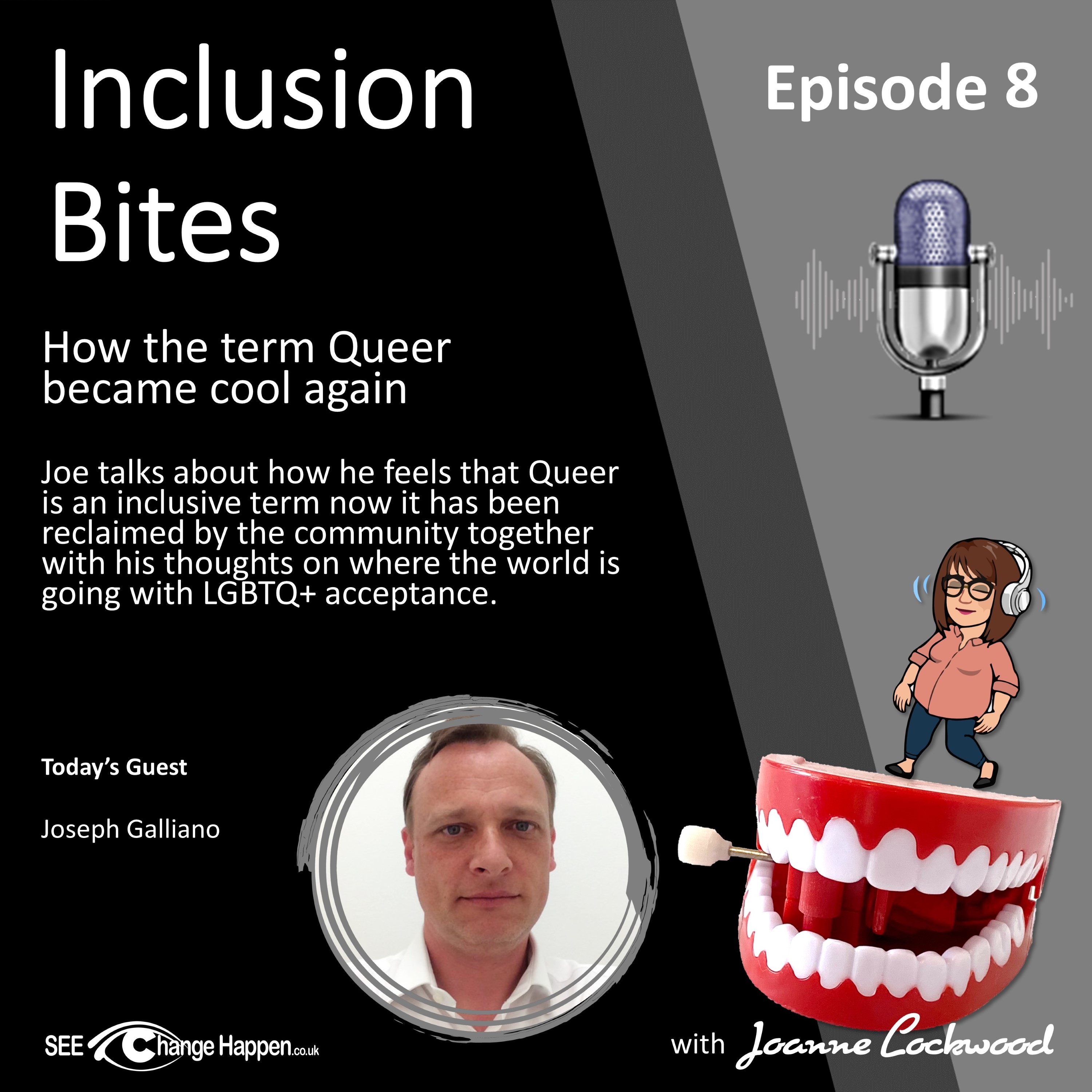
How The Term Queer Became Cool Again
with Joseph Galliano-Doig · 13 June 2020
Lived Experience Identity
Joanne Lockwood is joined by Joseph Galliano-Doig, co-founder and CEO of Queer Britain, to explore how the word “queer” shifted from a weaponised slur to a reclaimed, inclusive umbrella term. They discuss generational differences in how the term lands, the importance of self-identification, and how language, intent, and context shape who holds power in a conversation.
Joe shares his career across LGBTQ+ media and advocacy, and the motivation behind establishing the UK’s first national, bricks-and-mortar LGBTQ+ museum. Together they reflect on why a permanent space matters for visibility, cultural memory, and creating somewhere both queer and non-queer people can learn, connect, and feel proud of these histories.
The conversation also touches on life during lockdown, including the ways isolation can be especially difficult for people who are not out or who are living in hostile environments. They discuss workplace inclusion as a potential refuge, the pressures of constantly managing language and disclosure, and the wider social climate—including trans rights debates in the media and renewed global attention on racism and allyship.
About Joseph Galliano-Doig
One-sentence summary
Joseph Galliano-Doig believes that when a community claims its own story — including the words once used to wound it — it transforms shame into power and secures dignity for generations to come.
---
Synopsis (two paragraphs)
Joseph Galliano-Doig is someone who has lived long enough to feel the ground shift beneath his feet. As a young man, he knew that loving another man could have meant prison. Today, he lives openly with his husband in a rural village, aware of how extraordinary that arc really is. He has edited magazines, built networks and led teams, but when asked about his superpower, he says simply: “other people”. What moves him most are the quiet emotional moments — a tear in a business meeting, a mother and daughter standing side by side after one has come out — that tell him this work matters more than reputations or titles ever could.
He co-founded Queer Britain not out of institutional ambition, but from something deeply personal: he knows what it means not to see yourself reflected in the culture around you. He imagines a young woman and her mother walking through a museum together, both leaving “excited with the possibilities of the world”. For Joseph, bricks and mortar are not about prestige; they are a signal that queer lives are valued, protected and woven into the national story. He is trying to safeguard gains that arrived quickly and could unravel just as quickly — to create a beacon that says: we were here, we are here, and we belong.
---
10 Small, digestible concepts for easy learning
1. Reclaiming a word reclaims power.
When Joseph embraces “queer”, he shifts the force of the word from violence to self-definition.
2. Intent carries more weight than vocabulary.
“You hear the violence rather than the word” when harm is intended.
3. Representation changes emotional weather.
Seeing yourself reflected in culture softens shame and builds possibility.
4. Bricks and mortar signal permanence.
A physical space says: these stories are not temporary or negotiable.
5. Progress can unravel.
Rights gained quickly can be lost quickly if they aren’t rooted in shared memory.
6. Most people just want to get on with their lives.
Being turned into a public debate is exhausting.
7. Privilege shapes perspective.
A white, middle-class gay man sees a different landscape from someone who is trans or Black.
8. Identity is contextual.
Different parts of us surface depending on safety, company and circumstance.
9. Silence can be self-protection.
Choosing not to correct someone may be about safety, not shame.
10. Community is an act of hope.
Building together is a refusal to let fear define the future.
---
The “why” in the story
What they believe is true about people
That most people are not trying to be cruel; they are trying to live. And when given space to understand, they often respond with kindness.
What they cannot unsee
How easily progress can reverse. How familiar today’s rhetoric about trans people feels compared to how gay men were spoken about decades ago.
What they are no longer willing to tolerate
Queer lives being treated as temporary trends or cultural footnotes. Communities being divided for political gain.
What they are trying to build instead
A permanent, visible home for queer stories that locks dignity into the fabric of national life — a beacon for those who need to feel less alone.
---
### Narrative structure
1. The trigger:
Realising, in his own lifetime, that he moved from potential criminal to married man — and that such change, while exhilarating, is fragile.
2. The tension:
The emotional arithmetic of everyday life: whether to correct someone who assumes he has a wife; whether holding hands should feel political; whether today’s rights will withstand tomorrow’s culture wars.
3. The insight:
If stories are not preserved and positioned “in the heart of the mainstream”, they can be rewritten or erased. Memory is protection.
4. The pivot:
Instead of simply commenting on culture, he chose to build something physical — a museum — that anchors queer contribution in public life.
5. The destination:
A world where a young person and their parent can walk into a national institution and leave “excited with the possibilities of the world” — not arguing over whether they belong in it.
---
Five key takeaways and learning points
1. Language can wound — or liberate.
So what: Pay attention to who holds the power in any exchange, and whether your words restore or remove it.
2. Visibility is not vanity; it’s survival.
So what: Cultural presence reduces isolation and protects future rights.
3. Rights are not self-sustaining.
So what: Safeguarding progress requires ongoing care, not complacency.
4. Everyday moments carry emotional cost.
So what: Small corrections, hesitations and calculations add up — create spaces where people don’t need to double-think who they are.
5. Solidarity must be intentional.
So what: Divisions are often manufactured; connection must be chosen and defended.
---
Ten distinct ideas explained
1. Reclamation as healing
When a community adopts a slur as self-description, it rewrites the emotional script of that word. The sting lessens because the speaker now chooses it.
2. The museum as mirror
Cultural institutions tell us whose lives matter. Not being shown suggests invisibility; being displayed signals worth.
3. Fragility of acceptance
Legal change can feel permanent, but political tides shift. Without collective memory, gains are easier to dismantle.
4. Debate versus lived life
People rarely want to be symbols; they want ordinary joys — marriage, work, family — without scrutiny.
5. Intersectional reality
Comfort for one group does not equal safety for all. Progress is unevenly distributed.
6. The emotional labour of correction
Deciding whether to clarify “husband” instead of “wife” is a calculation of risk, energy and loyalty.
7. Culture wars as distraction
Dividing marginalised groups weakens solidarity and redirects blame rather than solving injustice.
8. Community as refuge
During lockdown, many lost the spaces where they could safely be themselves. Being cut off from affirming spaces can erode identity.
9. Visibility in hostile narratives
Negative media stories amplify rare harms and drown out ordinary happiness, shaping public perception unfairly.
10. Hope as discipline
Joseph describes himself as an “anxious optimist”. Hope isn’t naïve; it’s a conscious decision to look for what can be built.
---
How people should change as a result
### 1. Think
- Shift from “Is this still necessary?” to “Who might need this more than I realise?”
- Recognise that progress is not linear or guaranteed.
- Understand that cultural institutions shape whose dignity feels secure.
- Consider how unevenly safety is distributed, even within the same community.
### 2. Feel
- From defensiveness to curiosity about others’ lived experiences.
- From complacency to gentle vigilance.
- From guilt to shared responsibility.
- From fear of saying the wrong thing to willingness to learn.
### 3. Act
- Use the language people choose for themselves — and correct gently when you err.
- Support cultural projects that preserve underrepresented histories.
- Create environments — at work or socially — where people don’t have to calculate whether it’s safe to be honest.
- Speak up when rhetoric seeks to divide marginalised groups.
- Ask, simply and sincerely: “How can I help?”
- Notice who is not in the room — and help make space.
---
One thing to remember
When we honour our stories in public, we make belonging harder to erase.