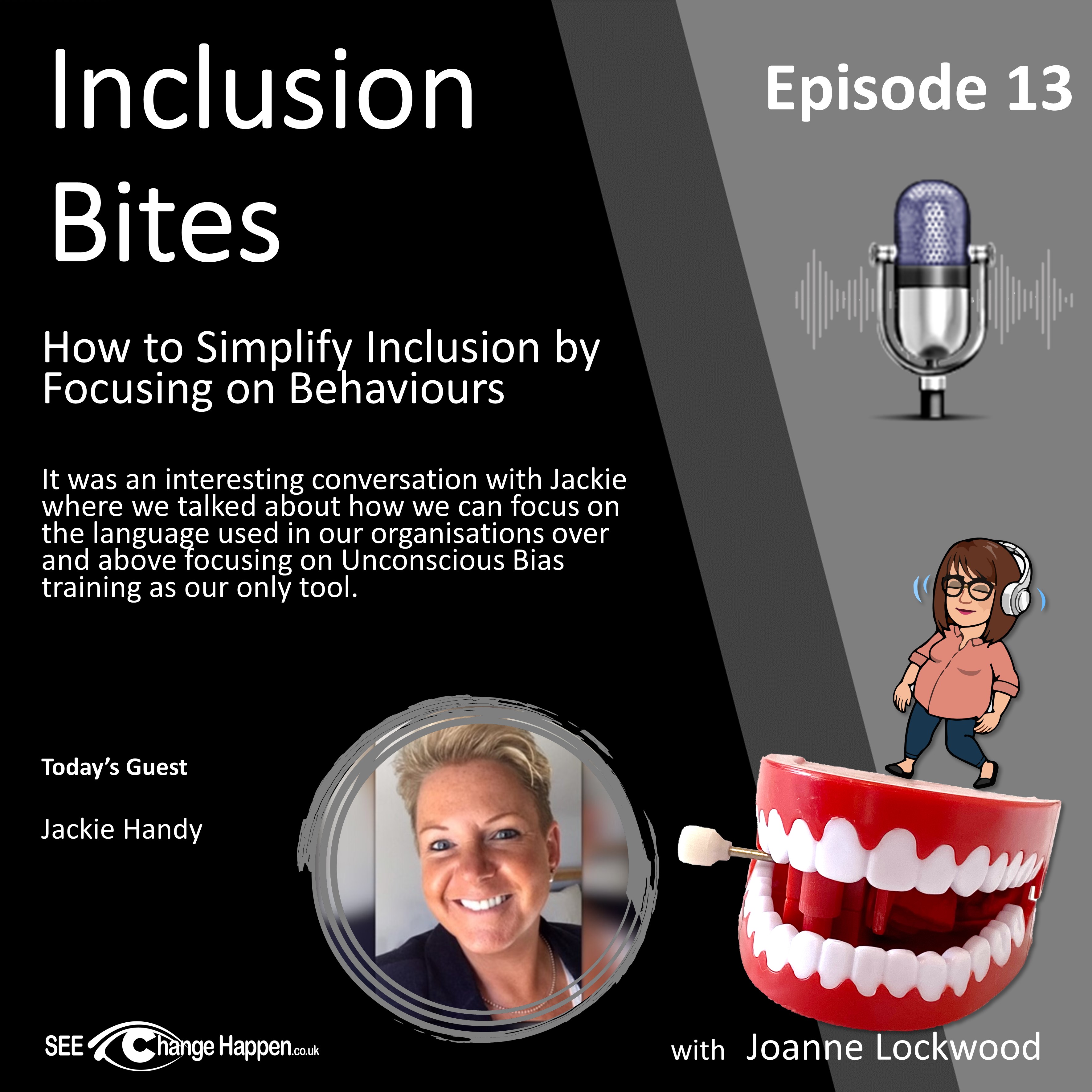
How To Simplify Inclusion By Focusing On Behaviours
with Jackie Handy · 10 September 2020
Workplace Culture Systems
Joanne Lockwood is joined by Jackie Handy to explore how organisations can make inclusion feel more practical and achievable by focusing on everyday behaviours and language, rather than relying on unconscious bias training as a standalone solution.
They discuss why bias training can sometimes trigger defensiveness or shame, and why inclusion efforts work best when they are part of a broader, ongoing approach that builds understanding, reflection, and action. The conversation looks at privilege, systemic barriers, and the importance of creating safe conditions for people to have honest discussions that may feel challenging.
Jackie and Joanne also examine what proactive allyship looks like in practice, including the courage to challenge harmful comments and the vulnerability to admit what we do not yet know. They reflect on how storytelling can educate while also risking tokenism if organisations treat difference as performance rather than embedding change into culture.
The episode closes with a vision of inclusion and belonging becoming so embedded in organisations that it no longer needs to be labelled as a separate initiative, supported by small, consistent behavioural steps taken by everyone.
About Jackie Handy
One-sentence summary
Jackie Handy believes inclusion begins not with blame or labels, but with ordinary people choosing brave, loving behaviours that protect each other’s dignity.
---
Synopsis
Jackie Handy speaks about inclusion in a way that feels personal rather than procedural. As a white woman who identifies as lesbian, she understands what it means to carry both privilege and disadvantage in the same body. She knows how it feels to want someone to “stand up for me, take my side, fight my corner,” and she has also felt the sting of having her own privilege exposed. What shaped her isn’t theory — it’s lived contradiction. She has seen defensiveness rise in a room when people are told they are biased. She has felt her own fragility flare when challenged. And she has stayed curious instead of walking away.
What she is trying to change is the tone of the conversation. She longs for a world where we don’t begin with accusation but with understanding — where we talk about behaviours, courage and vulnerability before we talk about bias. Because she knows what happens when people feel shamed: they shut down. And when they shut down, the people who most need allyship feel alone. Jackie wants us to move from passive “I’m not racist” statements to proactive care. She is not interested in moral superiority. She is interested in everyday bravery — the kind that makes someone feel seen, defended and safe.
---
10 Small, digestible concepts for easy learning
1. Inclusion lives in behaviour, not intention.
What you do daily matters more than what you believe privately.
2. Privilege is not about wealth — it’s about head starts you didn’t ask for.
It’s the wind at your back that you barely notice.
3. Defensiveness is human, not proof you’re evil.
It’s often fear of being seen as a bad person.
4. Small steps build real trust.
Gentle progress lasts longer than dramatic declarations.
5. Vulnerability creates safety.
Saying “I don’t know, but I want to know” changes the tone of a room.
6. Allyship is active, not passive.
Silence rarely protects the person being harmed.
7. Identity is layered.
No one is only privileged or only disadvantaged.
8. Storytelling is powerful — but it must never become spectacle.
Difference is not entertainment.
9. You can respect a viewpoint without agreeing with it.
Respect is about dignity, not compliance.
10. Love is a serious strategy.
Seeing another human being first with compassion changes decisions.
---
The “why” in the story
What they believe is true about people
Jackie believes there is good in everyone, and that most people want to do better when they feel safe enough to try.
What they cannot unsee
She cannot unsee how shame shuts people down — and how silence leaves those being bullied or marginalised feeling abandoned.
What they are no longer willing to tolerate
She is no longer willing to accept passive neutrality: the quiet shrug of “I’m not prejudiced” while harmful behaviour continues.
What they are trying to build instead
She is building a culture of everyday courage — where people practise vulnerability, challenge unfairness gently but firmly, and see one another first as fellow human beings.
---
Narrative structure
1. The trigger:
Years of watching organisations invest heavily in bias training while inclusion barely shifted. Combined with personal memories of wanting someone — anyone — to speak up when she was being targeted.
2. The tension:
Rooms go cold when people feel accused. Leaders recoil when their privilege is challenged. Even experienced professionals feel defensive. The work risks turning into blame or theatre.
3. The insight:
“You don’t have to always agree with somebody’s viewpoint to respect it.”
If we begin with shared human behaviours — courage, understanding, education, love — people engage instead of retreat.
4. The pivot:
Shift the focus from labelling bias to exploring privilege. From compliance sessions to everyday conversations. From identity boxes to “the person to the left and right of me.”
5. The destination:
A future where belonging is ordinary — where D&I is no longer a department because humane behaviour is simply how we work and live.
---
Five key takeaways and learning points
1. Neutrality is not harmless.
If you don’t speak up, someone else may feel completely alone.
2. Discomfort needs support, not shock tactics.
People grow when challenged kindly, not cornered publicly.
3. Behaviour crosses every identity line.
Anyone can practise courage or empathy, regardless of background.
4. Education is ongoing, not a badge.
The moment you think you know enough is the moment you’ve stopped listening.
5. Inclusion is relational, not performative.
It’s built in one-to-ones, team meetings, quiet conversations — not just on stages or social media.
---
Ten distinct ideas explained
1. Fragility is protective, not malicious.
When challenged, many react defensively to protect their self-image. Recognising this makes growth possible without humiliation.
2. Privilege is relational, not absolute.
Someone can experience advantage in one area and marginalisation in another. This complexity deserves respect.
3. Being seen changes energy.
When someone’s lived experience is acknowledged, tension softens; invisibility creates exhaustion.
4. Tokenism exhausts the “represented”.
When difference becomes display, the person carries the emotional labour for everyone else’s learning.
5. Courage feels risky because it is.
Challenging a family member or senior colleague can feel unsafe — but silence carries its own cost.
6. Belonging is an innate need.
To feel your contribution matters and that you are valued shapes confidence and wellbeing.
7. Labels can both clarify and confine.
Categories help us understand patterns, but they can also reduce people to a single trait.
8. Safety enables honesty.
When people trust that respect is guaranteed, harder truths surface constructively.
9. Education empowers responsibility.
Giving people language and understanding enables them to act, not just react.
10. Love reframes disagreement.
Seeing someone first as human shifts conflict from attack to conversation.
---
How people should change as a result
1. Think
- Move from “Am I a good person?” to “How do my behaviours affect others?”
- See privilege as context, not accusation.
- Understand that discomfort can signal growth, not guilt.
- Recognise inclusion as relational, not reputational.
- Replace labels in your mind with “fellow human being”.
2. Feel
- Shift from defensiveness to curiosity.
- From guilt to responsibility.
- From fear of getting it wrong to willingness to try.
- From indifference to care.
- From cynicism to hope.
3. Act
- Speak up, even gently, when you hear exclusionary remarks.
- Start one conversation a week from “I don’t know — can you help me understand?”
- Reflect privately on where society has eased your path — and how you can use that advantage consciously.
- Build simple agreements in teams about respectful dialogue.
- Make inclusion part of routine check-ins, not special events.
- Practise naming positive behaviours you see in others.
- Keep learning — read, listen, ask — without expecting praise for doing so.
---
One thing to remember
Inclusion is not a policy to implement — it is a daily choice to love the person in front of you enough to act differently.