Inclusive Leadership Management
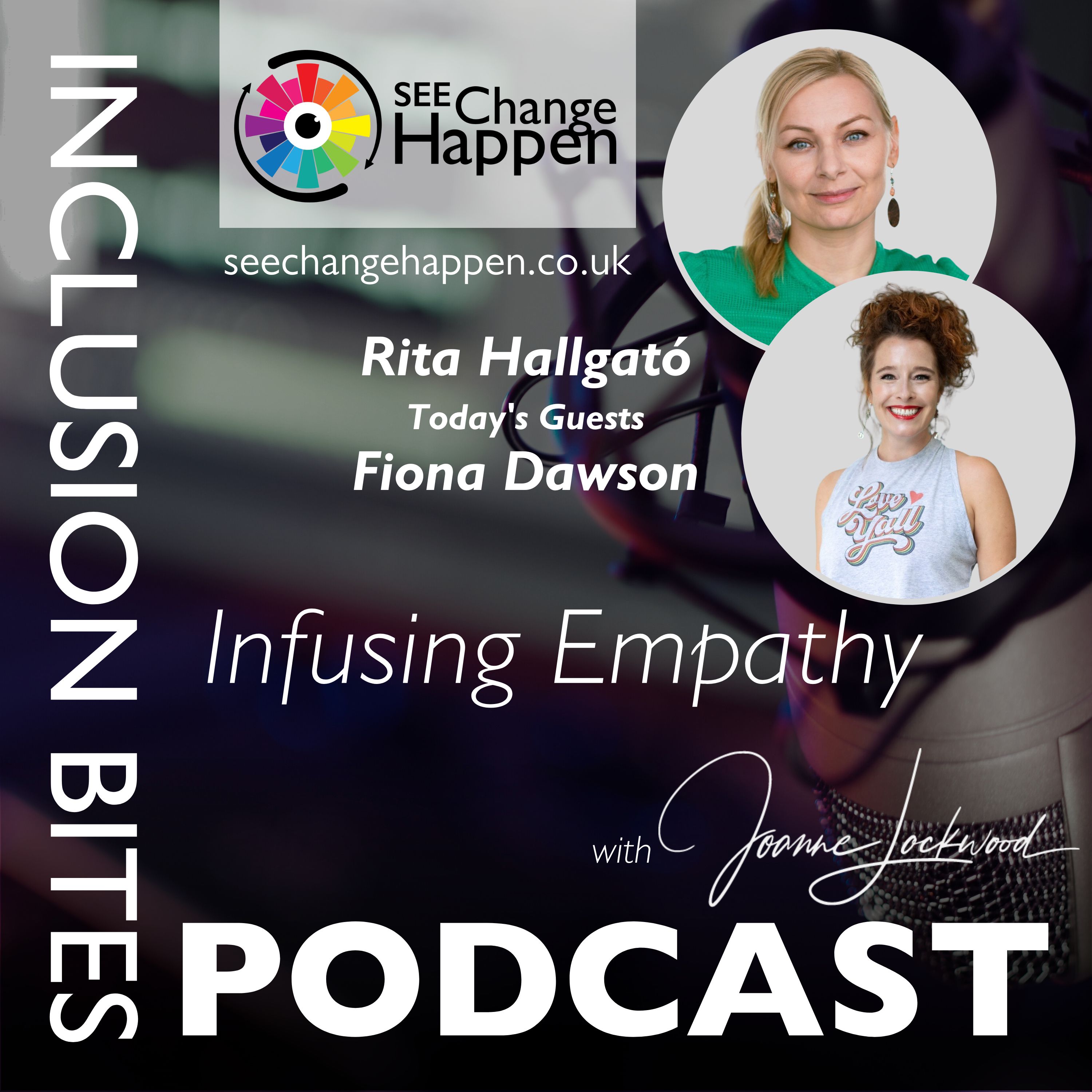
Joanne Lockwood is joined by DEI and storytelling collaborators Rita Hallgató and Fiona Dawson to explore what it means to “infuse empathy” into workplace inclusion efforts.
They discuss how personal storytelling can help colleagues understand one another beyond surface differences, and why creating trust and psychological safety is essential if people are going to share lived experience in a corporate setting. The conversation also looks at the current backlash and budget cuts around DEI, arguing for a shift in mindset from viewing inclusion as a cost to treating it as an investment tied to better people experiences, retention, and performance.
Fiona shares lessons from her filmmaking work, including projects spotlighting transgender service members, and how those experiences translate into creating spaces where people feel seen and heard at work. Rita and Joanne consider practical levers inside organisations—such as breaking down silos between DEI, HR, and marketing; building authentic ERG participation; and improving inclusive hiring—so inclusion becomes embedded in culture rather than treated as a standalone initiative.
Across the episode, the central message is that empathy is not just personal—it’s a foundation for sustainable culture change and more inclusive leadership.
About Fiona Dawson
One-sentence summary
Fiona believes that if we let people be seen in their full, complicated humanity, fear loosens its grip and love quietly does the work that policies alone cannot.
---
Synopsis
Fiona Dawson did not set out to become a filmmaker. She left corporate life in 2010 with no film school training and chose risk over safety because she believed stories could reach places arguments could not. Living across continents — from Bangladesh to Portugal to the United States — she learned what it means to be an immigrant, an outsider, a bridge between worlds. As a bisexual, cisgender woman living with a non-apparent disability, she speaks of her identities plainly, not for attention but for connection. “Labels help you find each other,” she says, offering herself as proof that identity can be a doorway rather than a dividing line.
Her work with transgender service members in the United States military changed her. Hearing people whisper to her after screenings — thanking her, quietly confiding they were early in their transition — showed her the cost of invisibility and the relief of being seen. What she is trying to change is not simply workplace practice but emotional climate. She wants workplaces — where most people spend the majority of their waking lives — to feel human. She believes vulnerability is not weakness but permission. If we can create spaces where straight white men, queer veterans, immigrant women and everyone in between feel included in the conversation, then the door stops being something to bang on and becomes something we open together.
---
10 Small, digestible concepts for easy learning
1. Stories reach where statistics can’t.
Facts inform the mind; lived experience softens the heart.
2. Vulnerability invites vulnerability.
If you want someone to open up, you have to risk opening first.
3. Inclusion is a feeling, not a policy.
It lives in how people are treated day to day.
4. Fear is often a reaction to change, not to people.
Help someone through the change, and the resistance eases.
5. No one is only one thing.
We are all icebergs — most of who we are sits beneath the surface.
6. Labels can be bridges.
They help people recognise themselves and find one another.
7. Privilege doesn’t cancel pain.
Even those in power carry stories that need space.
8. Workplaces are human ecosystems.
Feelings don’t stay at home when people clock in.
9. Small actions grow big shifts.
A single authentic story can ripple further than a glossy campaign.
10. Love is practical.
Kindness, courage and empathy are not soft extras — they shape culture.
---
The “why” in the story
What they believe is true about people
That beneath surface identities, people long to be recognised, connected and safe enough to be themselves.
What they cannot unsee
The relief in someone’s eyes when they realise they are not alone. The quiet confessions after a screening. The cost of policies that erase real human lives.
What they are no longer willing to tolerate
Spaces where emotion is treated as weakness, where some identities are welcomed and others quietly sidelined, where straight white men are framed as the enemy rather than part of the solution.
What they are trying to build instead
Workplaces and communities where everyone’s story counts, where courage is collective, and where empathy carries people through change.
---
Narrative structure
1. The trigger:
Leaving corporate life to pursue filmmaking. Beginning in 2012 to document the lives of transgender service members still banned from serving openly. Watching audiences moved to tears — and hearing people whisper, “That’s me.”
2. The tension:
Operating in Texas while political rhetoric shifts. Working in a climate where diversity initiatives are questioned or cut. Navigating the feeling that some groups — especially straight white men — experience inclusion work as exclusion.
3. The insight:
“You can’t build inclusion by excluding.” Real change requires expanding the table, not rearranging the seating. Self-awareness comes first; then awareness of others; then courageous action.
4. The pivot:
Moving from lecturing to storytelling. From arguing with detractors to helping them see themselves as part of the conversation. From abstract principles to human exchange.
5. The destination:
A world where people feel they belong at work and beyond — where joy exists above the clouds of fear, and where empathy is habitual rather than exceptional.
---
Five key takeaways and learning points
1. If you want someone to listen, help them feel.
Stories humanise what debate polarises.
2. Everyone needs to see themselves in the work.
When inclusion excludes, it breeds defensiveness instead of solidarity.
3. Change feels threatening before it feels freeing.
Acknowledge the fear, don’t mock it — and guide people through.
4. Authenticity travels further than performance.
Shiny campaigns cannot replace lived truth.
5. Lead with humanity, not hierarchy.
Titles matter less than whether people feel safe enough to speak.
---
Ten distinct ideas explained
1. Work is emotional whether we admit it or not.
People carry grief, pride, fear and joy into the office; pretending otherwise diminishes them.
2. Invisibility is exhausting.
When someone cannot name who they are, it drains energy that could fuel creativity and contribution.
3. Representation saves lives quietly.
A film, a story, a shared experience can show someone their future is possible.
4. Fear of losing status fuels resistance.
When people feel sidelined, they harden; when they feel included, they soften.
5. Intersectionality is lived, not theoretical.
A person may be queer, disabled, immigrant and a leader all at once — systems that ignore this flatten their humanity.
6. Empathy reduces polarisation.
Seeing the person behind the label interrupts easy stereotypes.
7. Policy without culture is brittle.
You can change the rules, but if hearts stay closed, exclusion persists.
8. Courage is contagious.
When one person shares honestly, it grants others permission to do the same.
9. Marketing shapes belonging.
The stories organisations choose to tell signal who is welcome and who is not.
10. Joy is not naive.
Believing in a better future sustains the stamina needed for long-term change.
---
How people should change as a result
1. Think
- Move from “Who is this work for?” to “Where do I fit into this work?”
- Replace “This is political” with “This is personal.”
- Stop seeing identity as a competition for attention.
- Understand that inclusion expands space; it does not shrink it.
2. Feel
- From defensiveness to curiosity.
- From fear of saying the wrong thing to willingness to learn.
- From guilt about privilege to responsibility with privilege.
- From cynicism about change to cautious hope.
3. Act
- Share one piece of your own story at work that others wouldn’t guess.
- Ask someone about their lived experience — and listen without fixing.
- Audit whose stories are amplified in your organisation’s communications.
- Invite someone outside your usual circle into a project decision.
- Support employee groups that centre connection, not just compliance.
- When someone is targeted or dismissed, say something — even briefly.
- Choose businesses that reflect your values with your spending power.
---
One thing to remember
Inclusion begins the moment someone feels fully seen — and that starts with the courage to see each other.