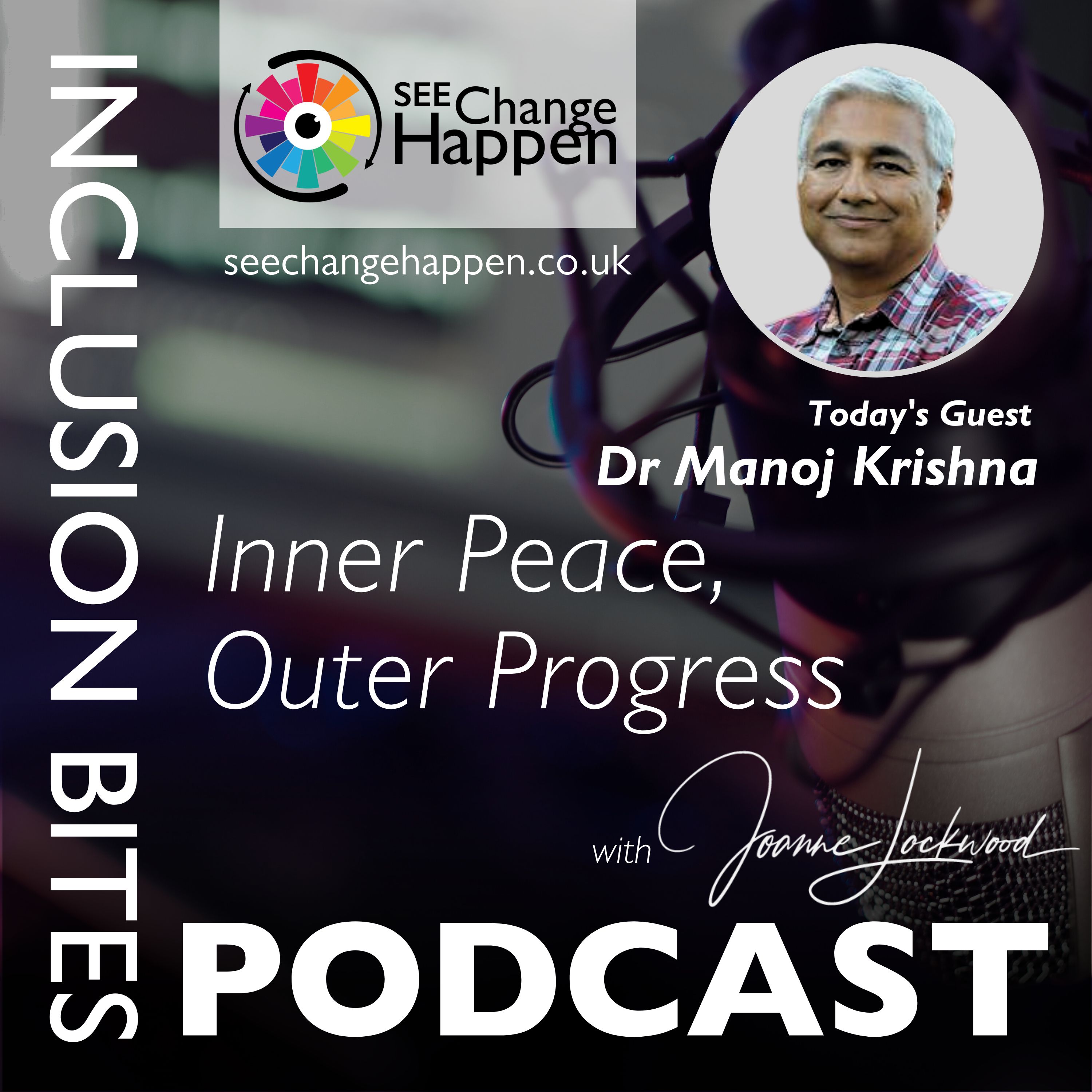
Inner Peace, Outer Progress
with Manoj Krishna · 05 September 2024
Mental Health Wellbeing Trauma
Joanne Lockwood is joined by Dr Manoj Krishna, a former spine surgeon who left medicine to focus on reducing human suffering through the Human Wisdom Project and his HappierMe app.
Together they explore how greater self-understanding can shift how we think, feel, and behave, with ripple effects for relationships, conflict, and society. Manoj argues that many of our biggest challenges—stress, anxiety, loneliness, addiction, and persistent conflict—are fuelled by unseen patterns of conditioning and fear, and that learning to question our thinking can open the door to calmer, more intelligent choices.
The conversation also critiques how education can suppress curiosity, and makes the case for teaching self-awareness and emotional understanding as core life skills. Using stories from work with children, they discuss identity, difference, and the importance of mixing with people unlike ourselves to build connection and reduce division. The episode closes with practical encouragement to start with curiosity and simple questions, and pointers to Manoj’s resources for those who want to go further.
About Manoj Krishna
One-sentence summary
Manoj Krishna believes that the peace we search for in possessions, power and protection can only be found by turning inward and understanding our own minds — and that doing so could change not just individual lives, but the future of humanity.
---
Synopsis
Manoj Krishna didn’t arrive at this work through theory — he arrived through heartbreak. After a ten-hour spinal surgery, driving home exhausted, he heard on the radio that a children’s hospital had been bombed. He remembers hearing the children screaming. In that moment, something shifted. “We humans need to do better,” he says. Not as an accusation — as a plea. He had spent years repairing bodies. Suddenly he felt called to address something deeper: the suffering created by the unexamined human mind. So he left medicine and began sitting with children, asking questions rather than giving answers, discovering what he calls their “innate intelligence”.
What he is trying to change is deceptively simple. He believes we are highly capable but not properly educated about ourselves. We are taught to acquire, defend, compete, justify — but not to pause and ask why. He sees wars, broken relationships, anxiety, addiction and loneliness not as separate crises, but as symptoms of minds running on unconscious conditioning and fear. What he wants to protect is peace — not as an abstract ideal, but as a lived, daily experience inside people’s hearts. Because if a person can live in peace with themselves, he insists, “then I can live in peace with you. And then we can have peace in the world.”
---
10 Small, digestible concepts for easy learning
1. We are capable — but not necessarily intelligent.
Capability is skill; intelligence is understanding ourselves.
2. Education should draw out, not just pour in.
Real growth comes from awakening inner wisdom, not stuffing in more information.
3. Identity can comfort you — and trap you.
The moment you cling to an identity, someone else can manipulate it.
4. Children remember what adults forget.
They see common humanity before they learn division.
5. Pleasure fades; peace remains.
Chasing stimulation hides inner emptiness but never resolves it.
6. Fear is often imagination projected as reality.
Our minds create worst-case futures and we react as if they’re happening now.
7. Loneliness isn’t lack of people — it’s lack of depth.
Real connection requires awareness, not just proximity.
8. We justify everything when unexamined.
Without reflection, even harmful behaviour feels reasonable.
9. Curiosity is the doorway to wisdom.
The simple question “Why am I thinking this?” changes everything.
10. Change doesn’t require crisis — only awareness.
You don’t have to wait for the crash to slow down.
---
The “why” in the story
What they believe is true about people
That every human being has innate intelligence and the capacity for peace — even if it is buried under fear, conditioning and habit.
What they cannot unsee
The scale of preventable suffering — children in war zones, young people self-harming, relationships quietly collapsing, millions living anxious, lonely lives.
What they are no longer willing to tolerate
A world where we educate for performance but not self-understanding. A culture that normalises stress, conflict and endless consumption as ‘just the way life is’.
What they are trying to build instead
A world where children and adults learn how their minds work; where peace is cultivated internally; where relationships have depth; where difference becomes curiosity, not threat.
---
Narrative structure
1. The trigger:
Hearing children scream after a hospital bombing. That moment crystallised a thought: political fixes are not enough; the root problem is in the human mind.
2. The tension:
People resist change. Many don’t know they are stressed, anxious or deeply conditioned. Others believe peace is impossible, or that someone else should fix the world. Manoj faces the challenge of inviting reflection without imposing belief.
3. The insight:
“The question has the power to open the door to wisdom.” When people — especially children — are asked to explore their own thinking, clarity emerges naturally.
4. The pivot:
He left surgery. He stepped into classrooms. He began treating not spines, but suffering at its psychological root. He built tools that ask questions instead of giving instructions.
5. The destination:
A world where life feels spacious rather than frantic, where relationships are deep rather than transactional, where peace isn’t chased — it’s lived.
---
Five key takeaways and learning points
1. Peace is an inner skill, not an external reward.
So what: If you cultivate it internally, your circumstances no longer dictate your worth or stability.
2. Unexamined identity fuels division.
So what: When you see identity as conditioning rather than essence, you are less easily manipulated.
3. Consumerism often masks emptiness.
So what: Reducing compulsive acquisition frees time, money and emotional energy.
4. Fear is amplified by imagination.
So what: Questioning fearful thoughts lowers anxiety and improves decision-making.
5. Curiosity dissolves prejudice.
So what: Mixing with difference enriches rather than threatens your life.
---
Ten distinct ideas explained
1. Innate intelligence
Beneath social roles and conditioning, each person has insight available to them — when they slow down enough to access it.
2. Conditioning shapes perception
Beliefs about nation, race, success and safety often arise from upbringing, not deliberate choice — yet we defend them fiercely.
3. Attachment to identity
When identity becomes rigid, difference feels like danger, and conflict escalates quickly.
4. The pleasure cycle
External stimulation creates short bursts of satisfaction, followed by emptiness — driving further consumption.
5. Inner boredom as driver
Restlessness fuels overwork, overspending and overindulgence. Sitting with it can transform it into calm.
6. Fear as projection
Anxiety often stems from imagined futures — mental movies mistaken for reality.
7. Emotional intelligence
Understanding your own reactions reduces impulsive harm and strengthens relationships.
8. Loneliness amid connection
Being surrounded by people does not guarantee being seen.
9. Curiosity as bridge
Approaching difference with interest rather than judgement builds belonging across divides.
10. Self-inquiry as prevention
Reflection today prevents breakdown tomorrow.
---
How people should change as a result
1. Think
- Move from “That’s just the way I am” to “How did I become this way?”
- Shift from blaming circumstances to examining reactions.
- Rethink happiness as peace, not stimulation.
- See identity as influence, not absolute truth.
- Understand stress as a signal to reflect, not a badge of honour.
2. Feel
- From defensiveness to curiosity.
- From fear of difference to interest.
- From scarcity to sufficiency.
- From restless craving to quiet contentment.
- From helplessness to personal responsibility.
3. Act
- Pause daily and ask: Why am I thinking this right now?
- Spend time with someone unlike you — and listen.
- Notice moments of consumption driven by emotion, not need.
- Replace one purchased pleasure with a shared or nature-based experience.
- Reflect on one conflict and examine your part in it.
- Practise sitting with boredom without reaching for stimulation.
- Start one honest conversation about stress or loneliness.
---
One thing to remember
If you can live in peace with yourself, you change the world without raising your voice.