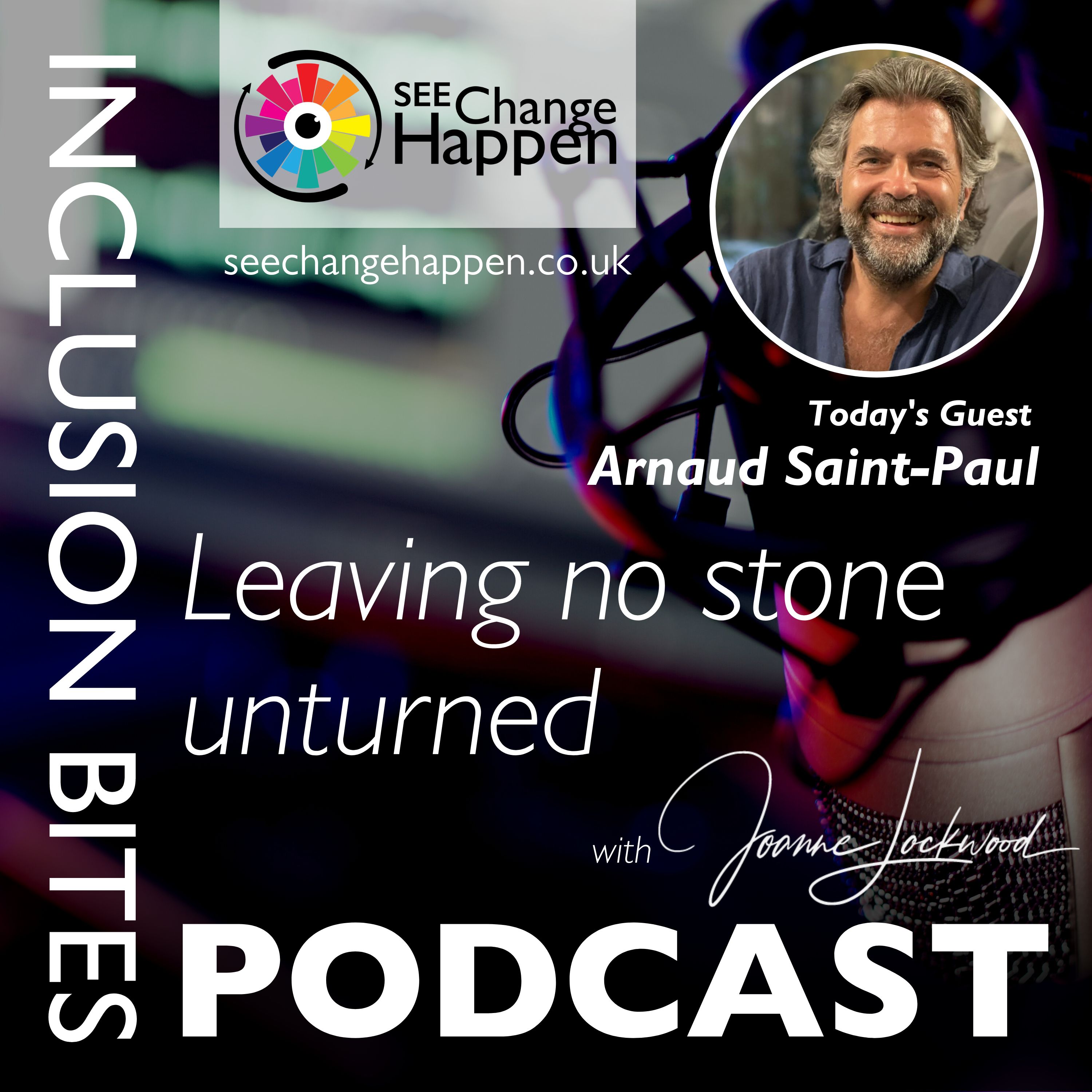
Leaving No Stone Unturned
with Arnaud Saint-Paul · 13 July 2023
Lived Experience Identity
Joanne Lockwood speaks with Arnaud Saint-Paul about what it means to “leave no stone unturned” in understanding our lives: noticing repeating patterns, stepping off autopilot, and making conscious choices that realign us with who we are. Arnaud outlines a framework he has developed over decades to help people interpret everyday events as signals that reveal underlying beliefs, and he shares how small, consistent decisions can compound into lasting change.
The conversation weaves between personal and societal scales. Joanne reflects on the fear that comes with disrupting momentum and expectations, and shares her own experience of gender transition as a radical reorientation toward authenticity. Together they discuss how conscious choice often requires redefining identity, letting go of victimhood, and taking responsibility for one’s reactions and next steps.
They also explore implications for workplaces and society, including lessons from pandemic-era remote work and the tension between trust and control in leadership cultures. The episode touches on inclusion, backlash to change, and wider shifts around equality, sustainability, and generational change.
Joanne adds practical examples of habit change—improving health, stopping drinking, and building fitness through micro-choices—illustrating the episode’s central theme: change doesn’t have to be dramatic to be transformative, but it does require intention and follow-through.
About Arnaud Saint-Paul
One-sentence summary
Arnaud Saint-Paul believes that when we dare to pause, face who we really are, and make conscious choices instead of living on autopilot, we step into a freer, more loving version of ourselves — and that changes everything.
---
Synopsis
Arnaud Saint-Paul has spent nearly four decades turning over what he calls “every stone” in his own life — not out of restlessness, but out of a deep desire to understand why we repeat patterns, why freedom feels fleeting, and why so many of us drift along without questioning where we are going. He describes himself as “tapu’wa”, meaning eternal rebirth, and speaks with the conviction of someone who has wrestled with identity, fear and control. For him, life is not random; it is a mirror. Every difficult conversation, every recurring frustration, is feedback. He has dedicated his work to mapping that inner terrain so people can see what is really driving them.
What he is trying to change is simple but radical: he wants people to stop living on autopilot. He believes we mistake momentum for meaning, control for safety, and stability for truth. In doing so, we slowly drift away from who we are. Arnaud insists that at any moment we can pause and ask, “What do I choose now?” That small reclamation of agency — repeated over time — becomes transformation. He is not trying to build a world of rebels; he is trying to build a world of people who act from coherence rather than fear. In his vision, that shift — from cacophony to symphony — restores dignity, trust and love at both a personal and societal level.
---
10 Small, digestible concepts for easy learning
1. Autopilot is a habit, not a destiny.
Most of what we repeat isn’t fate — it’s unconscious choice.
2. A pause is power.
Between reaction and response, there is enough space to reclaim yourself.
3. Life mirrors, it doesn’t persecute.
Recurring tensions often reflect an unexamined belief.
4. Identity is not fixed — it’s layered.
We wear roles like coats; we are not the coats.
5. Freedom compounds.
Small conscious choices, repeated, create exponential change.
6. Control often hides fear.
The tighter we grip, the more we reveal what we don’t trust.
7. Rebirth is not dramatic — it’s incremental.
Every honest decision is a quiet beginning.
8. Stability can blind as much as struggle can awaken.
Comfort sometimes keeps us from asking necessary questions.
9. Tension is part of balance.
Growth often swings like a pendulum before finding harmony.
10. Harmony is alignment, not perfection.
It’s the feeling of being in tune with yourself, not flawlessness.
---
The “why” in the story
What they believe is true about people
Arnaud believes every person carries an inner coherence — a natural harmony — that gets buried under habits, fear and inherited expectations.
What they cannot unsee
He cannot unsee how often people repeat the same emotional patterns — in relationships, in workplaces, in leadership — while believing circumstances are to blame.
What they are no longer willing to tolerate
He is no longer willing to accept unconscious living as inevitable. He rejects the idea that we are merely products of our past or victims of our systems.
What they are trying to build instead
He is trying to build individuals and teams who act from awareness, who trust life more than fear, and who create environments rooted in responsibility and love.
---
Narrative structure
1. The trigger
Years of noticing patterns — in himself and in others — that repeated despite intelligence, status or effort. The same conflicts. The same frustrations. The same sense of something missing.
2. The tension
People resist change even when they are unhappy. Leaders cling to control. Individuals fear disrupting stability. Society swings between extremes. There is comfort in the familiar, even when it constrains us.
3. The insight
“We all have a pause button.” At any moment, we can stop reacting and consciously choose. That shift from autopilot to awareness changes not only behaviour, but identity.
4. The pivot
He created visual maps, frameworks and guided journeys to help others see their patterns clearly. Rather than blaming circumstances, he teaches people to ask what belief is operating beneath the surface.
5. The destination
A society where people trust themselves and each other enough to act from love rather than fear — where work, leadership and relationships feel like a symphony, not a struggle.
---
Five key takeaways and learning points
1. You are not your patterns.
So what: Once you see a pattern, you are no longer trapped inside it.
2. Control is often a coping strategy.
So what: Loosening control can unlock growth you’ve been blocking.
3. Small choices matter more than dramatic declarations.
So what: Daily honesty reshapes a life more than one bold gesture.
4. Tension signals transition.
So what: Resistance can indicate change is actually happening.
5. Responsibility is freedom.
So what: When you stop blaming, you regain authorship of your story.
---
Ten distinct ideas explained
1. Life as mirror
Situations are not random attacks but reflections of inner narratives. When you feel repeatedly undermined or overlooked, it may be echoing an internal belief about worth.
2. Autopilot living
Much of adult life runs on inherited scripts — family expectations, cultural norms, workplace roles — which slowly distance us from our authentic self.
3. Conscious choice
A deliberate response interrupts inherited momentum. It can be as small as choosing kindness over irritation.
4. Identity as layered garments
Roles — parent, leader, partner — are expressions, not essence. When over-identified, they constrain growth.
5. Masculine and feminine energies
He speaks of control versus flow, structure versus chaos. Imbalance creates tension; integration creates creativity.
6. Compounding change
Just as interest grows over time, so does self-trust. Small decisions build an internal architecture of confidence.
7. Privilege and awareness
Comfort can dull urgency. Those in survival mode often live more present; those with comfort may need to consciously cultivate presence.
8. Societal pendulum swings
Cultural shifts — remote work, identity movements — often overshoot before settling into balance.
9. Leadership as relationship
A company, in his view, has its own “consciousness”. The founder’s fears can limit its growth.
10. Symphony versus cacophony
When parts of ourselves compete, we feel fragmented. When aligned, life feels musical — not silent, but coherent.
---
How people should change as a result
1. Think
- Move from “This always happens to me” to “What belief might be repeating here?”
- Shift from seeing control as strength to seeing awareness as strength.
- See tension as information, not failure.
- Understand identity as evolving rather than fixed.
2. Feel
- From defensiveness to curiosity.
- From helplessness to agency.
- From fear of disruption to openness to rebirth.
- From guilt about the past to responsibility for the present.
3. Act
- Practise pausing before responding — even once a day.
- Journal one recurring pattern and ask what belief feeds it.
- Make one small conscious change this week (a conversation, a boundary, a habit).
- In leadership, delegate one area you normally control tightly.
- Ask someone you trust how they experience you under pressure.
- Replace one complaint with one deliberate action.
- Reflect weekly on where you acted from fear and where from alignment.
---
One thing to remember
You always have a pause button — and in that pause, your rebirth begins.