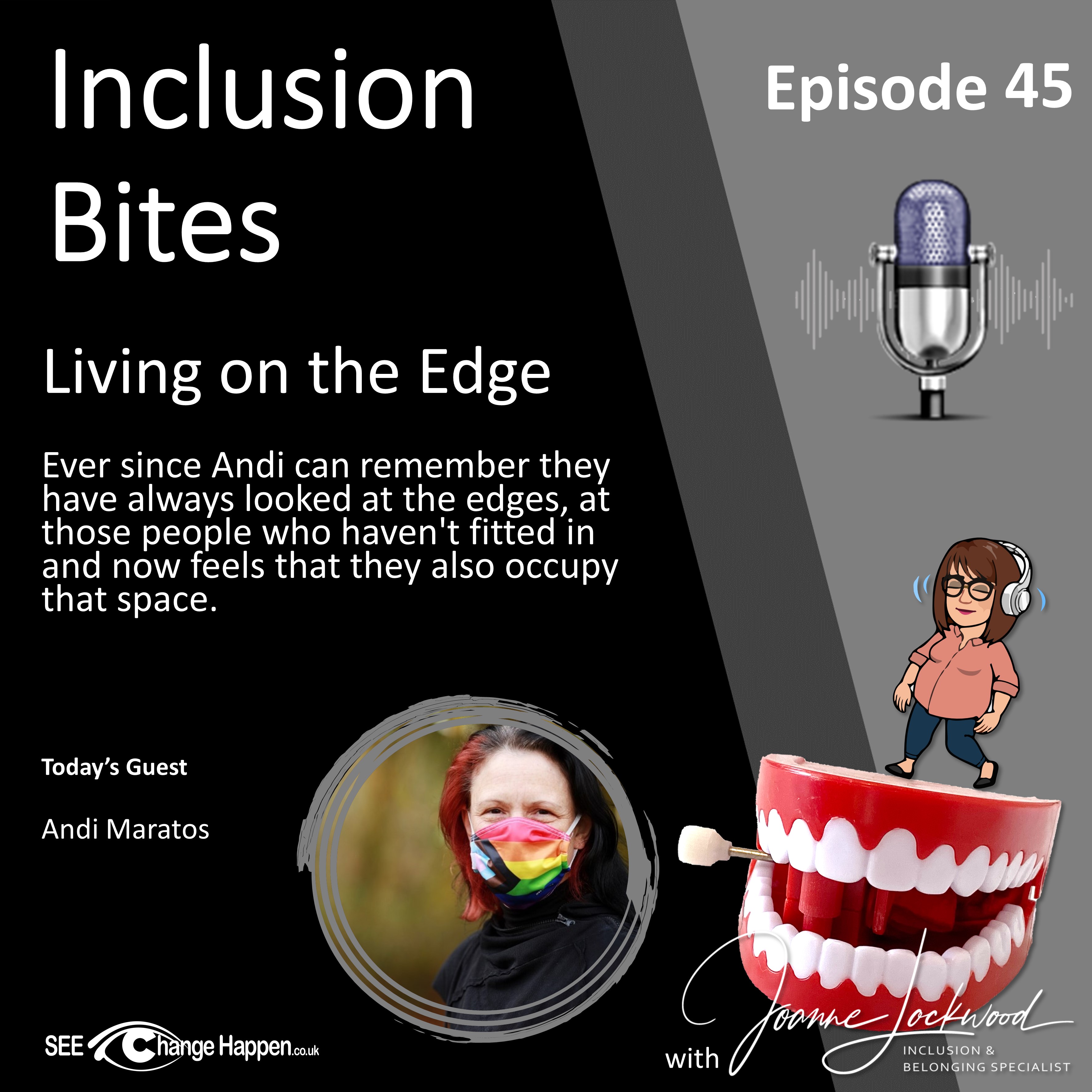
Living On The Edge
with Andi Maratos · 16 September 2021
Lived Experience Identity
Andi Maratos and host Joanne Lockwood explore what it means to live “on the edge” of the mainstream, and how that perspective can make it easier to see the world differently and create safer spaces for others.
Andi reflects on growing up feeling like they didn’t quite fit, “playing the game” in the corporate world, and the cost of hiding parts of their intrinsic self. They discuss the shift that can happen when a workplace makes room for individuality, and how authenticity can unlock confidence, reduce the need for masking, and support life and career decisions.
The conversation also looks outward: the role of allyship, the impact of public rhetoric on trans communities, and the difference between performative corporate Pride and meaningful action. Andi shares what organisations can do in practice, including reviewing policies such as transition-at-work guidance, resourcing internal networks, and backing inclusion with real investment.
Andi also talks about taking on the CEO role at Chrysalis (Gender Identity Matters), rebuilding and growing the charity’s support offer, and inviting listeners to get involved through donations, fundraising, and volunteering.
About Andi Maratos
One-sentence summary
Andi Maratos lives on the edge not out of rebellion, but because that’s where they learned to see clearly, love honestly, and build spaces where no one has to hide.
---
Synopsis
Andi Maratos never quite felt “in the middle”. Growing up, they “tried to play the game”, to fit into the expected path of career, conformity and quiet self-editing. But it meant “hiding who I was” — not just sexuality or gender identity, but the intrinsic, alternative, questioning self underneath it all. Redundancy became a rupture. Moving from a competitive corporate world into education, Andi experienced something simple yet transformative: a former army officer telling them they were welcome exactly as they were. That moment — permission without performance — flicked a switch. Andi realised they didn’t have to pretend. Living “on the edge” wasn’t a drawback; it was clarity.
From there, Andi stopped asking permission. They “came out as alternative”, found confidence in their difference, and eventually took the leap to lead Chrysalis — a small charity supporting trans, non-binary and questioning people and their families. It had six months left to live. Andi believed it could become something more. Under their leadership, it has grown from a fragile presence in the shadows to a visible, agile, values-driven organisation. What they are trying to change is simple and radical: that nobody should feel shame for existing. That difference is not a problem to soften, but a strength to celebrate. That belonging begins when someone says, “You are welcome here as you.”
---
10 Small, digestible concepts for easy learning
1. The edge gives you perspective.
When you don’t quite fit, you see the systems and assumptions others take for granted.
2. Hiding costs more than risk.
Pretending to belong drains you in ways courage never does.
3. Authenticity frees everything else.
When one part of you is released, the rest begins to grow.
4. Labels only hurt until we own them.
What is used to exclude can become language for pride when claimed.
5. Questioning is a place of growth, not failure.
Confusion is often the doorway to clarity.
6. Safety in the middle can become suffocation.
Comfort without reflection limits who you can become.
7. Belief in people is a superpower.
Change accelerates when someone truly believes you are capable.
8. Difference is not the opposite of professionalism.
Tattoos, pronouns, identity — none of these reduce competence.
9. Real allyship costs something.
Policy, funding, accountability — not just rainbow logos.
10. You don’t lose by developing yourself.
Even when relationships shift, you gain integrity.
---
The “why” in the story
What they believe is true about people
That people are inherently valuable. That most are acting on what feels true to them. That everyone deserves to become their authentic self without shame.
What they cannot unsee
The harm caused by denial, discrimination and silence. The extra emotional labour of “covering”. The mental toll of being shouted at — literally or metaphorically — for existing.
What they are no longer willing to tolerate
Pretence. Pinkwashing without policy. Debates about someone else’s reality. Organisations benefiting from diversity while failing to protect it.
What they are trying to build instead
Spaces where difference is ordinary. Where questioning is welcomed. Where trans and gender-diverse people — and their families — can breathe, grow and belong without armour.
---
Narrative structure
1. The trigger
Redundancy. A pivot from corporate competition to educational collaboration. A boss saying yes to visible self-expression. The internal moment of realising, “You don’t have to keep pretending.”
2. The tension
Living visibly brings risk — being shouted at, misunderstood, debated in public discourse. Leading a charity with six months to survive. Navigating corporate allyship that sometimes wants optics without substance.
3. The insight
“Living on the edge is valuable and creates change.”
The edge is not a weakness. It offers clarity, courage and innovation. Authenticity is expansive — it strengthens everything else.
4. The pivot
Stopping asking for permission. Taking leadership at Chrysalis. Putting infrastructure behind inclusion. Turning belief into action and growth.
5. The destination
A world where nobody is argued out of their existence. Where policies match pride flags. Where difference feels unremarkable. Where love isn’t negotiated.
---
Five key takeaways and learning points
1. You cannot grow while hiding.
So what: Secrecy may feel protective, but it silently erodes confidence and connection.
2. Support changes trajectories.
So what: One affirming response — one “yes, be you” — can alter someone’s life path.
3. Visibility is both risk and power.
So what: When people see difference at leadership level, it reframes what is possible.
4. Belonging takes resources, not rhetoric.
So what: If inclusion isn’t funded or embedded in policy, it won’t protect anyone when it matters.
5. Authenticity strengthens resilience.
So what: When you are no longer lying to yourself, criticism loses its sting.
---
Ten distinct ideas explained
1. The psychological cost of covering
Constant self-editing creates anxiety and exhaustion. When someone can stop masking, their energy returns to creativity and contribution.
2. Edges as innovation spaces
Those outside the centre often spot what others miss. Systems improve when margins are heard.
3. Shame versus dignity
Shame shrinks people into silence; dignity expands them into leadership.
4. Risk and fear in identity disclosure
Telling the truth about yourself may risk rejection — but silence risks self-erasure.
5. Belief as leadership practice
Andi leads by assuming capability. When people feel trusted, they rise.
6. Labels and power dynamics
Labels marginalise when imposed; they empower when chosen.
7. Policy as protection
Good intentions do not shield someone from harm. Clear policies can.
8. Allyship as participation, not performance
Real inclusion involves listening, funding and structural change — not seasonal branding.
9. Freedom from internalised judgement
When you stop believing you are “wrong”, external hostility loses authority.
10. Small organisations as catalysts
Agility allows small charities like Chrysalis to move quickly, innovate and deeply impact lives.
---
How people should change as a result
1. Think
- Move from “difference as disruption” to “difference as insight”.
- Understand that neutrality in identity debates often favours existing power.
- Recognise that authenticity is not indulgent — it is foundational.
- See questioning as growth, not instability.
- Remember that belonging requires infrastructure, not intention alone.
2. Feel
- Shift from defensiveness to curiosity.
- Move from pity to respect.
- Exchange discomfort for compassion.
- Replace cynicism with cautious hope.
- Trade guilt for responsibility.
3. Act
- Review whether your workplace has a clear transition-at-work policy.
- Introduce yourself with your pronouns in appropriate professional contexts.
- Challenge discriminatory behaviour in real time, not retrospect.
- Financially support organisations doing frontline support work.
- Audit whether your public commitments are matched by internal practice.
- Have one honest conversation with someone about what makes them feel safe or unsafe.
- Stop asking people to debate their own reality.
---
One thing to remember
Difference is not a flaw in the system — it’s the doorway to a freer one.