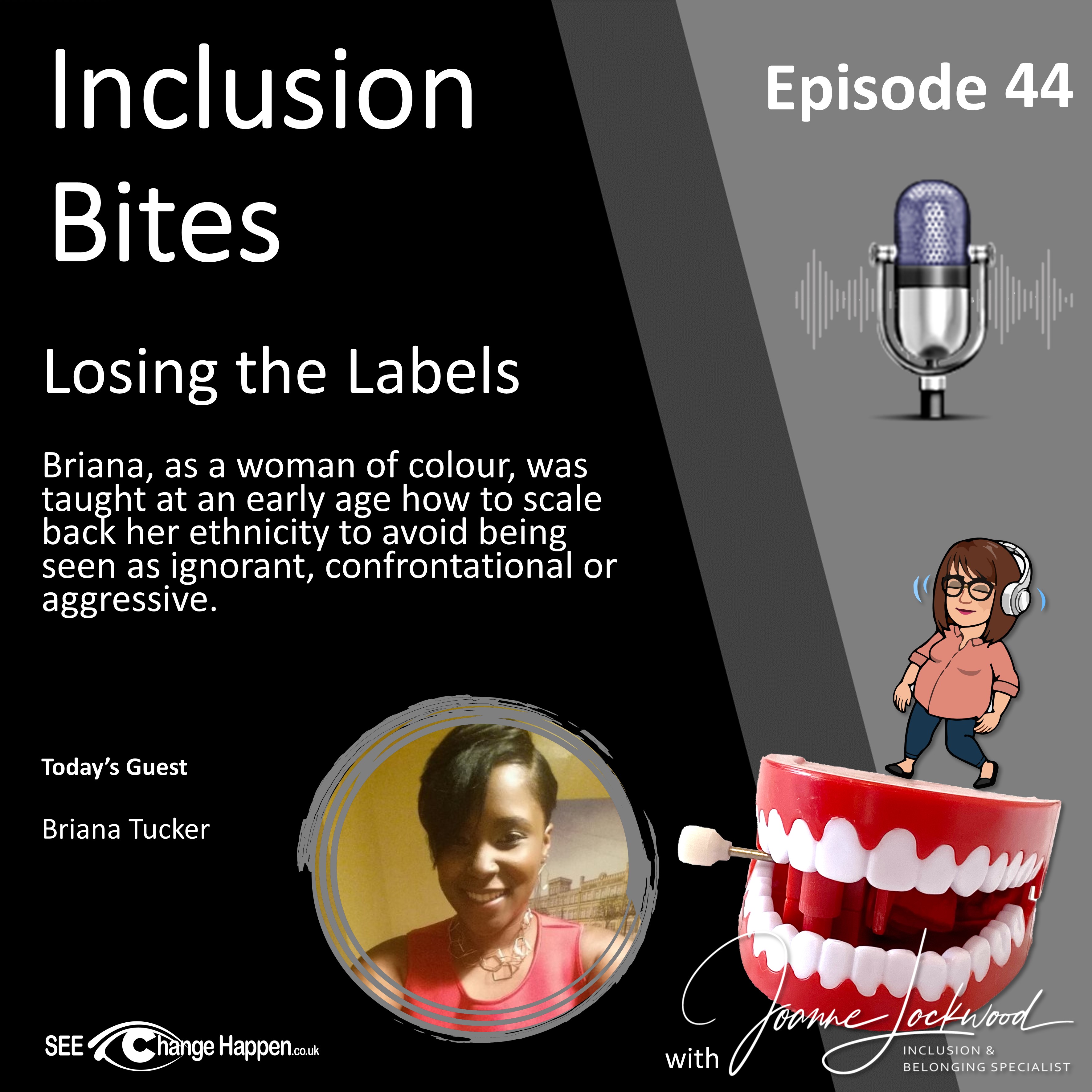
Losing The Labels
with Briana Tucker · 09 September 2021
Lived Experience Identity
Briana Tucker describes what it feels like to live under constant scrutiny as a woman of colour in Wisconsin, where everyday situations can carry the risk of being stereotyped, labelled, or treated as a threat. She shares stark examples of overt racism and how assumptions about “aggression”, professionalism, and even hair and appearance shape what feels safe at work, in public, and at home.
Joanne and Briana explore how labels and bias operate at both individual and institutional levels, including policing, healthcare, hiring, and education. They discuss the emotional and practical labour involved in staying safe, the role of allies validating experiences, and why people must take responsibility for their own learning rather than relying on marginalised communities to educate them.
The conversation also touches on faith, spirituality, and finding ways to move from heightened awareness to action. Briana closes by sharing her consulting work in process improvement and DEI advocacy, and why she wants a future where people can live without being defined by stereotypes and can show up as themselves, unapologetically.
About Briana Tucker
One-sentence summary
Brianna Tucker’s story is a quiet act of defiance: refusing to shrink herself to survive, and choosing instead to build a world where no one has to trade safety for being fully themselves.
---
Synopsis
Brianna Tucker grew up moving between two Americas — an affluent, predominantly white private school and the reality of impoverished, segregated neighbourhoods in Milwaukee. As a Black woman in Wisconsin, she learned early that her safety depended on calculation: who she travelled with, how she spoke, what she wore, even how she styled her hair. She has been told outright that her “kind” would not be hired. A university adviser dismissed her as a future stereotype rather than a future engineer. Police tried to remove her from a car simply because she “didn’t belong” with her white classmates. These are not abstract injustices to her; they are memories lodged in the body.
Yet Brianna is not defined by bitterness. She is shaped by conviction. She describes her “superpower” as listening and seeing through fog — perhaps because she has spent her life navigating fog thick with assumptions. Professionally, she helps organisations think clearly about what they are doing and why. Personally, she is trying to dismantle the labels that cage people in. What she wants is startlingly simple: a world where being different is not dangerous, where curiosity replaces fear, and where love of neighbour is practised rather than preached.
---
10 Small, digestible concepts for easy learning
1. Labels shrink people before they even speak.
Once a label is attached, your humanity has to fight to breathe.
2. Survival can become second nature.
When danger is constant, strategy becomes instinct.
3. Bias is learnt — and so it can be unlearnt.
But only if we are willing to admit it exists.
4. Representation does not guarantee safety.
Even progress can provoke backlash.
5. Curiosity without consent is still entitlement.
Admiring someone does not give you ownership of their body or space.
6. Privilege often shows up as innocence.
“I didn’t realise” is easier to say when you are not the one at risk.
7. Being heard is protection.
Validation from others can be the difference between credibility and dismissal.
8. Faith without love becomes exclusion.
Spirituality rooted in compassion refuses to cast others out.
9. Efficiency and inclusion share a root.
Both begin by asking: what are we actually trying to achieve, and who is missing?
10. Small steps still count.
Change does not have to be dramatic to be meaningful.
---
The “why” in the story
What they believe is true about people
Brianna believes people are not their labels. She believes everyone carries a story you cannot see from the outside, and dignity is not conditional on conformity.
What they cannot unsee
She cannot unsee how quickly institutions meant to protect can become threats. She cannot unsee how easily a stereotype overrides lived truth.
What they are no longer willing to tolerate
She is no longer willing to comply with quiet disrespect — whether it is being followed in a shop, told she is inherently less capable, or expected to allow someone to cross her boundaries “because they’re curious”.
What they are trying to build instead
She is building spaces — in business and beyond — where operations are thoughtful, where hiring is fair, and where people are treated as individuals rather than assumptions.
---
Narrative structure
1. The trigger
Repeated moments of overt rejection: being told “we don’t hire your kind”, dismissed by an adviser, nearly criminalised for sitting in the “wrong” car. Each incident etched in the same message — you do not belong.
2. The tension
Living in constant vigilance while also wanting to believe in human goodness. Wanting safety without wanting to harden. Wanting to tell the truth without being labelled “aggressive”.
3. The insight
That many people are not intentionally cruel — they are unexamined. And unexamined beliefs can shape entire systems. Silence keeps those beliefs intact.
4. The pivot
She chose to speak. To share her story openly. To refuse spaces that demand she minimise herself. To anchor her business in respect, clarity, and access.
5. The destination
A future where a knock at the door is just a knock. Where a child’s ambition is not filtered through skin colour. Where being different is ordinary, not hazardous.
---
Five key takeaways and learning points
1. If you have never had to calculate your safety daily, that is privilege.
So what: recognise that others may be navigating risks you have never noticed.
2. Overt racism still exists — and it wounds in real time.
So what: do not dismiss stories that sound “too extreme” to be true.
3. Unconscious bias shapes conscious outcomes.
So what: examine what you were taught, even if it feels uncomfortable.
4. Boundaries are not aggression.
So what: respect “no” without demanding explanation.
5. Change begins with responsibility, not guilt.
So what: you do not need to feel shame — you need to do the work.
---
Ten distinct ideas explained
1. Living in survival mode
When your safety feels uncertain, your nervous system rarely rests. Over time, vigilance becomes your baseline, not the exception.
2. Segregation by postcode
Inequality is not only economic; it is geographical. A single street can divide wealth from poverty, possibility from limitation.
3. Institutional distrust
When systems repeatedly fail you, calling for help stops feeling like protection and starts feeling like risk.
4. The stereotype tax
You pay extra emotional labour to disprove assumptions others never had to confront.
5. White fragility as fear of displacement
For some, equality feels like loss because dominance was mistaken for normality.
6. Hair as identity and boundary
For Black women, hair is history, culture and care — not a public exhibit.
7. Visibility versus safety
Representation in high office does not automatically dismantle everyday prejudice.
8. Intersectional vulnerability
Layer identities — race, gender, sexuality — and risk multiplies rather than adds.
9. Self-education as responsibility
Stories are available in books, videos and communities; expecting marginalised people to teach you personally adds further burden.
10. Validation as solidarity
When witnesses speak up, truth becomes harder to erase.
---
How people should change as a result
1. Think
- Shift from “That can’t still happen” to “What have I not noticed?”
- Move from seeing racism as historical to recognising it as lived.
- Replace “diversity problem” with “dignity problem”.
- Understand that neutrality often protects the status quo.
- Recognise that respect is not performative — it is behavioural.
2. Feel
- From defensiveness to humility.
- From shock to sustained concern.
- From guilt to responsibility.
- From distance to connection.
- From fear of saying the wrong thing to courage to learn.
3. Act
- Believe people when they describe their lived experience.
- Challenge stereotypes in private conversations, not just public forums.
- Respect personal boundaries without argument or justification.
- Audit recruitment and promotion processes for patterns, not just intentions.
- Educate yourself through books, talks and credible sources rather than relying solely on affected colleagues.
- Create environments where someone can say “that hurt” without fear of punishment.
- Check in with those who may be carrying invisible vigilance.
---
One thing to remember
No one should have to strategise their survival just to be themselves.