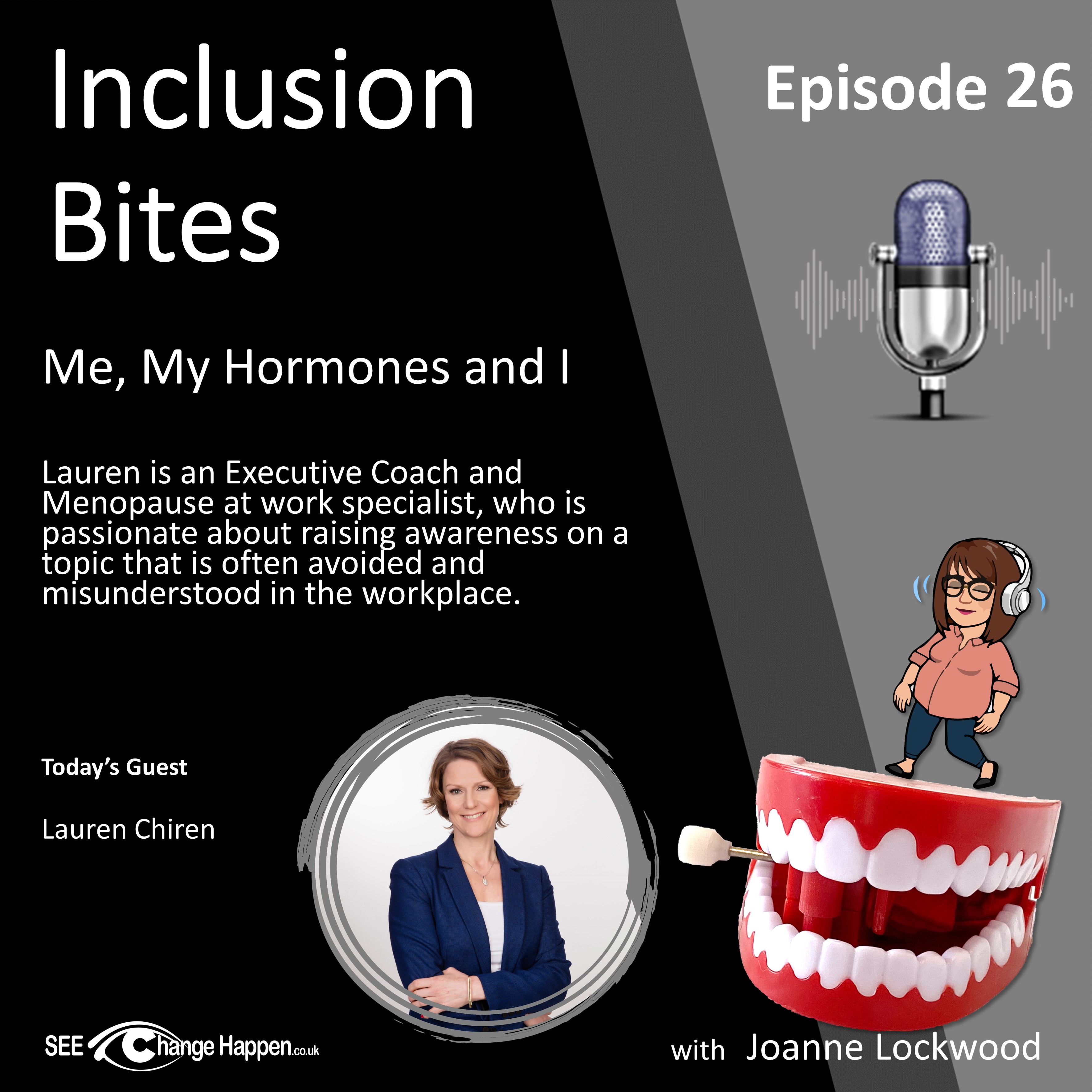
Me, My Hormones And I
with Lauren Chiren · 01 February 2021
Mental Health Wellbeing Trauma
Lauren Chiren joins Joanne Lockwood to talk candidly about how early menopause showed up in her working life long before she had language for it. After a difficult meeting with her boss, Lauren reflects on months of exhaustion, anxiety, palpitations, memory problems and collapsing self-esteem, initially fearing early-onset dementia. A GP later helped her recognise that she was experiencing early menopause, prompting her to ensure other people don’t lose their health or careers through a lack of understanding of this natural life stage.
The conversation explores what perimenopause and menopause mean, the breadth of potential symptoms, and why many people don’t recognise what’s happening—especially when contraception masks cycle changes. Lauren and Joanne discuss stigma and silence around periods and menopause, the ripple effects on relationships and work, and practical ways employers and colleagues can become more informed and supportive.
They also touch on hormone replacement therapy (HRT), the importance of good medical conversations and trusted resources, and how building community and education—through workplace programmes and peer support—can help people navigate menopause with more confidence and less isolation. The episode includes explicit discussion of trans identity and how inclusive language and workplace practices should recognise that not everyone who experiences periods or menopause identifies as a woman.
About Lauren Chiren
One-sentence summary
Lauren Chiren turned the moment she felt broken and diminished into a quiet, stubborn mission to make sure no one else loses their confidence, career or relationship simply because no one talked about hormones.
---
Synopsis
Lauren Chiren did not set out to become a menopause advocate. She was a high-performing leader in financial services, a single mother to a child with medical needs, the kind of person who described her superpower as “tenacity – getting shit done, especially those things that others barely talk about.” She worked hard because that is who she had always been – a girl who helped her father with wages and property rounds at four years old, a woman comfortable in male-dominated rooms, someone who never questioned her place. So when a manager told her she was “not becoming of a female leader” and seemed like “a shadow” of her former self, the words landed like a verdict. She left believing she might have early-onset dementia. Instead, she discovered she had been through an early menopause at under forty.
That moment cracked something open. Lauren realised she had not become less capable; her hormones had shifted and nobody — including her — understood what that meant. She had not known what perimenopause was. She had not known there were over 30 potential symptoms. She had simply felt herself slipping. Now, she is determined that no employer loses talent through ignorance, no woman walks blindly into brain fog and anxiety thinking she is losing her mind, and no partner confuses hormonal upheaval with falling out of love. What she is trying to change is not biology, but silence — because silence costs people their dignity, their income, their marriages and sometimes their hope.
---
10 Small, digestible concepts for easy learning
1. Hormones don’t erase your ability — they can temporarily scramble the signal.
Feeling foggy doesn’t mean you’ve lost your intelligence.
2. Silence turns symptoms into shame.
What we don’t name, we internalise as personal failure.
3. You can be thriving on paper and unraveling in private.
A bonus and an award don’t cancel exhaustion and anxiety.
4. Responsibility is shared.
Employees must understand their bodies; employers must create space for honesty.
5. Menopause is a transition, not a disappearance.
It signals another stage of life, not an ending.
6. Symptoms are diverse and deeply individual.
No two experiences are identical — comparison is unhelpful.
7. Education protects relationships.
Understanding what is happening biologically can prevent emotional misinterpretation.
8. Confidence in your message changes how people receive it.
Lauren stands taller now — and the room shifts with her.
9. Prevention is quieter than crisis.
Small adjustments early can avert resignations and breakdowns later.
10. Awareness is not indulgent — it is practical.
Understanding hormones improves performance, not excuses it.
---
The “why” in the story
What she believes is true about people
Lauren believes people are capable and resilient — and that most of the time, when someone changes, there is a reason. She believes that when we are informed, we behave with more compassion.
What she cannot unsee
She cannot unsee the moment she thought she was losing her mind, nor the statistics linking menopause to women leaving work, divorce and rising distress. She cannot forget hearing someone say, “I think you might just have saved my marriage.”
What she is no longer willing to tolerate
She is no longer willing to tolerate ignorance dressed up as professionalism — environments where people feel they must wear a mask, push through, and never admit they need support.
What she is trying to build instead
She is building workplaces and homes where menopause is spoken aloud without embarrassment, where people understand their bodies, and where capability is not written off as decline.
---
Narrative structure
1. The trigger:
A birthday meeting where she was told she was not the leader she used to be. Followed by a holiday in Iceland where, in the stillness, she realised exhaustion and confusion had been building for 18 months.
2. The tension:
Being a high achiever who “never took her foot off the pedal”, yet feeling her memory falter, her confidence drop, her emotions swing. Trying not to appear weak. Trying not to give anyone “ammunition”.
3. The insight:
“I didn’t stop being bright, intelligent or capable.” The change was hormonal, not moral. Biology had shifted, and without awareness, she mistook it for failure.
4. The pivot:
Leaving her job and choosing to speak publicly about menopause. Standing up at events and asking rooms to say the word out loud until it lost its power to embarrass.
5. The destination:
A world where saying “perimenopause” is as ordinary as saying “puberty” — and where midlife feels like a second beginning, not an unravelling.
---
Five key takeaways and learning points
1. If someone’s behaviour changes, ask what might be happening — not what’s wrong.
This shift protects dignity and prevents unnecessary damage.
2. High performance can mask silent struggle.
So what: don’t assume competence equals wellbeing.
3. Hormonal changes affect relationships as much as workplaces.
So what: education is not just a workplace initiative; it is a family safeguard.
4. Confidence grows when vocabulary grows.
So what: learning the language helps us articulate needs instead of apologising for them.
5. Menopause can be a beginning.
So what: midlife can become a space for reinvention, not retreat.
---
Ten distinct ideas explained
1. Brain fog is frightening when unnamed.
Without context, memory lapses feel like cognitive decline, undermining identity and pride.
2. Masking strength carries a cost.
Continually proving competence while struggling internally breeds isolation.
3. Menopause intersects with ambition.
Many women reach senior roles just as symptoms peak; losing them at that stage erases hard-won influence.
4. Language creates belonging.
When “menopause” can be spoken plainly, people stop feeling abnormal.
5. Shared knowledge prevents misinterpretation.
A partner who understands hormonal shifts is less likely to personalise distance or mood change.
6. Medical literacy is empowering.
Knowing options around HRT allows informed choice, not fear-based decisions.
7. The workplace is part of the life cycle.
Hormones do not pause between 9 and 5; neither should awareness.
8. Identity is not erased by transition.
Just as Joanne described hormonal change bringing calm, shifts can reveal a truer self rather than erase one.
9. Midlife longevity reframes the story.
If women may live decades post-menopause, this is not an ending but a substantial new chapter.
10. Standing in your power invites others to do the same.
Lauren’s posture changed; with it, people leaned in rather than recoiled.
---
How people should change as a result
1. Think
- Stop treating menopause as a niche issue; understand it as a normal life stage.
- Replace “what’s wrong with her?” with “what might she be navigating?”
- Recognise that biology and professionalism coexist.
- View midlife as expansion, not decline.
2. Feel
- Move from awkwardness to openness.
- Shift from scepticism to curiosity.
- Replace quiet judgement with empathy.
- Exchange fear of saying the wrong thing for willingness to learn.
3. Act
- Learn the basic stages: perimenopause, menopause, post-menopause.
- Ask gentle, private check-in questions if someone seems unlike themselves.
- Share reliable resources rather than rumours.
- Normalise conversations about health without gossiping.
- Review workload, flexibility and realistic expectations for midlife employees.
- Encourage partners and family members to educate themselves too.
- Say the word “menopause” out loud — and often.
---
One thing to remember
She didn’t lose her ability — she lost support, and she refuses to let that happen to anyone else.