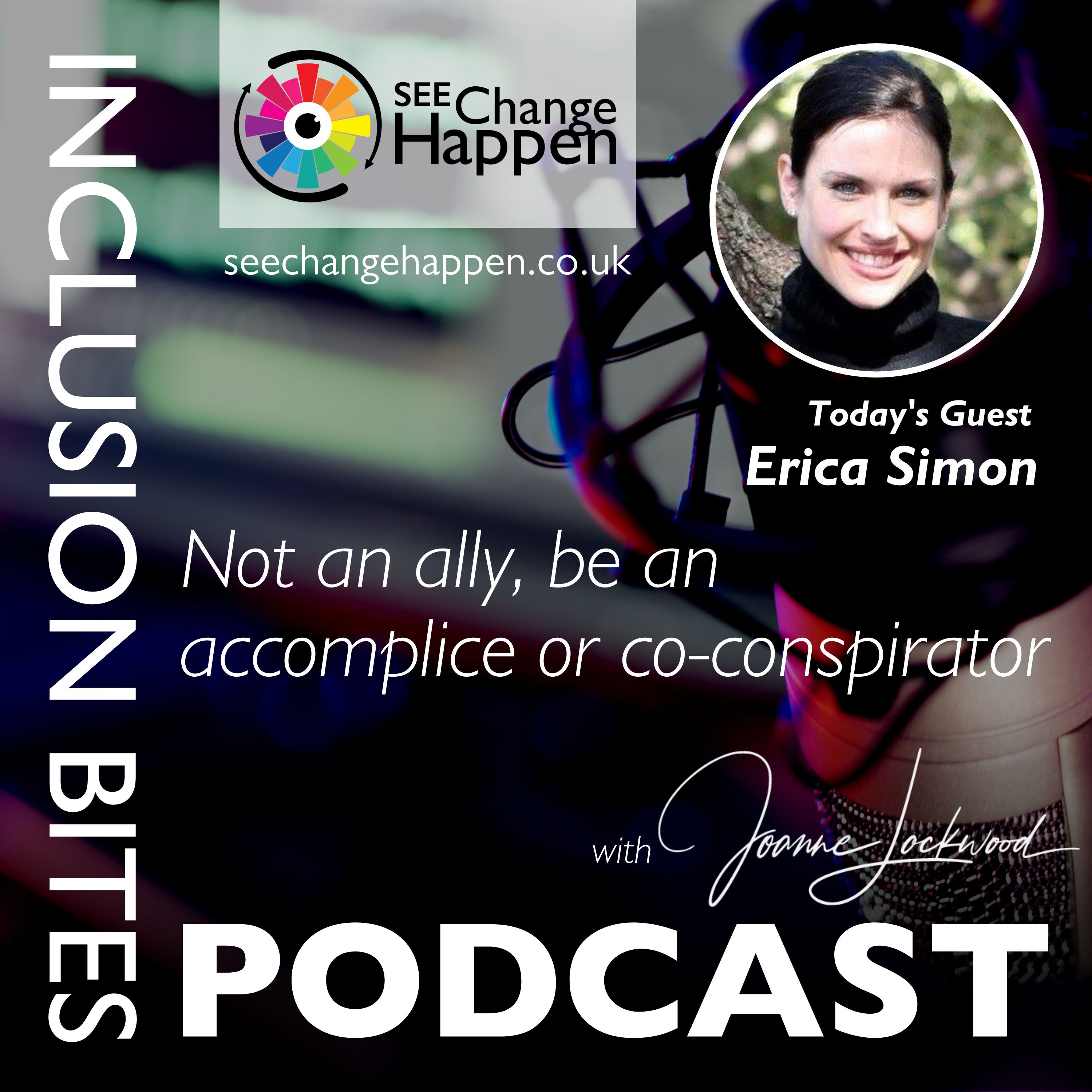
Not An Ally, Be An Accomplice And Co-Conspirator
with Erica Simon · 06 July 2023
Workplace Culture Systems
Joanne Lockwood is joined by clinical psychologist and social justice consultant Erica Simon to explore why “ally” is not an identity you can claim, but a set of actions you consistently take. Together they unpack what it means to be an accomplice or co-conspirator: having “skin in the game,” speaking up when it’s uncomfortable, and aligning values with behaviour rather than seeking recognition.
The conversation examines why equality efforts often trigger backlash, including the idea that when people are used to unearned privilege, equality can feel like oppression. Joanne and Erica connect this to wider social and political dynamics, and to the need to address root causes in systems and structures rather than offering superficial fixes.
They also discuss accessibility and inclusive design in workplaces and public spaces, using lived examples of navigating environments with mobility needs and the ways poor design can create dependency. The episode broadens inclusion beyond headline categories, highlighting micro-communities and the importance of cultural intelligence, curiosity, and listening. Neurodiversity is explored through communication norms and how “typical” expectations (like eye contact) can unintentionally exclude.
Across themes of identity, power, and belonging, the episode invites listeners to take responsibility for the environments they shape, seek feedback on whether psychological safety is real, and contribute to building workplaces where people can show up as whole selves.
About Erica Simon
One-sentence summary
Erica Simon believes that real justice begins when we stop standing nearby and start sharing the risk — because none of us are free while others are navigating harm we refuse to see.
---
Synopsis (two paragraphs)
Erica Simon is a clinical psychologist shaped by curiosity, discomfort, and a refusal to settle for being “right”. What defines her isn’t simply her expertise, but her willingness to sit inside ambiguity. Growing up with the mantra that “character is who you are in the dark”, she learned early that values are not performance — they are practice. Over years of working alongside marginalised communities, she has come to understand how easily comfort disguises injustice. She is alert to the “water we’re swimming in”: the invisible privileges that allow some people to opt in and out of struggle while others carry it all day, every day.
What she is trying to change is the distance between sympathy and responsibility. “We don’t get to just say hey, I’m here and I support you,” she explains. “We have to have skin in the game.” For Erica, calling yourself an ally is not enough — allyship can be switched off. Instead, she asks people to become accomplices and co‑conspirators: people who understand that systems are “working exactly how they were designed to work” and choose to challenge them anyway. Her vision is deeply human — workplaces where no one has to shave off pieces of themselves to survive; a world where dignity isn’t conditional; a culture where we recognise that “I’m not free either” until justice is shared.
---
10 Small, digestible concepts for easy learning
1. Support is optional; justice requires commitment.
Allyship can be taken up and put down — shared freedom cannot.
2. Privilege is the water you don’t notice.
If you can opt out of a conversation, that’s already a sign of advantage.
3. Character happens when no one is applauding.
Doing the hard thing quietly is the real measure of values.
4. Equality can feel like loss to the comfortable.
When you’re used to advantage, fairness feels threatening.
5. Systems behave as they were built to behave.
Inequality isn’t accidental — it’s patterned.
6. Not all discomfort is harm — some is growth.
Leaning into ambiguity is how learning begins.
7. Access benefits everyone.
The ramp helps the parent with a pram, the traveller with a suitcase, and the wheelchair user alike.
8. Token presence is not shared power.
Having a seat at the table means little if your voice isn’t shaping the room.
9. Curiosity is a moral choice.
Asking “what don’t I see?” changes everything.
10. None of us are free until we are all free.
Liberation is collective or it isn’t liberation at all.
---
The “why” in the story
What they believe is true about people
Erica believes people are capable of growth — that most harm comes not from evil intent but from ignorance we refuse to examine.
What they cannot unsee
She cannot unsee how workplaces quietly traumatise people whose identities are constantly questioned or politicised. She cannot unsee how privilege allows others to disengage.
What they are no longer willing to tolerate
Surface-level allyship. Performative inclusion. Systems that remain intact while language changes.
What they are trying to build instead
A culture where people show up with “skin in the game” — where dignity is protected structurally, not sentimentally.
---
Narrative structure
1. The trigger:
Years of watching conversations about justice stall at comfort. Witnessing how quickly people retreat when action costs them something. Seeing identities debated as political talking points.
2. The tension:
She lives in the “and” — progress and backlash, civil rights growth and emboldened hate. It’s exhausting to keep holding complexity when others want certainty.
3. The insight:
Truth can stand side by side. Progress and harm can coexist. And if we only react to the loudest extreme, we lose nuance — and each other.
4. The pivot:
She stopped asking how to look supportive and started asking how to share responsibility. She leaned into being wrong, into discomfort, into actively searching for her blind spots.
5. The destination:
A world where people don’t have to calculate how safe they are in a room; where autonomy, accountability and compassion are not opposites but companions.
---
Five key takeaways and learning points
1. If you can step away, someone else can’t.
Notice when you’re choosing silence — and what that silence protects.
2. Feeling defensive is a doorway, not a verdict.
Sit with it; ask what it’s trying to defend.
3. Representation without influence changes little.
Inclusion means shaping decisions, not decorating brochures.
4. Discomfort doesn’t mean danger.
Growth often feels awkward before it feels right.
5. Justice is relational.
Your freedom is tied to the safety of others, whether you acknowledge it or not.
---
Ten distinct ideas explained
1. Shared freedom
When Erica says “I’m not free either,” she reframes justice as mutual, not charitable. Oppression shrinks everyone’s humanity — even the beneficiary’s.
2. The cost of invisibility
Some people navigate spaces without thinking about identity; others calculate every move. That cognitive load is exhausting and unseen.
3. Trauma in everyday systems
A workplace that subtly implies “you don’t belong” erodes safety. Belonging isn’t a perk — it’s psychological survival.
4. The myth of neutrality
Choosing not to act within an unjust system is still participation. Silence stabilises structures.
5. Ambiguity as strength
Sitting in complexity — bodily autonomy and collective safety, for example — prevents shallow solutions.
6. Performative safety
Declaring yourself safe doesn’t make you safe. Safety is decided by those most at risk.
7. Infantilising difference
Pity and over‑glorification both strip agency. True dignity respects autonomy.
8. The labour of education
Expecting marginalised people to constantly explain their pain compounds it. Do your own work first.
9. Equality versus equity tension
Adjustments are not special treatment — they are corrections to built‑in imbalance.
10. Conscientious presence
Showing up thoughtfully — aware of your impact — is quieter than activism slogans but often more transformative.
---
How people should change as a result
1. Think
- Move from “How can I help?” to “What is my responsibility here?”
- Replace either/or thinking with “both can be true”.
- See systems as designed — not accidental — and therefore changeable.
- Ask yourself regularly: What water am I swimming in?
2. Feel
- Shift from defensiveness to curiosity.
- Move from guilt to accountable responsibility.
- Replace fear of being wrong with willingness to learn.
- Let compassion extend beyond intention to impact.
3. Act
- Interrupt dismissive comments, even when it costs social comfort.
- Audit one space you influence — is it accessible without special effort?
- Seek feedback about how you’re perceived and listen without rebuttal.
- Share opportunities, not just encouragement.
- Educate yourself before asking marginalised colleagues to do so.
- Back policies that reduce harm, even if they inconvenience you.
- Stay in difficult conversations longer than is comfortable.
---
One thing to remember
You don’t become just by standing nearby — you become just by sharing the risk.