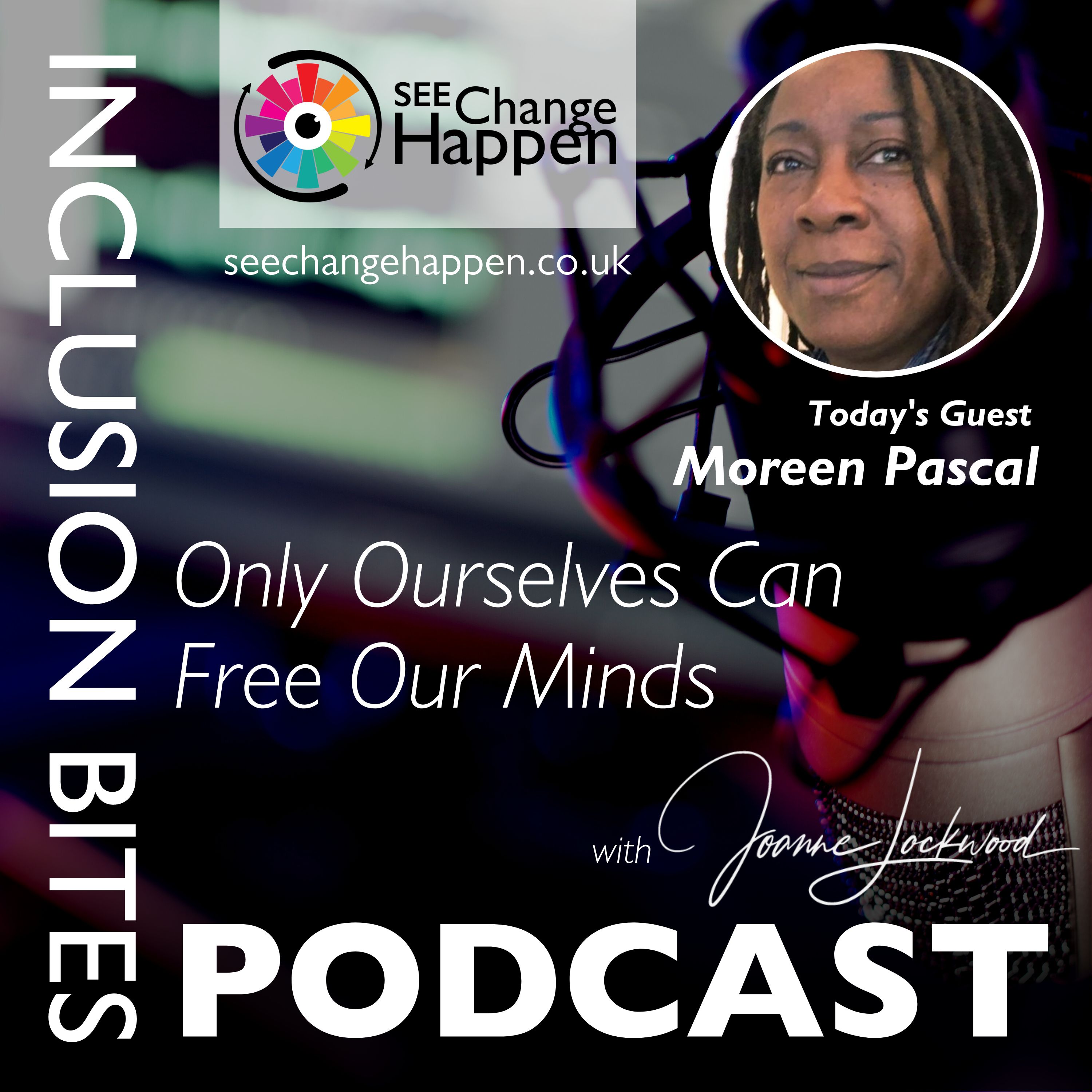
Only Ourselves Can Free Our Minds
with Moreen Pascal · 10 November 2022
Workplace Culture Systems
Moreen Pascal joins Joanne Lockwood to explore what it means to “free our minds” from the norms, assumptions and internalised beliefs that keep oppressive cultural and institutional practices in place. Drawing on her Caribbean heritage and the influence of her parents’ generation, Moreen frames inclusion and belonging through a political and social justice lens, connecting personal identity with wider systems of power.
The conversation moves through stark contemporary examples of structural racism, including the Child Q case and the wider impact of racial violence, and reflects on how institutional responses can reveal whose safety and dignity are prioritised. Alongside this, Moreen and Joanne discuss allyship, protest and disruption as catalysts for change, and why progress can feel slow and cyclical unless people stay alert and engaged.
They also bring the discussion into workplace and governance settings, looking at board diversity, “culture fit”, image and power dressing, and why representation and diversity of thought matter in decision-making. Moreen shares her journey into a non-executive director role and the importance of networks, mentoring and community-minded leadership in opening up opportunities and expanding the mosaic of human talent.
About Moreen Pascal
One-sentence summary
Maureen Pascal believes that true freedom begins in the mind — and that courage, not comfort, is what protects our dignity when the world would rather we shrink.
---
Synopsis
Maureen describes herself as an “inside outsider” — a daughter of Caribbean parents who arrived in Britain in the 1950s carrying culture, endurance and political awakening with them. Raised in North London on Bob Marley, trade union politics and the fierce clarity of Angela Davis, she grew up with what she calls “double vision”: the ability to see Britain as both home and something to question. Her father’s habit of connecting local struggles to global injustice shaped her early understanding that what looks ordinary is often political. As a child of two cultural worlds — the food at home and the food at school, the music at family gatherings and the music on the radio — she learned early that what is presented as “normal” is only ever partial.
What she is trying to change is not simply policy or representation, but the quiet acceptance of unfairness. When she speaks about the strip-search of Child Q or the Buffalo shootings, her voice carries both grief and resolve. She cannot ignore harm, even when it is not directed at her personally. “We are connected,” she says in effect. For Maureen, justice is not abstract; it is about whether people are safe in school, whether communities feel seen, whether power is questioned. She is not interested in performing activism. She wants to widen the table so that decisions reflect real lives — because who sits in the room affects the person on the street.
---
10 Small, digestible concepts for easy learning
1. Freedom begins inside.
Political freedom means little if your mind remains shaped by narratives that diminish you.
2. Double vision is a strength.
Seeing the same society from more than one cultural lens sharpens your judgement.
3. Marginalised is not a personality trait.
It describes a power imbalance, not a flaw in the people pushed to the edges.
4. If it hurts one of us, it concerns all of us.
Disconnection is how injustice survives.
5. Appearance is often mistaken for authority.
Sounding the part can eclipse real competence.
6. Courage sometimes looks like refusal.
Not jumping, not conforming, not shrinking can be braver than going along.
7. Outliers move history.
Those who disrupt expectations often carry the clearest thinking.
8. You cannot fix what you deny.
Structural harm begins where truth is avoided.
9. Representation shapes reality.
Who makes decisions determines who feels human in the outcome.
10. Mentorship is quiet repair work.
One steady relationship can redirect a life.
---
The “why” in the story
What they believe is true about people
That most people want dignity and fairness — and that many would choose courage if they believed they were not alone.
What they cannot unsee
That power protects itself. That children can be humiliated in places meant to keep them safe. That violence and discrimination are often rationalised unless we force ourselves to name them.
What they are no longer willing to tolerate
Silence masquerading as civility. The idea that “that’s just how it is.” The comfort of elite sameness at decision-making tables.
What they are trying to build instead
Rooms where difference is not decorative but influential. Communities where young people see possibility. Systems that are humble enough to listen.
---
Narrative structure
1. The trigger
Growing up hearing her father connect Grenada’s trade union struggles to global politics. Watching injustice reported while knowing it could easily reach her family. Seeing cases like Child Q confirmed that inequality is not ancient history but present reality.
2. The tension
Living as an “inside outsider” — belonging yet not fully centred. Being invited into boardrooms while knowing she had to learn the language and codes of those spaces. Holding optimism while feeling weary at repeated harm.
3. The insight
That systems are sustained not only by laws but by mindset. Colonisation is external — but it also implants itself internally. You must challenge both.
4. The pivot
Instead of only critiquing power, she placed herself at the table — becoming a non-executive director, mentoring across difference, training others to recognise vulnerability. She stopped waiting to be included and started claiming space.
5. The destination
A society where authenticity outruns performance. Where a black child is safe in school. Where a young gay footballer is ordinary news. Where courage is normalised, not exceptional.
---
Five key takeaways and learning points
1. You can belong and still question.
Belonging does not require silence; challenge can be an act of loyalty to humanity.
2. Silence protects comfort, not people.
Choosing not to speak keeps existing power intact.
3. Difference adds intelligence.
When boards, teams or communities lack diverse experience, they lack information.
4. Authenticity is strength, not rebellion.
The courage to be yourself expands the possible for others.
5. Small actions matter.
A mentor, a board seat, a conversation — they shift trajectories more than grand statements.
---
Ten distinct ideas explained
1. Structural harm is cumulative.
It is not always loud; it shows up in who is believed, who is suspected, who is protected. Over time, it shapes self-worth.
2. Power defines “normal”.
When one group’s habits dominate institutions, everything else is framed as deviation.
3. Education spaces reflect society’s biases.
When a child is not presumed innocent, dignity collapses early.
4. Elite sameness narrows imagination.
If everyone around the table shares cultural cues and schooling, blind spots multiply.
5. Internalised limitation is real.
If dominant narratives tell you you're less capable, unlearning that becomes a lifelong task.
6. Protest is often labelled inconvenient before it is called visionary.
Disruption unsettles comfort — but comfort rarely reforms itself.
7. Cultural code-switching has a cost.
Learning the “right language” to be credible opens doors — but it can strain authenticity.
8. Authentic courage inspires quietly.
When someone refuses pressure, it widens psychological safety for others.
9. Mentorship bridges social distance.
Intentional relationships can dismantle stereotypes on both sides.
10. Hope is work.
Optimism is not naivety; it is a decision to keep building despite setbacks.
---
How people should change as a result
1. Think
- From “that’s unfortunate” to “what system allowed that?”
- From “marginalised people” to “people marginalised by power”.
- From “diversity as extra” to “difference as essential intelligence”.
- From “neutral policies” to “who benefits most from this design?”
- From “activists are disruptive” to “disruption may signal neglect”.
2. Feel
- From defensiveness to curiosity.
- From guilt to responsibility.
- From fatigue to shared commitment.
- From detachment to connection.
- From cynicism to cautious hope.
3. Act
- Invite someone with a different lived experience into a real decision, not a symbolic one.
- Intervene gently when stereotypes surface — don’t let them pass as humour.
- Mentor or sponsor across difference.
- Examine one system you influence and ask who it unintentionally excludes.
- Support courageous voices publicly, not just privately.
- Learn the language of spaces you want to enter — then reshape them once inside.
- Practise authenticity in small ways; remove at least one piece of armour.
---
One thing to remember
No one can grant you mental freedom — but once you claim it, you change the room you enter.