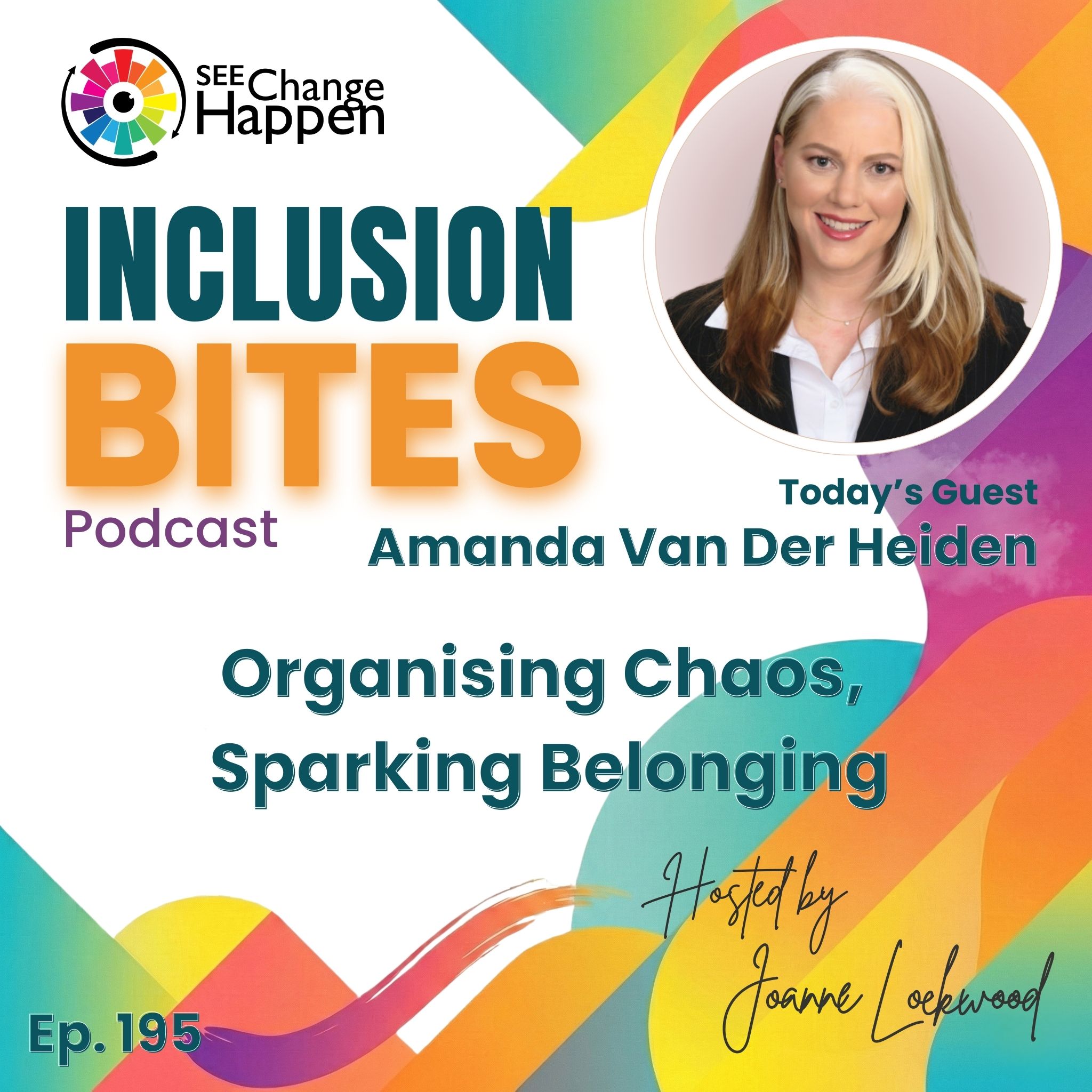
Organising Chaos, Sparking Belonging
with Amanda Van Der Heiden · 05 February 2026
Workplace Culture Systems
Joanne Lockwood is joined by learning and development leader Amanda Van Der Heiden to unpack what it really means to “organise chaos” and spark belonging at work. They explore why belonging is more than a DEI policy line—it’s a felt experience of being seen, heard, and valued—and how that feeling can be created (or undermined) through everyday communication, leadership habits, and organisational choices.
Amanda shares how growing up between Kentucky and New York shaped her ability to navigate different worlds, connect across perspectives, and translate complexity into people-centred momentum. She also reflects on being visibly different due to piebaldism and what that taught her about empathy, assumptions, and inclusion.
Together, they discuss practical approaches for bridging divides in polarised times: balancing authenticity with respect, adapting communication styles to different audiences, asking “why” to get to root causes, and supporting people through change. The conversation also touches on post-COVID shifts such as return-to-office expectations, the importance of trust, and how leaders can set people up for success by focusing on autonomy, intent, transparency, and strengths.
About Amanda Van Der Heiden
One-sentence summary
Amanda Van Der Heiden’s life has taught her that belonging isn’t about fitting neatly into one world — it’s about learning how to bridge worlds without losing yourself.
---
Synopsis
Amanda grew up between opposites. Kentucky and New York — rural tradition and urban intensity — shaped her in ways that left her, as she puts it, “not a perfect fit anywhere, but I can fit in anywhere.” Add to that her rare piebald hair, something she was born with and could never hide, and she learnt early what it feels like to visibly stand out. As a child moving schools with “two colour hair, two coloured skin and a southern accent”, she felt like “an alien from another planet”. It was painful. Kids can be cruel. Strangers still reach out and try to touch her hair. Yet over time, she chose to see that difference not as a flaw to conceal, but a lesson in empathy.
Today, she channels that early dislocation into her work — bringing people together in moments of change, growth and uncertainty. She describes herself as the “glue” and a “chaos coordinator”, someone who helps wildly different people align without erasing who they are. Beneath the strategies and templates is something simple: people want to be seen and heard. She refuses to accept workplaces that treat humans as problems to manage. Instead, she is building environments where difference isn’t ironed out — it’s organised, respected and turned into shared momentum.
---
10 Small, digestible concepts for easy learning
1. You don’t have to fit perfectly to belong somewhere.
Amanda learnt that belonging isn’t sameness — it’s connection.
2. Standing out hurts at first — then it teaches.
Being visibly different gave her a lifelong sensitivity to exclusion.
3. There is no capital-T Truth.
What feels absolute is often just local perspective.
4. People judge others by behaviour but themselves by intention.
Empathy begins when we question that instinct.
5. Authenticity doesn’t mean disregard.
You can be fully yourself and still adapt to respect others.
6. Change is emotional, even when it looks procedural.
Systems shift; humans feel.
7. If people don’t understand the why, they disengage.
Transparency fuels motivation.
8. Belonging is a feeling, not a policy.
You can be included structurally and still feel alone.
9. Simple isn’t easy.
Awareness and mindset work are straightforward — but require discipline.
10. Organisations are not entities — they are collections of people.
Care for the people, and the performance follows.
---
The “why” in the story
What they believe is true about people
People want to be heard, seen and respected. Most conflict is misunderstanding dressed up as opposition.
What they cannot unsee
How quickly humans categorise, judge and box someone in — sometimes in five predictable clichés. And how much harm comes from assumptions.
What they are no longer willing to tolerate
Leaders hiding behind policy. Change forced without empathy. Authenticity used as an excuse for carelessness.
What they are trying to build instead
Workplaces where individuality and collective purpose coexist — where difference becomes strength, not friction.
---
Narrative structure
1. The trigger
Moving from Kentucky to New York as a visibly different child — her hair, accent and identity marking her as “other” — taught her survival through adaptability.
2. The tension
The world keeps polarising. People cling harder to identity, belief and control. Leaders swing between extremes. She repeatedly meets resistance to nuance.
3. The insight
“There’s no capital T truth.” Exposure changes perspective. Adaptation does not equal compromise of self.
4. The pivot
Instead of trying to belong by shrinking, she chose to belong by bridging. She became intentionally adaptable — still Amanda, but conscious of how she lands.
5. The destination
Rooms where differences don’t compete for dominance but coordinate. Where people feel safe enough to contribute fully. Where chaos becomes shared progress.
---
Five key takeaways and learning points
1. Belonging starts with being seen.
If someone feels invisible, performance and loyalty disappear.
2. Adaptation is a skill, not betrayal.
Adjusting how you communicate isn’t inauthentic — it’s respectful.
3. Most organisational friction is emotional, not technical.
Solve for fear and clarity, and the systems follow.
4. Self-awareness is leadership’s first responsibility.
Without it, you lead by unconscious habit.
5. Momentum begins with one conversation.
You may not change 10,000 people at once — but you can start the ripple.
---
Ten distinct ideas explained
1. Difference visible vs difference invisible
Amanda’s hair makes her difference obvious. Many differences aren’t. Both shape how someone experiences belonging.
2. Adaptability as early survival
Growing up between cultures taught her to read rooms quickly — a skill born from necessity, now refined into leadership.
3. Belonging vs inclusion
Inclusion is invitation; belonging is emotional safety once inside.
4. Judgement bias
We excuse our own lateness; we condemn others’. This gap fuels unnecessary tension.
5. Intentional leadership
Managing by proximity (the “water cooler” style) falls apart under pressure. Intention survives distance.
6. The power of why
Ask “why” five times and surface motivations shift from control to clarity.
7. Strength-based environments
People thrive when allowed to work from their strengths instead of constantly repairing weaknesses.
8. Control vs trust
The urge to see people working often masks insecurity, not leadership strength.
9. Language shapes behaviour
Saying “do this” instead of “don’t do that” subtly rewires outcomes.
10. Mindset reframing
Deadlines can be panic — or fuel. The internal narrative changes the experience.
---
How people should change as a result
1. Think
- From “Who fits?” to “How can we bridge?”
- From “This is the right way” to “This is one way.”
- From “Why are they like that?” to “What shaped them?”
- From “Policy first” to “People first.”
- From “Authenticity means unfiltered” to “Authenticity with responsibility.”
---
2. Feel
- From defensiveness to curiosity.
- From judgement to patience.
- From overwhelm to agency.
- From exclusion to empathy.
- From control to trust.
---
3. Act
- Ask someone an extra why before assuming their motive.
- Share the full picture when assigning work — not just the task.
- Notice your language for a week; flip negatives into constructive direction.
- Adjust your communication to the person in front of you.
- Check in before correcting.
- Make space for one voice that’s quieter than the rest.
- Clarify the purpose behind change initiatives.
---
One thing to remember
Belonging isn’t about becoming the same — it’s about learning how to bridge the differences without erasing yourself.