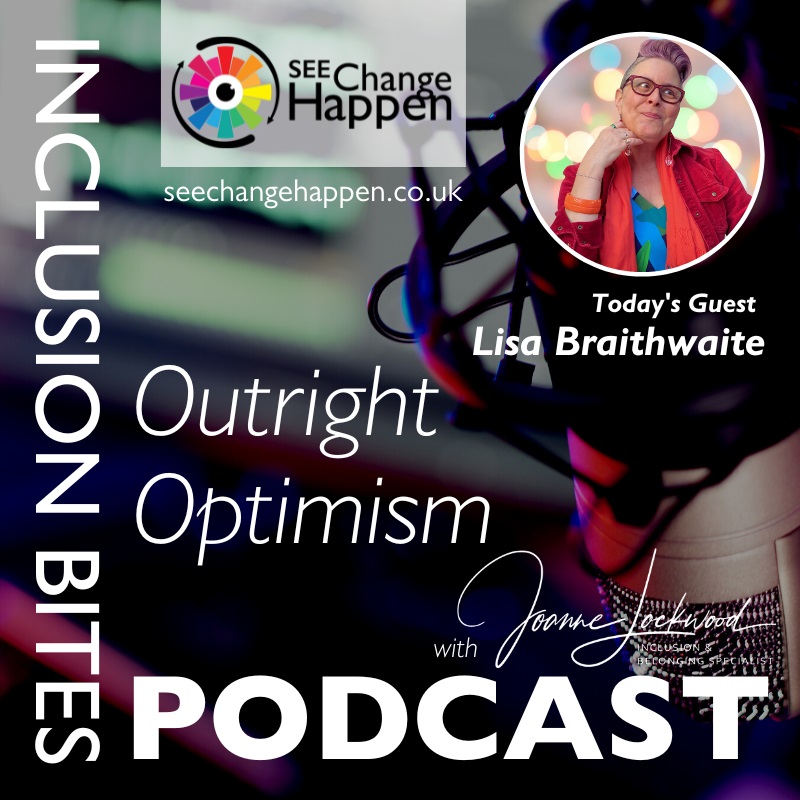
Outright Optimism
with Lisa Braithwaite · 08 September 2022
Workplace Culture Systems
Joanne Lockwood is joined by public speaking coach Lisa Braithwaite to unpack what she calls “outright optimism” and how it fuels a pushback against narrow, outdated ideas of what “professional” is supposed to look like.
They explore authenticity in public speaking and in everyday working life, including the pressure to appear polished on social media, the pull of perfectionism, and the fear of being judged or excluded for standing out. Lisa shares how “This Is What Professional Looks Like” has become a community where people reclaim self-expression—whether that’s hair, clothes, tattoos, or natural features—and why visibility matters for widening the definition of professionalism.
The conversation also touches on ageism and body image, the influence of gender socialisation on what people feel they “should” do to look acceptable, and how leaders, speakers, and individuals with relative privilege can help shift norms by modelling something different. Throughout, the focus stays on helping people feel freer, more connected, and more able to bring their whole selves to work and to the stage.
About Lisa Braithwaite
One-sentence summary
Lisa Braithwaite’s message is a fierce, joyful insistence that freedom comes from showing up as your real self — wrinkles, pink hair, nerves and all — and trusting that belonging begins there.
---
Synopsis
Lisa Braithwaite is a public speaking coach who has spent a lifetime feeling like a “weirdo” — silly, bright, a little different — and trying, at various points, to shrink herself into something more acceptable. As a teenager she wrote in her journal, “Stop being so weird,” while also longing to be more fully herself. Now, at 57, with pink hair and a shaved cut, she describes herself as “born this way” — irrepressibly optimistic, able to fall down and recover quickly. That optimism isn’t naïve; it’s grounded in lived tension around ageing, body image, professionalism and the quiet pressure to disappear.
She is trying to loosen the grip of silent rules — about how women should age, how professionals should look, who gets to take up space — because she knows the cost of hiding. When she says liberation is the goal, she means it in the most practical sense: wearing trainers on stage, showing her full body online, questioning why we put on lipstick, and allowing people to see her as she is. For Lisa, this isn’t about aesthetics; it’s about dignity. It’s about making space for people to speak, lead and live without first scrubbing themselves into something more palatable.
---
10 Small, digestible concepts for easy learning
1. Optimism is a muscle, but also a temperament.
Lisa says she was “born this way”, able to see the silver lining and get back up quickly.
2. Professionalism was designed — and can be redesigned.
If old norms were built by a narrow group, they can be widened by the rest of us.
3. Perfection is the enemy of authenticity.
The more polished you try to appear, the less reachable you become.
4. Liberation feels better than fitting in.
When people finally show up fully, they describe it as freedom.
5. Ageing is a privilege, not a failure.
“If we’re lucky enough, we all do it.”
6. Internalised bias lives quietly inside us.
Ageism, sexism and racism don’t only sit ‘out there’ — they echo in our own self-criticism.
7. Visibility opens doors for others.
When privileged people break moulds safely, they widen the path behind them.
8. We are wired to belong.
Fear of judgement is biological — it’s about survival, not vanity.
9. Your audience wants connection, not flawlessness.
Relatability creates influence; untouchable perfection creates distance.
10. You can reclaim the words that hurt you.
Owning “weirdo” or “ragtag” can turn shame into solidarity.
---
The “why” in the story
What they believe is true about people
Lisa believes people are desperate to belong, to feel safe in the herd — and equally desperate to be seen as themselves. She believes most of us are hiding parts of who we are.
What they cannot unsee
She cannot unsee how arbitrary “professionalism” is, or how much time and money people spend trying to erase signs of ageing, difference or authenticity.
What they are no longer willing to tolerate
She is no longer willing to shrink to fit patriarchal or ageist expectations. She refuses to pretend that perfection is required for credibility.
What they are trying to build instead
A visible community where people can say: this is what professional looks like — tattoos, silver hair, trainers, bright lipstick or none at all — and still be taken seriously.
---
Narrative structure
1. The trigger
Years of feeling “weird”, writing resolutions to stop being herself, then stepping into the professional world and realising she was still editing who she was to fit outdated norms.
2. The tension
The pull between wanting acceptance and wanting freedom. The quiet voice asking, “What if I just fixed this one thing?” — her eyelids, her ageing, her presentation — versus her conviction that ageing is not a flaw.
3. The insight
Fear of judgement is biological. We are social animals. But we also have the ability to question our reactions and choose differently.
4. The pivot
She stopped colouring her grey hair. She shaved her head. She embraced pink. She began posting full-body photos at 57. She created and amplified “This is what professional looks like.”
5. The destination
A world where stepping on stage — or onto a video call — feels liberating, not performative. Where people don’t wait to lose weight, hide wrinkles or buy better clothes before speaking up.
---
Five key takeaways and learning points
1. You are already allowed to take up space.
Waiting to be “ready” often means waiting forever.
2. Bias doesn’t only happen to you — it can live inside you.
Noticing internalised ageism or sexism is the start of freeing yourself from it.
3. Connection beats polish.
People remember how real you felt more than how perfect you looked.
4. If your job is safe, use that safety.
Visible authenticity from those with privilege can shift norms for others.
5. Belonging expands when someone goes first.
Courage is contagious; one visible difference gives others permission.
---
Ten distinct ideas explained
1. Professionalism is cultural, not neutral.
Dress codes and grooming standards were shaped by power. When we treat them as universal, we exclude quietly.
2. Ageing carries emotional weight.
Wrinkles aren’t just lines; they carry stories — and shame when society labels them decline.
3. Social media magnifies comparison.
Filters create a fantasy standard that normal, human faces cannot meet — eroding self-worth.
4. Visibility can be protective.
Seeing someone who looks like you on stage reduces the emotional cost of showing up.
5. Fear of speaking is fear of exile.
Public exposure taps into a primal fear of being cast out from the group.
6. Liberation is embodied.
Changing shoes from heels to trainers can transform how your body feels — and how confidently you move.
7. Internalised ageism is subtle.
When we panic about looking our age, we reinforce the idea that ageing is undesirable.
8. Authenticity builds trust.
When leaders show imperfection, others feel safer admitting theirs.
9. Reclaiming language restores dignity.
Taking ownership of words once used to belittle can strip them of their harm.
10. Community forms around honesty.
When people admit, “I felt weird too,” isolation softens and solidarity grows.
---
How people should change as a result
1. Think
- Question where your idea of “professional” came from.
- Consider that fear of judgement is biological — not proof you’re inadequate.
- Recognise ageing as evidence of survival, not decline.
- Separate what you truly enjoy from what you feel pressured to perform.
- Understand that visibility can shift norms for someone else.
2. Feel
- Move from self-criticism to self-compassion.
- Shift from defensiveness to curiosity about your internalised biases.
- Replace embarrassment with ownership.
- Trade comparison for solidarity.
- Swap perfectionism for courage.
3. Act
- Post one unfiltered photo or share one honest reflection about ageing or difference.
- Wear something that feels authentically you — even in a professional setting.
- Ask yourself before changing your appearance: “Is this for me or for fear?”
- Encourage others to turn cameras on without shaming those who can’t.
- Compliment someone on their presence or message, not just their appearance.
- If you hold influence, explicitly widen what “appropriate” looks like.
---
One thing to remember
Freedom begins the moment you stop waiting to look acceptable and start living as yourself.