Personal Is Political And How Silence Speaks
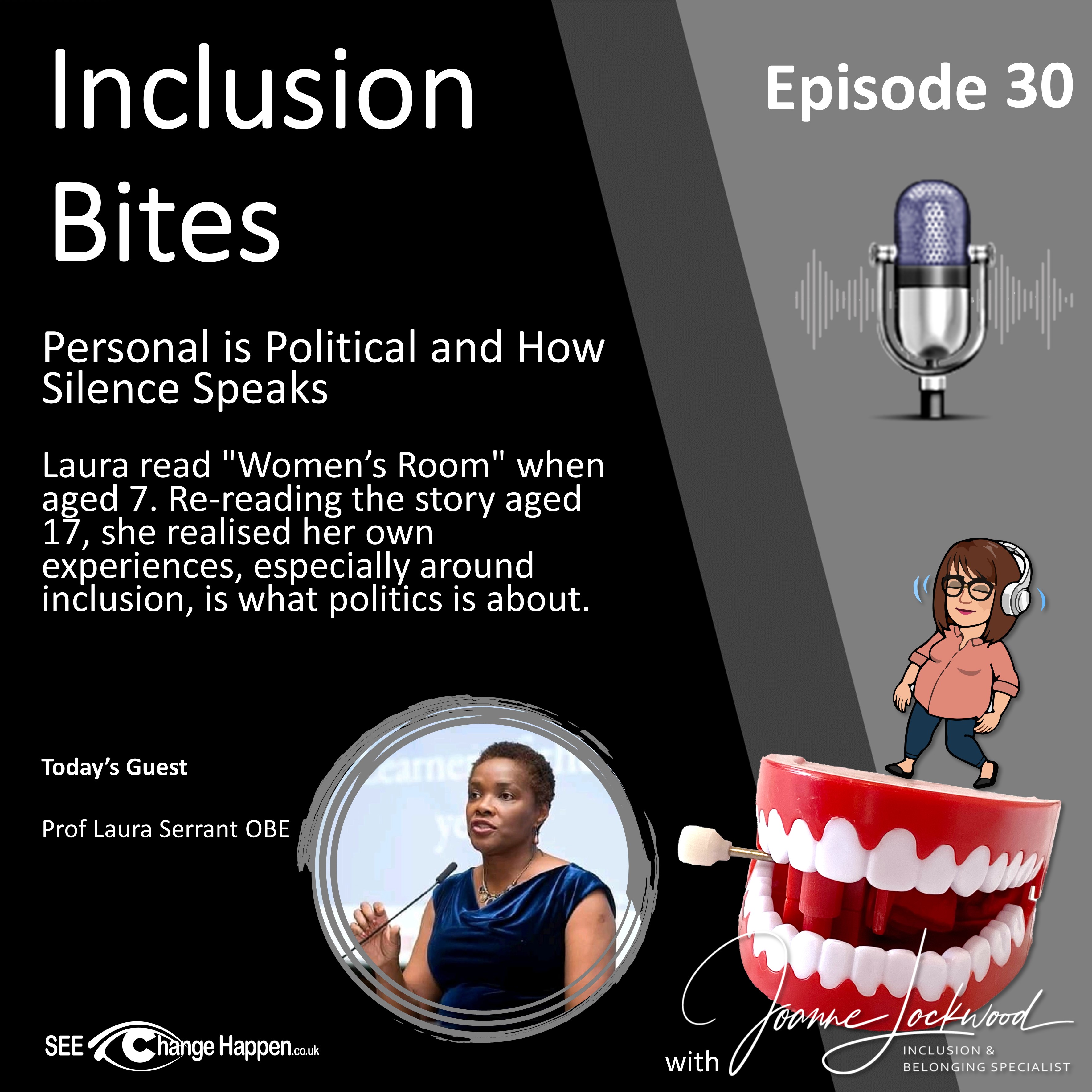
with Laura Serrant · 04 March 2021
Lived Experience Identity
Professor Laura Serrant OBE joins Joanne Lockwood to unpack what it means for “the personal to be political”, and why our everyday experiences of inclusion, exclusion, and being given (or denied) equal chances reflect how society distributes value, resources, and voice.
They explore the power of storytelling as a bridge to empathy, how perspective shapes reactions to the same event, and how group dynamics, belonging, and fear of ostracism can silence people or push them into conformity. Laura reflects on the particular responsibility that can fall on those who visibly occupy minority positions, including the ongoing work of naming what is offensive even when it isn’t personally felt as offence.
The conversation also moves into practical inclusion: asking people what they need rather than guessing, listening for intent and impact, and avoiding “survey fatigue” by ensuring feedback leads to visible action. Laura shares how poetry helps her “download” her thoughts and how her Windrush-inspired poem amplified untold stories, before reflecting on her career and honours as a tribute to the communities, colleagues, and ancestors whose voices shaped her work.
About Laura Serrant
One-sentence summary
Laura Serrant believes that our silences carry truth, and that when we choose to speak from our lived experience, we honour those who came before us and protect the dignity of those who come after.
---
Synopsis
Laura Serrant is a Black woman, nurse, academic and self-described queen whose life has been shaped by witnessing both the best and worst of humanity. As the daughter of Windrush generation parents, she grew up understanding that opportunity is often paid for by sacrifice. Her early career as a nurse in the 1980s, caring for people dying during the AIDS crisis, exposed her to stigma, fear and profound dignity. Those moments — standing beside people who were vilified simply for being who they were — taught her that lived experience is knowledge, and that silence can wound as deeply as words.
She is trying to change how we listen to one another. For Laura, “the personal is political” means that everyday slights, exclusions and quiet injustices are not isolated incidents — they reflect how society distributes power, worth and belonging. She wants us to stop treating inclusion as an abstract target and instead recognise it as something that affects whether people feel safe walking down the street, speaking in a meeting, or simply existing without defence. Her work is about making sure people do not have to scream to be heard — and that when they do speak, something actually changes.
---
10 Small, digestible concepts for easy learning
1. We are the expert on our own life.
No handbook knows you better than you know yourself.
2. What happens to you is never “just personal”.
Individual experiences often reveal something structural about the world.
3. Silence isn’t empty — it holds untold stories.
What isn’t said can reveal as much as what is.
4. Intent matters — but listening matters more.
Curiosity must be paired with patience.
5. Belonging is monitored in micro-moments.
We constantly scan: am I safe, accepted, valued?
6. Being visibly different carries responsibility and exhaustion.
You cannot “switch off” an identity others can see.
7. Stories humanise where policies can’t.
A manual informs; a story transforms.
8. Asking isn’t the problem — inaction is.
People tire of contributing when nothing changes.
9. Different spaces create different vulnerabilities.
Confidence in one context does not erase fragility in another.
10. Recognition is collective, not individual.
Success stands on the shoulders of unseen others.
---
The “why” in the story
What they believe is true about people
That every person holds expertise in their own experience, and that most people want to do better — they just fear getting it wrong.
What they cannot unsee
The dignity of those who suffered in silence: patients abandoned during the AIDS crisis, Windrush elders who rebuilt a nation yet were denied belonging, individuals whose voices never reached policy rooms.
What they are no longer willing to tolerate
Performative listening. Being invited to speak and then ignored. Systems that invite stories without changing outcomes.
What they are trying to build instead
Spaces where stories are heard, responses follow reflection, and no one has to carry the weight of representation alone.
---
Narrative structure
1. The trigger:
Reading the phrase “the personal is political” as a young woman and later realising that the exclusions she felt were not accidental — they were about who counts. Nursing in the early AIDS epidemic, witnessing stigma alongside extraordinary human grace.
2. The tension:
Occupying rooms where few look like her. Feeling the responsibility to speak, even when the issue is not hers personally. Balancing pride with fatigue. Being both symbol and self.
3. The insight:
“What you see depends on who’s looking.” Perspective shapes interpretation. Silence speaks. Stories carry power that instructions never can.
4. The pivot:
Choosing to speak — through policy, poetry and presence. Writing the Windrush poem when funding wasn’t available. Using her voice deliberately and asking, “So what difference will this make?”
5. The destination:
A world where people’s contributions visibly matter. Where belonging feels ordinary, not exceptional. Where silence can be restful, not suffocating.
---
Five key takeaways and learning points
1. Your lived experience is valid knowledge.
When you speak from it, you contribute something no one else can.
2. If you ask for someone’s view, show them the impact.
Action is the clearest sign of respect.
3. Curiosity is welcome — care is essential.
Asking well builds bridges; assuming builds walls.
4. Being visibly different changes how you move in the world.
Recognise the invisible labour others may be carrying.
5. Listening is not passive — it is active responsibility.
Hearing a story means you now share part of its accountability.
---
Ten distinct ideas explained
1. Visible identity cannot be put down.
For Laura, being a Black woman is not situational. Others interpret her before she speaks, shaping interactions before intention is known.
2. Representation creates double awareness.
When she raises an issue about race, it is often assumed to be personal, even when she speaks for others who are absent.
3. Belonging is about safety.
We constantly assess whether a group will accept or reject us. That calculation shapes what we say — or silence.
4. Offence is contextual.
Someone can name something as offensive without being personally wounded by it — because they understand its wider harm.
5. Fatigue comes from futility, not effort.
People don’t tire of sharing; they tire of speaking into a void.
6. Stories surface hidden history.
Her Windrush poem gave voice to sacrifices that formal celebrations often overlook.
7. Recognition carries memory.
Receiving an OBE, she saw the faces of those who never received public honour but shaped her path.
8. Silence can protect — and suppress.
We choose which stories to tell to guard ourselves. But sometimes the silence grows loud enough that it demands release.
9. Evidence includes emotion.
As an academic, she values data — but she also sees lived stories as legitimate evidence.
10. Leadership is cultural stewardship.
Calling herself a “queen” reflects responsibility for holding community stories and modelling strength for younger women.
---
How people should change as a result
1. Think
- Move from “That’s just your experience” to “What does this reveal about the system?”
- See identity not as an add-on, but as something shaping daily navigation.
- Treat personal stories as expertise, not anecdotes.
- Ask not only “What happened?” but “Who did it affect and how?”
2. Feel
- Shift from defensiveness to openness when challenged.
- Replace fear of saying the wrong thing with willingness to learn.
- Move from passive sympathy to active respect.
- Allow discomfort to be a teacher rather than a threat.
3. Act
- When you ask for feedback, report back on what changed.
- Create moments of genuine pause in meetings — let silence work.
- Ask individuals what they need rather than guessing based on group labels.
- Challenge offensive remarks even when they are not about you.
- Acknowledge contributions publicly, especially from those rarely centred.
- Practise attentive listening: mirror, clarify, and thank people for sharing.
- Notice who carries the burden of speaking up — and lighten it.
---
One thing to remember
Silence always speaks — the question is whether we are brave enough to listen, and responsible enough to act.