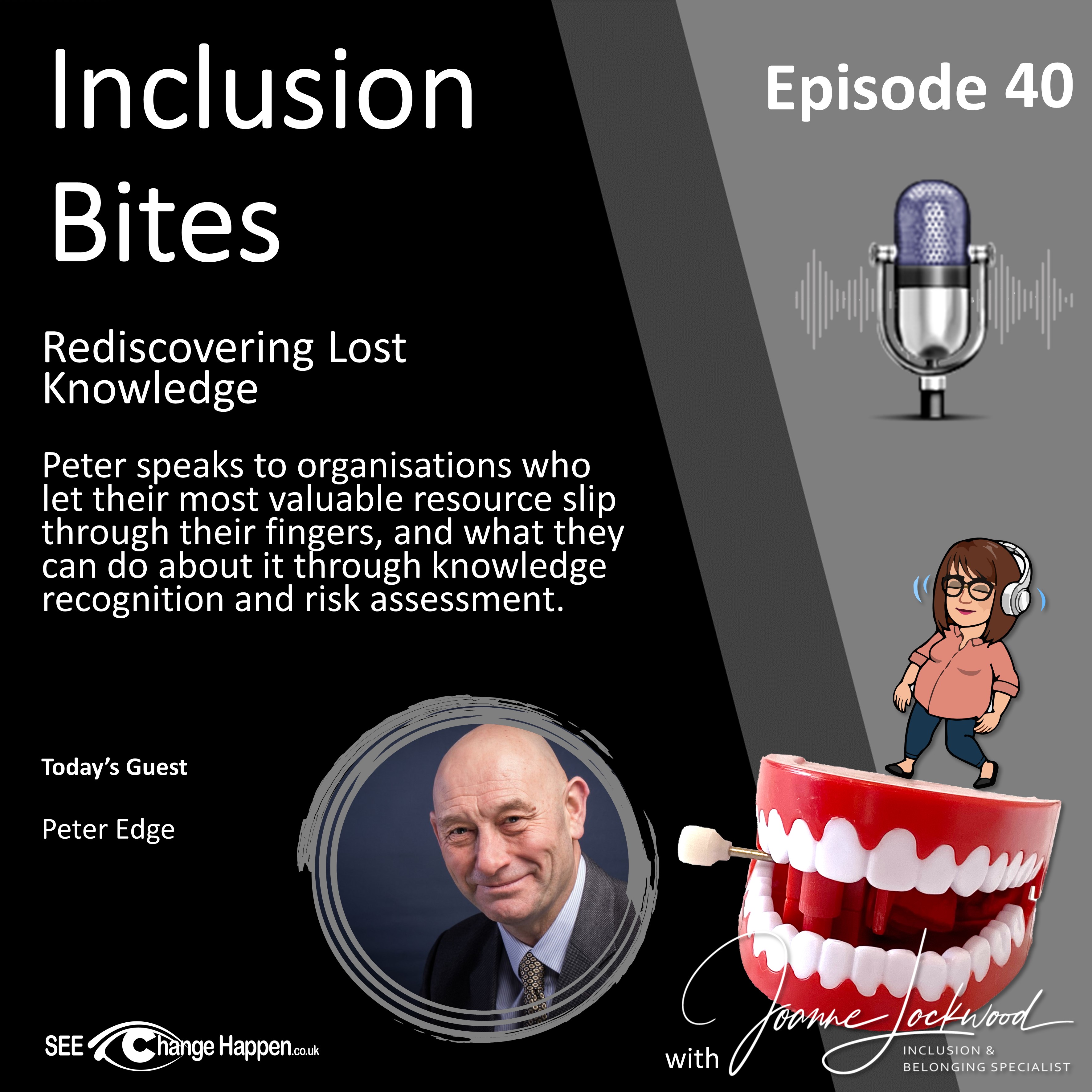
Rediscovering Lost Knowledge
with Peter Edge · 12 August 2021
Workplace Culture Systems
Peter Edge joins Joanne Lockwood to explore what happens when organisations fail to notice, capture, and transfer the expertise that keeps work moving. Using stories from policing, education, the NHS and specialist manufacturing, Peter illustrates how “lost knowledge” isn’t abstract—it shows up as cost, disrupted performance, demoralised teams, and repeated onboarding that drains leaders’ time.
They discuss why knowledge often walks out of the door unnoticed: leaders who don’t listen, cultures that treat people as replaceable cogs, appraisal and performance systems that miss real contribution, and environments where people hoard expertise because they don’t feel trusted or safe. The conversation connects knowledge retention to staff retention, succession planning, and the practical discipline of identifying single points of failure through simple risk assessment.
The episode also touches on how COVID and remote/hybrid work changed informal learning and “water-cooler” mentoring, and how organisations might rethink communication, trust, and flexibility so that learning and connection aren’t dependent on being in an office. Throughout, the focus remains on building workplace systems that recognise value, support progression, and prevent critical expertise from disappearing.
About Peter Edge
One-sentence summary
Peter Edge is driven by a deep discomfort with waste — not of money, but of people — and believes we dishonour one another when we let hard-earned knowledge quietly walk out of the door.
---
Synopsis
Peter Edge is a former senior investigating officer who has spent a lifetime noticing patterns — in crime, in people, and now in organisations. What troubles him most is not failure, but neglect. A friend who transformed a classroom was told, “If we could bottle what you have…” and then allowed to leave without a trace of that wisdom being kept. A detective force suddenly realised its experience base was vanishing faster than it could replace it. A specialist who had woven cables for space for forty years remained the only one who knew how. These stories did something to Peter. They unsettled him. He hates waste — and to him, losing people’s knowledge is almost immoral.
What Peter wants to change is the casual way organisations treat insight as disposable and people as interchangeable. He sees what happens when contributions go unrecognised: morale drains, loyalty crumbles, teams become dependent on silent heroes, and performance rises and falls like a rollercoaster. More than efficiency, Stephen is talking about dignity — about telling someone, “You matter. What you carry matters.” He believes recognition is not a gold watch at retirement; it is the courage to say, while someone is still here, “Teach us. Help us understand how you do what you do so well.” Because when knowledge is hoarded out of fear or ignored out of laziness, everyone loses.
---
10 Small, digestible concepts for easy learning
1. Recognition is protection.
When you name someone’s value, you make it harder for their contribution to disappear unnoticed.
2. Knowledge doesn’t retire — it walks.
When a person leaves, what leaves with them is often invisible until it’s urgently needed.
3. Lazy leadership doesn’t listen.
If you don’t truly pay attention to your people, you cannot possibly know what you’re about to lose.
4. Hoarding is a symptom of fear.
People guard their expertise when they believe it’s the only thing making them safe.
5. Security without appreciation breeds resignation.
Feeling indispensable is not the same as feeling valued.
6. Succession is an act of respect.
Preparing someone else to step in says, “Your knowledge is important enough to preserve.”
7. Turnover drains spirit before it drains budgets.
Constant onboarding exhausts the people who remain.
8. You cannot replace nuance with a spreadsheet.
Some expertise lives in instinct, relationships and judgment — not manuals.
9. Trust precedes sharing.
People share more when they feel safe, not surveilled.
10. We survive by storytelling.
From campfires to corridors, knowledge passes through conversation — if someone is listening.
---
The “why” in the story
What they believe is true about people
Peter believes people want to do good work, be trusted, and be seen for the real value they bring.
What they cannot unsee
He cannot unsee the waste — teachers, detectives, engineers walking away with irreplaceable wisdom because no one thought to ask.
What they are no longer willing to tolerate
Leadership that treats appraisal as paperwork rather than curiosity. Systems that fail to ask, “Why are you so good at this?”
What they are trying to build instead
Workplaces where listening is active, succession is deliberate, and knowledge is honoured as shared treasure, not personal leverage.
---
Narrative structure
1. The trigger:
A headteacher admitted a man’s brilliance could make a school outstanding — and then let him leave without capturing any of it. Senior detectives retired en masse, leaving gaps no policy could immediately fill. These weren’t dramatic collapses; they were preventable losses.
2. The tension:
Peter lives with the frustration that organisations often know better — they have metrics, forecasts, HR processes — yet still ignore the simplest act: asking people about their plans and valuing their expertise. He meets resistance in hierarchy, presenteeism, and mistrust.
3. The insight:
Knowledge isn’t just stored in documents; it sits in relationships, judgement calls, instincts and years of lived experience. You cannot protect what you don’t first notice.
4. The pivot:
He began speaking, writing and challenging leaders to risk assess people not as replaceable units, but as holders of specific knowledge. He reframed appraisal as inquiry: “Tell us how you do this so well.”
5. The destination:
A working world where contribution is recognised early, expertise is shared without fear, and organisations grow steadily rather than lurching between loss and reinvention. A place where people leave celebrated — not quietly mourned for what vanished with them.
---
Five key takeaways and learning points
1. If you don’t ask people about their plans, you forfeit the right to be surprised when they go.
So what: Simple conversations prevent expensive departures.
2. Being the ‘only one’ is a risk, not an honour.
So what: Shared knowledge builds resilience and eases pressure.
3. Recognition must happen before resignation.
So what: Waiting until someone leaves to praise them is too late to protect what they brought.
4. Turnover is emotional as much as financial.
So what: Constant churn erodes pride, commitment and momentum.
5. Trusting adults to act like adults changes everything.
So what: Control constrains growth; trust unlocks contribution.
---
Ten distinct ideas explained
1. Corporate memory lives in people.
Documents record decisions; people remember why those decisions were made. When they go, context goes too.
2. Invisible labour sustains organisations.
The person who “just knows” which supplier to call or how to fix a crisis often sits low in hierarchy but high in impact.
3. Appraisals should be explorations.
Instead of judging performance, leaders can ask how excellence is achieved — turning pride into shared learning.
4. Burnout comes from repetition without progress.
Training new starters repeatedly, without structural change, drains experienced staff.
5. Scarcity creates defensiveness.
When job security feels fragile, knowledge becomes currency to guard.
6. Casual remarks are data.
A conversation at a coffee machine about mortgages or ambitions can signal future retention risks.
7. Not all progress looks like presence.
Productive work may happen at unconventional hours; value is not always visible.
8. Extinction happens quietly.
Skills disappear not through catastrophe, but through neglect.
9. Belonging protects knowledge.
When people feel part of something, they are more willing to invest their insight into its future.
10. Leadership is attentive, not ornamental.
Tokens of recognition mean less than consistent, thoughtful engagement.
---
How people should change as a result
1. Think
- Move from “roles are replaceable” to “relationships hold memory”.
- Replace “Who can cover this?” with “Who understands this deeply?”
- See turnover not only as cost but as loss of narrative and nuance.
- Consider knowledge as shared responsibility, not individual possession.
2. Feel
- Shift from complacency to curiosity.
- From control to trust.
- From defensiveness to openness.
- From fear of sharing to pride in teaching.
3. Act
- Ask each team member: “What do you know that others might not realise you hold?”
- Map who is the ‘only one’ in key processes — and create shadow opportunities.
- Build knowledge-sharing sessions that feel like conversations, not audits.
- Celebrate contributors publicly while they are still present.
- Check in on people’s aspirations at least twice a year — and listen properly.
- Pair experienced staff with newer colleagues intentionally.
- Notice signals of fatigue in those repeatedly onboarding others — and adjust support.
---
One thing to remember
If you can “bottle” someone’s brilliance, the least you can do is ask them how it’s made — before it walks away.