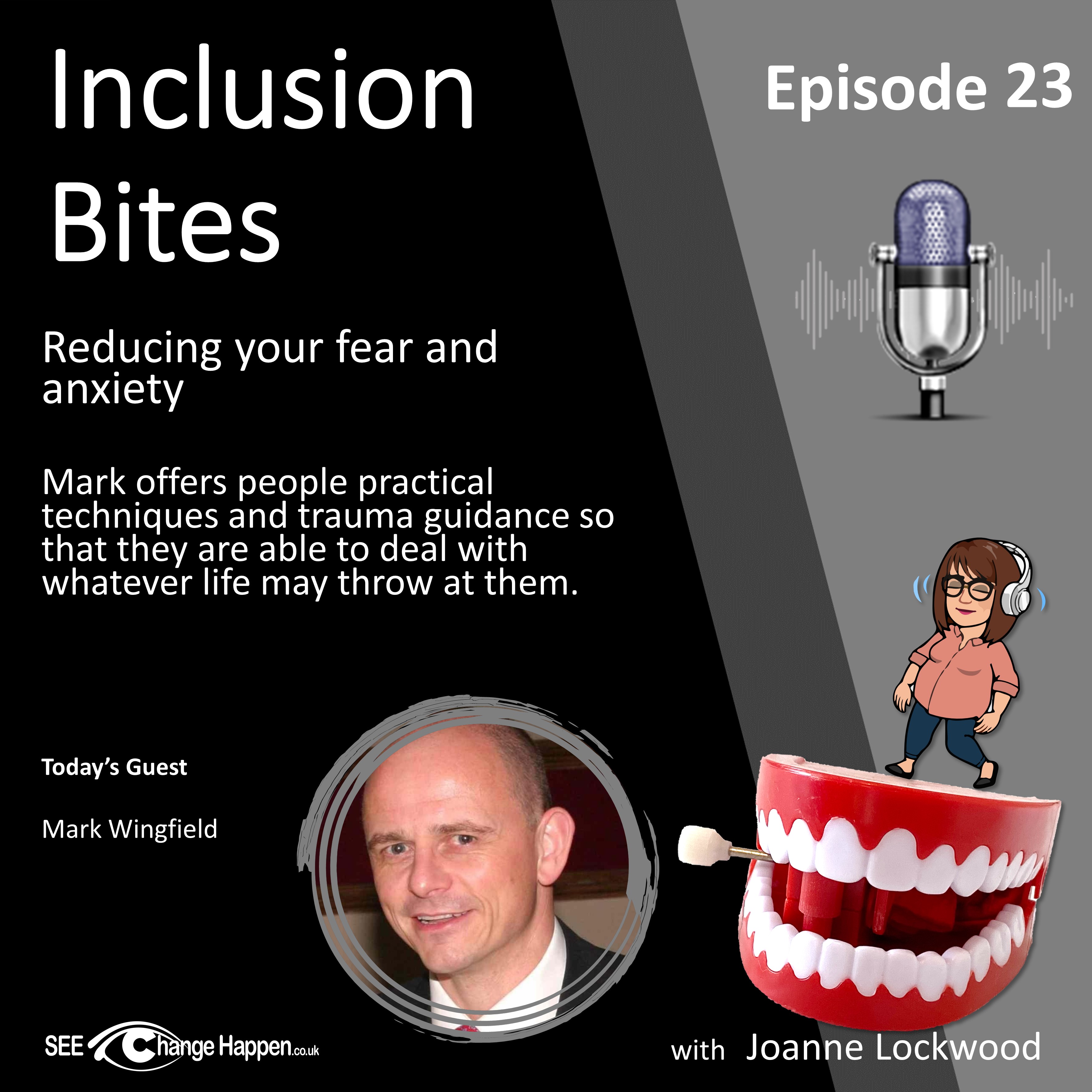
Reducing Your Fear And Anxiety
with Mark Wingfield · 07 January 2021
Mental Health Wellbeing Trauma
Joanne Lockwood is joined by Mark Wingfield to explore why fear and anxiety are so universal, and how they can limit people’s ability to show up fully and reach their potential.
Mark shares practical approaches he uses in his work, including calming techniques for when people feel triggered, and structured ways to respond to intimidation, bullying, and “banter” that crosses the line. They discuss how discrimination and microaggressions can fuel anxiety, why it can feel risky to speak up, and how timing, setting, and organisational processes (like HR routes and the Equality Act) affect what people can do next.
The conversation also looks at modern pressures such as social media and cyberbullying, and includes examples from schools and workplace environments. Joanne shares personal experiences of online abuse after her transition and reflects on the emotional impact of backlash and trolling.
Finally, Mark explains elements of his training and trauma-informed practice, including role-play methods designed to prepare people for difficult scenarios, and heart rate variability control to help people regain access to clear thinking under stress.
About Mark Wingfield
One-sentence summary
Mark believes that when people learn to steady their fear instead of being ruled by it, they reclaim their dignity, their voice, and their right to take up space.
---
Synopsis
Mark Wingfield is, at heart, an empath who refuses to let fear shrink people. He has known what it feels like to be jostled, excluded, circled like prey at school. He remembers the “jungle treatment”, boys circling, hoping to humiliate him. He stopped it instinctively back then. Later, he chose to understand it properly. What shaped him was not a desire to dominate conflict, but a quiet determination to prevent others from being overwhelmed by it. He has seen people discriminated against, bullied, ignored for how they turn up in the world. He works with those who are resilient and those who are not, knowing that fear does not discriminate – but its impact does.
What he is trying to change is not just behaviour, but helplessness. He sees how anxiety silences people before a word is spoken. He sees how early harm can settle into someone’s nervous system and dictate the rest of their life. He wants people to feel capable when they are frightened. To stay calm when their heart races. To say, clearly, “That is not acceptable.” Whether it’s frontline staff facing aggression, someone enduring subtle workplace humiliation, or a person confronting hate, Mark’s work is about restoring agency. He wants people to function without being hijacked by fear – not hardened, not numb, but steady. Human.
---
10 Small, digestible concepts for easy learning
1. Fear is universal — but control is learnable.
Everyone feels anxiety; not everyone learns how to steer it.
2. Your nervous system isn’t your enemy.
Fight, flight or freeze are survival responses — they just need guidance.
3. Calm is a skill, not a personality trait.
You can practise your way into steadiness.
4. What happens before eight can echo for decades.
Early patterns shape how safe or unsafe the world feels.
5. Unchallenged behaviour grows.
Silence can unintentionally reward harm.
6. Assertive is different from aggressive.
Clear and calm often holds more power than loud and reactive.
7. Pick your moment.
Timing and place matter as much as words.
8. The body remembers what the mind tries to forget.
Trauma isn’t just a story; it’s a physiological imprint.
9. Confidence is anchored through experience.
Practising scary scenarios in safety prepares you for real life.
10. You deserve to function at 100% of your potential.
Fear should not ration your talent.
---
The “why” in the story
What they believe is true about people
Mark believes people are far more capable than their fear allows them to be — and that most unkindness stems from distortion, insecurity, or learned behaviour rather than strength.
What they cannot unsee
He cannot unsee how often discrimination, humiliation and aggression go unchallenged — and how that slowly conditions people to accept shrinking.
What they are no longer willing to tolerate
He will not tolerate the idea that being frightened means being powerless. Nor that abuse “comes with the job”.
What they are trying to build instead
He is building steady humans — people who can regulate their bodies, think clearly under pressure and communicate firmly without losing themselves.
---
Narrative structure
1. The trigger
Childhood bullying, the circling, the testing. Later, witnessing staff assaulted, frontline workers abused, subtle and overt prejudice replayed across environments. Each pattern reinforced the same truth: fear freezes people.
2. The tension
How do you prepare people for real hostility without becoming hostile yourself? How do you recreate racism, sexism, aggression in training without reinforcing it? How do you confront harm while staying compassionate?
3. The insight
You cannot reason with fear while you are flooded by it. First, calm the body. When the amygdala quiets, thinking returns. With calm comes choice.
4. The pivot
Rather than simply telling people to “be confident”, he began imprinting confidence physically — through controlled intimidation scenarios, heart-rate techniques, trauma therapy. He moved from advice to embodied rehearsal.
5. The destination
A world where someone can say, without shaking, “Please stop. That is not acceptable.”
Where frontline staff are protected.
Where fear does not decide careers, wellbeing or worth.
---
Five key takeaways and learning points
1. You don’t have to respond in the moment.
Choosing your time can protect both your dignity and your outcome.
2. Regulation precedes resolution.
Calm your physiology first; only then tackle the problem.
3. Subtle harm still harms.
Microaggressions erode confidence drop by drop unless addressed.
4. Practical rehearsal builds real courage.
Experiencing intimidation in safe conditions increases real-world capability.
5. Leadership carries a duty of care.
Abuse should never be dismissed as “part of the job”.
---
Ten distinct ideas explained
1. The Freeze Response
When someone goes silent or still, it’s not weakness — it’s biology. Understanding this restores compassion.
2. Heart Rate Variability and Stress
The body signals overload long before words emerge. Managing breath steadies the mind.
3. Assertion as Boundary-Setting
Saying “When you say that, I feel uncomfortable” shifts blame to behaviour, not identity.
4. Choosing the Arena
Public confrontation can escalate; private conversation can resolve.
5. Learned Aggression
People often replicate what they witnessed at home or school. Behaviour is patterned before it is personal.
6. Resilience Isn’t Evenly Distributed
Two people can face the same insult; one shrugs, another spirals. Context matters.
7. Zero Tolerance Is Cultural, Not Just Policy
Visible signals that abuse is unacceptable empower staff to stand firm.
8. Emotional Detachment vs Emotional Control
Removing the emotional spike doesn’t mean removing care — it creates clarity.
9. Banter’s Fine Line
Intent doesn’t erase impact. Humour becomes harmful when it diminishes.
10. Confidence is Contagious
When one person calmly challenges harm, others often feel braver.
---
How people should change as a result
1. Think
- Shift from “Why didn’t they speak up?” to “What stopped their nervous system from allowing it?”
- See aggression as dysregulation — not just bad character.
- Understand that calm is trainable, not innate.
- Recognise that silence in a room often signals fear, not agreement.
- Realise that leadership is responsibility for psychological safety.
2. Feel
- Less judgement towards those who freeze.
- Less guilt about needing support.
- More curiosity about your own stress responses.
- More steadiness when confronted.
- More compassion for those who have learned harmful behaviour.
3. Act
- Practise slow, rhythmic breathing daily to improve regulation.
- Rehearse one clear boundary phrase you can use under pressure.
- Step away briefly before responding when triggered.
- Back up someone who challenges inappropriate behaviour.
- Tell colleagues explicitly that abuse is not acceptable.
- Seek practical training rather than relying on “common sense”.
- Reflect on early patterns you may unconsciously repeat.
---
One thing to remember
Fear may arrive uninvited — but it does not have to take the controls.