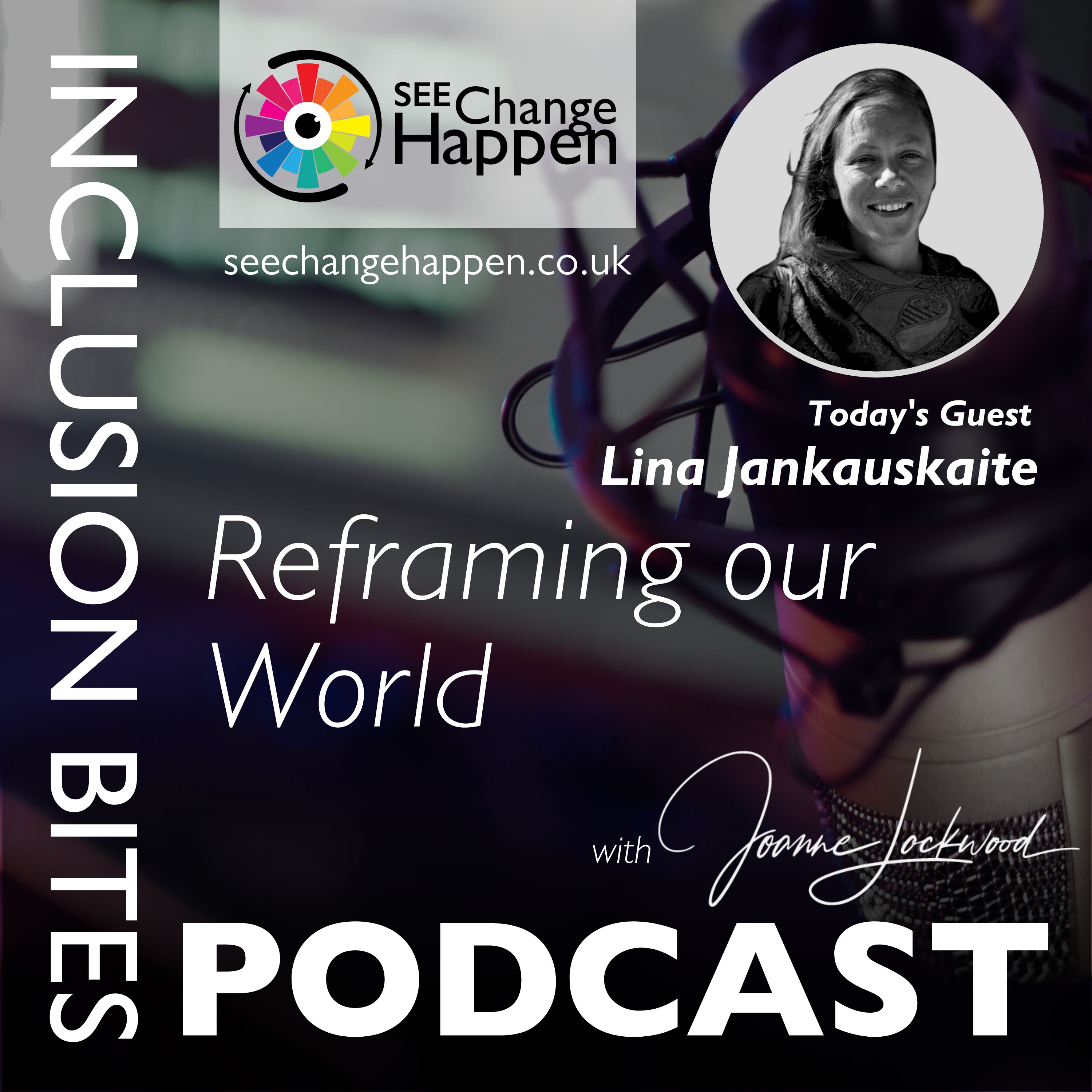
Reframing Our World
with Lina Jankauskaite · 12 September 2024
Inclusive Leadership Management
Joanne Lockwood is joined by psychologist and holistic life coach Lina Jankauskaite to explore how reframing our interpretations of people and events can reduce frustration and create more empowered choices. Using everyday examples like road rage, conflict, and technology stress, they unpack how language shapes thought patternsand how small shifts in wording can move us from a passive, disempowered stance into taking ownership of our reactions.
Lina shares her journey from rural Lithuania to the UK and reflects on how diversity, community, and belonging shaped her outlook. Together, they discuss self-leadership as a practice built on self-awareness, resilience, and the willingness to notice defensiveness before it takes over.
The conversation moves into leadership and accountability: why humility and vulnerability build trust, how admitting mistakes can strengthen relationships, and why leaders are better viewed as guides rather than all-knowing masters. Joanne connects these ideas to lessons from her entrepreneurial training and the importance of personal responsibility, planning, and learning rather than blame.
They also touch on recognising when to step away from toxic dynamics, finding closure, and using difficult experiences to reveal patterns that can be worked on. The episode leaves listeners with practical, repeatable strategies for reframing, taking responsibility, and creating healthier interactions that support more inclusive environments.
About Lina Jankauskaite
One-sentence summary
Lina Jankauskaite is driven by the belief that we can only change the world when we stop defending our corners and start leading ourselves with honesty, humility and courage.
---
Synopsis
Lina Jankauskaite arrived in the UK from a small Lithuanian town at twenty, expecting misty Sherlock Holmes streets and finding instead the blazing heat and chaos of Oxford Street. What stayed with her wasn’t culture shock, but awe. She watched. She observed. She sat on park benches and studied the movement of people from every corner of the world. In a restaurant at Stansted Airport, surrounded by colleagues from dozens of countries, she experienced diversity not as a concept, but as shared humanity. It was there she began to feel something quietly life-changing: belonging isn’t about being the same — it’s about recognising we’re all just trying.
Now a psychologist and self‑leadership coach, Lina describes her superpower as an “undefeatable belief” that humans are fundamentally good, giving and caring. But that belief has been tested — in traffic, in difficult relationships, in her own defensiveness, in moments when she felt disempowered. What she is trying to change isn’t just behaviour; it’s how we relate to ourselves. She wants people to notice their language, their assumptions, their need to be right. Because when we stop saying “she made me angry” and start saying “I feel angry”, we reclaim dignity, choice and responsibility. And that shift — small, consistent, deliberate — is how she believes the world becomes kinder.
---
10 Small, digestible concepts for easy learning
1. You are not powerless — you are often just unaware of your power.
The language you use either locks you into helplessness or opens up agency.
2. “They made me feel…” keeps you stuck; “I feel…” sets you free.
Owning emotion doesn’t excuse harm — it returns control to you.
3. Being right can be lonelier than being wrong.
Defending your corner isolates you; vulnerability connects you.
4. You only need to be a guide, not a master.
Leadership isn’t omniscience — it’s being a step ahead and still willing to learn.
5. Belonging often begins in shared struggle.
Connection grows when people recognise each other’s humanity, not perfection.
6. Defensiveness protects identity, not truth.
We argue hardest when our self-image feels threatened.
7. Practice rewires possibility.
Repeated small reframes literally shape how your brain responds.
8. Humility is strength under control.
Saying “I was wrong” takes more courage than winning an argument.
9. Not every battle deserves your energy.
Walking away can be wisdom, not weakness.
10. Systems change when people change.
Structures are built and sustained by individuals — transformation starts there.
---
The “why” in the story
What they believe is true about people
Lina believes that at their core, people are good, willing and caring — even when their behaviour misses the mark.
What they cannot unsee
She cannot unsee how often we trap ourselves in disempowering language, how quickly we slip into blame, and how lonely it becomes to constantly defend being right.
What they are no longer willing to tolerate
She is no longer willing to live in silent resentment, reactive anger or the exhausting need to prove herself correct.
What they are trying to build instead
She is trying to build a world where people practise self-leadership — where accountability, humility and emotional ownership create stronger relationships and braver leadership.
---
Narrative structure
1. The trigger:
Arriving in London at twenty — overwhelmed, fascinated, observing thousands of lives intersecting — she felt both small and expansive. Later, noticing her own flashes of road rage and defensiveness, she recognised that the only person suffering her anger was herself.
2. The tension:
The conflict between wanting to be right and wanting connection. The exhaustion of feeling disempowered. The temptation to blame circumstances, other drivers, systems, colleagues — instead of asking, “What can I change here?”
3. The insight:
Language shapes perception. Saying “she made me angry” leaves no room to move. Saying “I feel angry” opens a doorway to choice. The situation may be the same — but your agency shifts.
4. The pivot:
She began catching herself — the instant irritation, the defensive thought, the catastrophising. She practised reframing deliberately. She chose vulnerability over pride. She walked away when staying meant shrinking.
5. The destination:
A world where leaders see themselves as guides. Where admitting fault strengthens trust. Where people feel empowered enough to share wild ideas without fear. Where belonging feels natural because no one is pretending to be perfect.
---
Five key takeaways and learning points
1. You are responsible for your response.
You may not control what happens, but you always influence how you carry it forward.
2. Humility builds trust faster than authority.
When you admit mistakes, people feel safer around you.
3. Defensiveness is often fear in disguise.
If you notice yourself fighting hard to be right, ask what feels threatened.
4. Leadership begins with self-awareness.
Strategy without introspection eventually fractures relationships.
5. Walking away can be self-respect, not surrender.
Protecting your energy allows you to show up fully where it matters.
---
Ten distinct ideas explained
1. Belonging is experiential, not theoretical.
Lina felt it not in policy, but in a multicultural airport kitchen — immigrants figuring life out together.
2. Awe reduces fear.
When she arrived in London, awe replaced threat — curiosity disarmed isolation.
3. Language carries power.
The difference between blame and ownership is often just one pronoun — but the emotional consequences are vast.
4. Anger often masks powerlessness.
Road rage isn’t about traffic; it’s about feeling out of control.
5. Self-image can imprison growth.
If being “right” becomes your identity, learning becomes dangerous.
6. Vulnerability reconnects.
Admitting fault reopens dialogue and restores dignity on both sides.
7. Competition culture breeds defensiveness.
When we’re raised to outperform rather than collaborate, admitting error feels like defeat.
8. Guides evolve; masters calcify.
Seeing yourself as a guide keeps you adaptive and open.
9. Closure matters in difficult endings.
Leaving toxic spaces requires self-awareness — and sometimes patience with yourself.
10. Change ripples outward.
When individuals practise agency and accountability, relationships shift — and systems follow.
---
How people should change as a result
1. Think
- Move from “Who is to blame?” to “What is within my control?”
- See leadership as stewardship, not superiority.
- Regard apologies as credibility, not weakness.
- View conflict as a mirror before it is a battlefield.
- Recognise that being right and being connected are not the same aim.
2. Feel
- From defensiveness → to curiosity.
- From guilt → to responsible ownership.
- From resentment → to perspective.
- From superiority → to shared humanity.
- From helplessness → to quiet agency.
3. Act
- Notice your language for one week — especially “they made me…” statements.
- Replace blame statements with ownership statements, privately or aloud.
- Offer one genuine apology without qualification.
- In meetings, speak last — and listen first.
- When triggered, pause and ask: does this reaction serve me?
- Step away from one draining interaction that repeatedly diminishes you.
- Invite someone else’s idea before proposing your own.
---
One thing to remember
You don’t change the world by winning arguments — you change it by leading yourself first.