The Courage To Be Seen
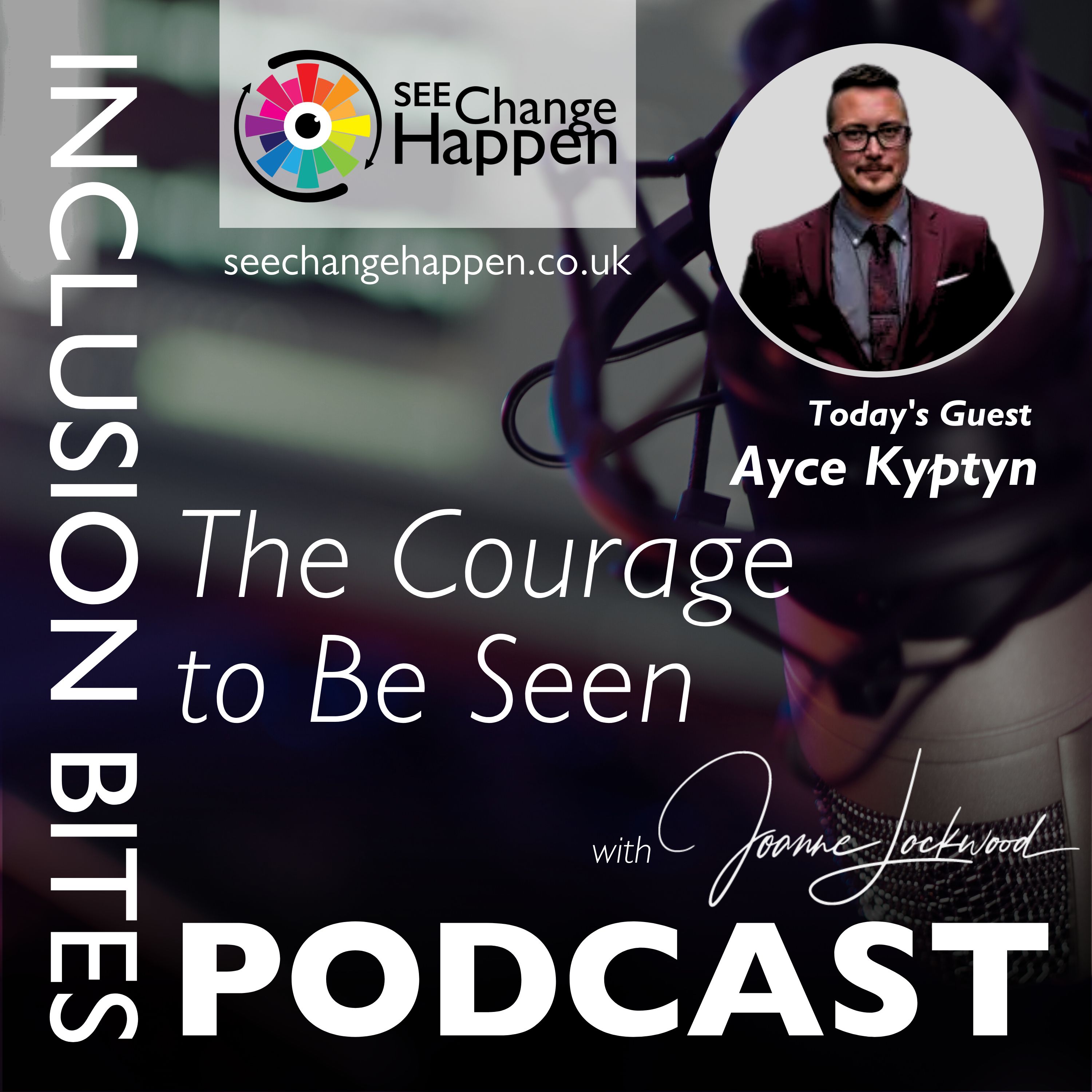
with Ayce Kyptyn · 19 September 2025
Lived Experience Identity
Joanne Lockwood is joined by somatic sexologist Ayce Kyptyn to explore what it really takes to be seen and to live in alignment with who you are, especially when society, faith, and community have taught you to hide.
Ayce shares how losing his job and the life he had built in 2022 triggered a deeper reckoning with years of repression and the pressure to conform. He talks candidly about realising he was trans, the pain of leaving behind family and an evangelical Christian community, and the relief and clarity that came with transition and finally recognising himself in the mirror.
The conversation also unpacks Ayce’s work in somatic sexology: creating safe, non-judgemental spaces where people can reconnect with their bodies, explore desire without shame, and integrate parts of themselves they have learned to abandon. Joanne and Ayce discuss the Erotic Blueprint framework, how curiosity and presence can replace performance and escalation, and why trust, community, and support systems are essential for lasting change.
Across identity, intimacy, and belonging, this episode invites listeners to question whose rules they are living by, and to consider what becomes possible when authenticity is treated not as a risk, but as a pathway to liberation.
About Ayce Kyptyn
One-sentence summary
Ayce Kyptyn’s story is about choosing truth over approval — even when it costs everything — and building a life where being fully seen feels like coming home.
---
Synopsis (two paragraphs)
For 38 years, Ayce lived a life that looked stable and successful on the outside: a respected theologian, a leader in evangelical circles, building a home and a future. But beneath that structure was a constant tension. He knew “at the age of four” that he was different, that he felt more aligned with boyhood than girlhood, yet he absorbed the message that who he was had to be reshaped to fit doctrine and expectation. In 2022, when he unexpectedly lost his career, the scaffolding of his life collapsed. Sitting in his therapist’s office, he finally admitted what had always been present: “It became really clear to me that I was trans.” What followed was grief, separation from community, and the painful choice to walk away from the world that had formed him — not out of rebellion, but, as he says, partly “out of love” to prevent further harm to those he cared about.
Now Ayce helps others return to their bodies. He describes his work as creating a space where “all of you” is welcome — the parts people were praised for and the parts they were taught to hide. Having lived decades in quiet pain, he speaks about learning to “transmute the pain into pleasure” — not as indulgence, but as alignment. What he is trying to change is not just people’s sex lives; it is the lifelong habit of self-abandonment. He believes that when someone can look in the mirror and feel what he now feels — “I’m really excited about what I see because it actually reflects how I feel inside” — something fundamental heals. For him, embodied authenticity is not radical. It is relief.
---
10 Small, digestible concepts for easy learning
1. We all play a character before we find ourselves.
Survival often means performing who we’re expected to be.
2. Pain can be a signal, not a sentence.
Long-term discomfort may be your body asking for truth.
3. You can love people and still leave them.
Walking away is sometimes an act of protection, not betrayal.
4. Shame thrives in silence.
The more unspeakable something feels, the more it needs safe space.
5. Safety unlocks honesty.
When the nervous system settles, truth surfaces.
6. Desire is information.
Curiosity about what you want is not indulgent — it’s instructive.
7. Alignment feels energising.
When identity and body match, vitality returns.
8. Not every ending is destruction.
Sometimes collapse is the doorway to coherence.
9. Ownership changes intimacy.
When each person owns their experience, connection deepens.
10. Being seen starts with seeing yourself.
The hardest coming-out conversation is often internal.
---
The “why” in the story
What they believe is true about people
That every person has an inner knowing which predates conditioning — and that the body often knows before the mind dares to admit it.
What they cannot unsee
The cost of repression: decades of low-grade pain, disconnection, and people living lives that look right but feel wrong.
What they are no longer willing to tolerate
Living by rules that erase identity. Performing faith or gender in ways that fracture the self.
What they are trying to build instead
Spaces where people can explore desire, identity and power without shame — and learn how to inhabit their own bodies safely and truthfully.
---
Narrative structure
1. The trigger:
In 2022, Ayce lost his career and stability overnight. The certainty he had built his life upon vanished, forcing him to confront the tension he had carried since childhood.
2. The tension:
Deep devotion to faith and family collided with his embodied truth. He loved his community, yet his authenticity threatened it. He describes this period as incredibly painful — losing role, reputation, and belonging.
3. The insight:
“The rules… are just all made up.” The life he was trying to uphold did not align with what he felt inside. That misalignment — not sin or failure — was the real source of suffering.
4. The pivot:
He chose to transition. He chose to leave. He chose to retrain and help others inhabit their bodies. Instead of repressing desire, he began exploring it with curiosity.
5. The destination:
A life where he wakes up energised, looks in the mirror and feels recognition. A world, ideally, where fewer people have to lose everything to live truthfully.
---
Five key takeaways and learning points
1. Authenticity may cost you — but repression costs more.
The short-term loss of approval can prevent a lifetime of quiet despair.
2. Your body is not the enemy.
Listening to physical sensations can guide you back to coherence.
3. Shame is socially constructed, not biologically ordained.
What feels forbidden may simply be unfamiliar.
4. Intimacy requires ownership.
When you stop scripting someone else’s reactions in your head, real connection begins.
5. Collapse can be a gift.
What feels like destruction may be the death of a persona that was never sustainable.
---
Ten distinct ideas explained
1. Self-abandonment as survival
Many people silence parts of themselves to maintain belonging. Over time, that silence becomes a habit that erodes dignity.
2. The nervous system and safety
When someone feels judged, their body braces. When they feel safe, curiosity and pleasure become accessible.
3. Gender incongruence as lived tension
For Ayce, the mismatch between inner identity and outer expectation wasn’t abstract — it was daily friction.
4. Faith and identity conflict
Doctrinal certainty can create belonging, but it can also compress people who do not fit its boundaries.
5. Pleasure as alignment
Pleasure, in Ayce’s framing, isn’t excess. It’s the body signalling congruence.
6. Community rupture
Losing faith communities can feel like losing family, history and language all at once.
7. Ego death and rebuilding
Letting an old identity die is disorienting — but it creates room for integration.
8. Repression in relationships
Couples often silence desires to avoid conflict, building distance instead of intimacy.
9. Power and vulnerability
Those who lead in public often crave relief from constant control — a place to simply receive.
10. Naming yourself
Choosing his surname from his “inner child” symbolises reclaiming authorship over identity.
---
How people should change as a result
1. Think
- Move from “Is this acceptable?” to “Is this true for me?”
- See desire as data, not danger.
- Recognise that social rules are constructed, not sacred.
- Understand that someone leaving a system isn’t necessarily rejecting love.
2. Feel
- From shame to curiosity.
- From defensiveness to empathy.
- From fear of collapse to openness to transformation.
- From judgement to compassion — especially towards your younger self.
3. Act
- Have one honest conversation you’ve been postponing — gently and without accusation.
- Notice moments when you silence yourself to keep the peace.
- Seek out a therapist or practitioner who prioritises nervous system safety.
- Ask yourself, in writing, “What do I want?” without editing the answer.
- Create one small space in your life where all of you is welcome.
- Practise mirror affirmation — look at yourself and name one thing that feels true.
- Replace judgement (of yourself or others) with a question.
---
One thing to remember
Living half-seen may keep the peace — but living fully seen is what brings you home.