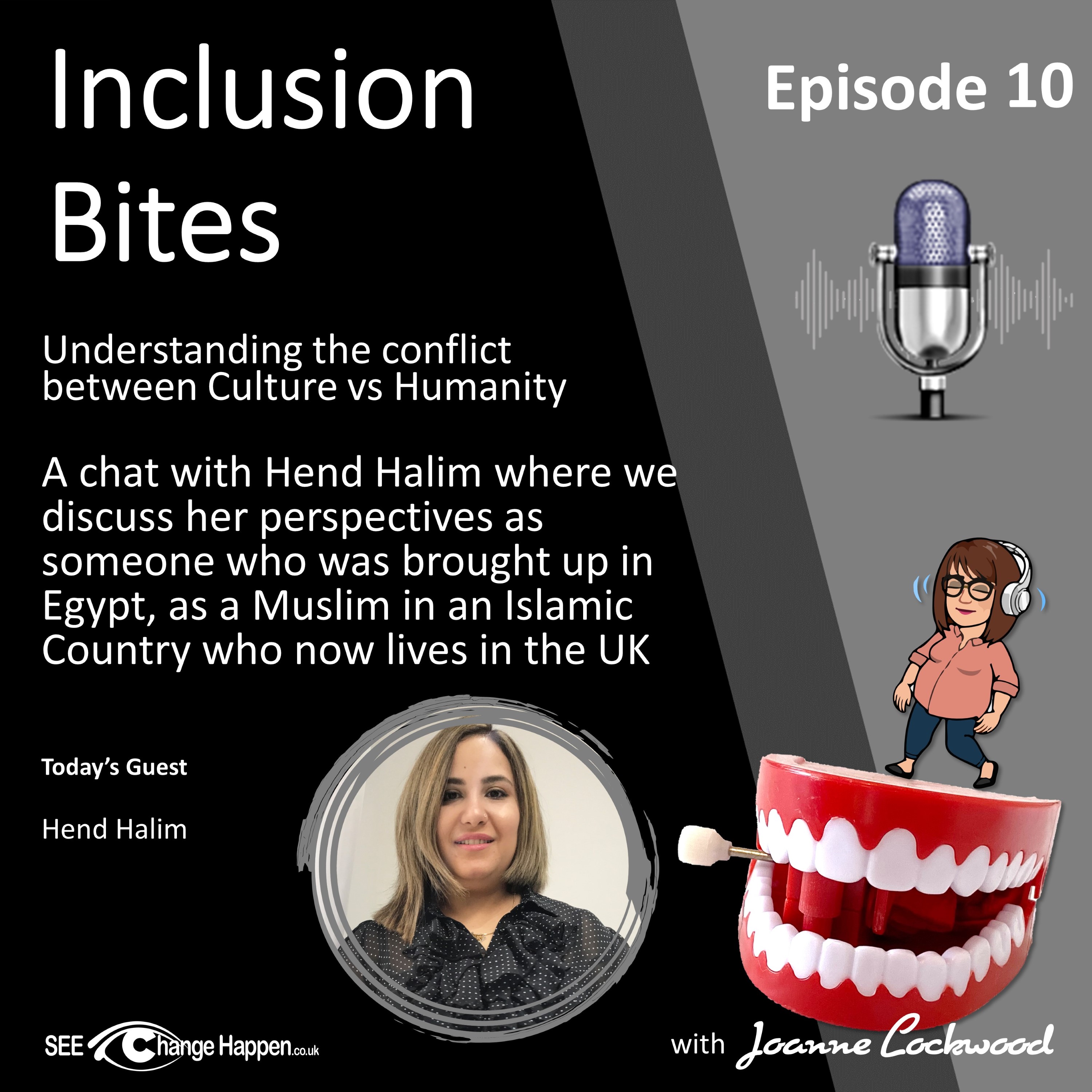
Understanding The Conflict Between Culture Vs Humanity
with Hend Halim · 23 July 2020
Workplace Culture Systems
Joanne Lockwood is joined by Hend Halim, an HR professional who grew up in Egypt and has lived in Holland and the UK, to explore the tension between cultural norms and shared humanity.
Hend reflects on how early cultural messaging shaped her understanding of LGBTQ+ people, and how education and direct relationships challenged stereotypes. She describes learning to separate morality and character from sexuality or gender identity, and why exposure and dialogue are essential for changing deeply held assumptions.
The conversation also looks at how law, privilege, and workplace culture affect people’s safety and inclusion, including examples of how LGBTQ+ people can face very different outcomes depending on social status. Hend discusses being an ally in practice, the realities of discrimination in supposedly tolerant environments, and simple ideas organisations can use to help employees connect across difference.
They also touch on wider societal context, including Black Lives Matter and colonial history, and how current events such as COVID-19 may shift working practices and expectations in ways that could improve flexibility and inclusion.
About Hend Halim
One-sentence summary
Hend Halim’s story is about choosing humanity over inherited fear — and daring to love people she was once taught to reject, even when it costs her comfort and belonging.
---
Synopsis
Hend Halim grew up in Egypt in a culture where sexuality was rarely spoken about and often condemned, shaped by faith, tradition and social expectation. As a cis, straight Muslim woman, she was taught certain truths about who was “right” and who was “wrong”. But life had other plans for her. Living across Egypt, Holland and the UK, she encountered people she’d been warned about — and found not danger, but kindness, intelligence and warmth. She recalls how a university project on “LGBT and Islam” was a profound turning point: “We were completely surprised… you cannot lose your faith and stop being a Muslim if you’re an LGBTQ person.” That discovery unsettled everything she thought she knew.
Now Hend speaks with quiet conviction about what she’s seen and what she can no longer ignore. She has witnessed how privilege shields some and destroys others, sharing the painful story of Sara Hegazy, imprisoned and tortured for raising a rainbow flag, who later took her own life. Hend’s motivation is simple and deeply human: “It’s just a matter of respect and accepting understanding.” She wants workplaces — and wider society — to become spaces where nobody has to shrink themselves to survive, where culture does not override compassion, and where difference is greeted with dignity rather than suspicion.
---
10 Small, digestible concepts for easy learning
1. Culture explains bias — it doesn’t excuse it.
What you were taught isn’t automatically the truth.
2. You can’t hate what you truly know.
Direct human contact dissolves stereotypes faster than arguments.
3. Faith without compassion contradicts itself.
“God is the most merciful and compassionate” cannot sit beside cruelty.
4. Privilege decides who is protected and who is punished.
The same act can lead to minor criticism for one person and torture for another.
5. What people do in private doesn’t define their goodness.
Character is measured by integrity, not identity.
6. Law can restrain behaviour, but not always hearts.
Tolerance under pressure is not the same as acceptance.
7. Backhanded compliments reveal hidden prejudice.
“You don’t look like them” still assumes something is wrong with “them”.
8. Representation starts at the top, but belonging starts in everyday moments.
Inclusion lives in lunch invitations as much as leadership roles.
9. Respect doesn’t require agreement.
“Live and let live” is often the bravest stance.
10. Humanity requires updates.
Just as technology evolves, so must our interpretations of tradition.
---
The “why” in the story
What they believe is true about people
Hend believes most people are shaped by what they’re taught, not by hatred at their core. When given proximity and understanding, hearts can shift.
What they cannot unsee
She cannot unsee the gap between the person she was taught to fear and the person she later befriended and loved. She cannot unsee how privilege determines survival. She cannot forget that raising a flag cost someone their life.
What they are no longer willing to tolerate
She is no longer willing to stay silent when faith is used to justify harm. She is no longer willing to let stereotypes go unchallenged — even when they come from her own community.
What they are trying to build instead
She is trying to build spaces — especially at work — where people meet as humans first, where curiosity replaces assumption, and where being different does not mean being unsafe.
---
Narrative structure
1. The trigger
At 17, assigned a graduation project on LGBT and Islam, Hend confronted research that contradicted everything she believed. Discovering thriving Muslim LGBTQ communities was her first rupture.
2. The tension
She faces pushback from friends who question her advocacy. She encounters casual prejudice in Europe that shocks her. She stands between cultures — expected by some to hold traditional views, assumed by others to fit stereotypes.
3. The insight
“Defending LGBTQ will not make me one as well.” Humanity is not contagious. Compassion is not betrayal. Knowing people personally dismantles fear.
4. The pivot
She chose engagement over distance — befriending, listening, inviting, advocating. She began speaking publicly, giving voice to underrepresented people and challenging recruitment bias against “foreign” names.
5. The destination
A world where people walk into work without bracing themselves. Where no one is excluded from lunch. Where faith, identity and dignity coexist without conflict.
---
Five key takeaways and learning points
1. Your upbringing is a starting point, not a life sentence.
So what: You can question inherited beliefs without losing yourself.
2. Proximity transforms prejudice.
So what: Sit with someone different long enough and your fear softens.
3. Privilege shapes consequences.
So what: Justice must account for who is protected and who is exposed.
4. Acceptance is more than legal compliance.
So what: Laws can’t create belonging — people do.
5. Small acts of exclusion cut deeply.
So what: Not inviting someone to lunch reinforces that they don’t belong.
---
Ten distinct ideas explained
1. Inherited homophobia
Growing up where 95% reject same-sex relationships normalises exclusion. Without challenge, it feels like moral clarity rather than cultural conditioning.
2. The pain of hidden identity
When someone hides their sexuality at work, it’s not secrecy — it’s self-protection.
3. Privilege as insulation
Noor Hashem’s relative safety versus Sara Hegazy’s torture shows that class and visibility determine survival.
4. Religious interpretation as power
When sacred words carry multiple meanings, those in authority decide which meaning governs lives.
5. Backhanded belonging
Being told you’re “not like the others” isolates you from your community and reinforces prejudice.
6. Name-based rejection
Being dismissed because of your name means your story never even gets read.
7. Intersectional fatigue
Being Muslim, Egyptian, a woman and a mother means overlapping assumptions follow you into rooms.
8. Tolerance versus warmth
Silence in a room can feel colder than open disagreement.
9. Workplace as culture maker
Inviting someone to sit down for ten minutes, like “speed dating”, turns abstract difference into shared humanity.
10. Courage to show up
“They should be greeted with so much respect and love for trying to show who they really are.” Visibility is brave.
---
How people should change as a result
1. Think
- Question which of your beliefs are inherited rather than examined.
- See culture as context, not destiny.
- Recognise that legality does not equal acceptance.
- Understand privilege as protection from harm, not absence of struggle.
- Consider how many people filter themselves before meeting you.
2. Feel
- Move from defensiveness to curiosity.
- Shift from silent tolerance to active respect.
- Replace discomfort with empathy.
- Let go of superiority disguised as humour.
- Feel responsibility rather than guilt.
3. Act
- Invite the person who is usually left out to join you.
- Challenge backhanded compliments gently but clearly.
- Review hiring processes for name or accent bias.
- Create structured opportunities for people to share personal stories safely.
- Learn about a faith or community from those who live it, not those who criticise it.
- Support underrepresented colleagues publicly, not just privately.
- Check who is absent from leadership and ask why.
---
One thing to remember
Humanity must always be stronger than the culture that tries to silence it.