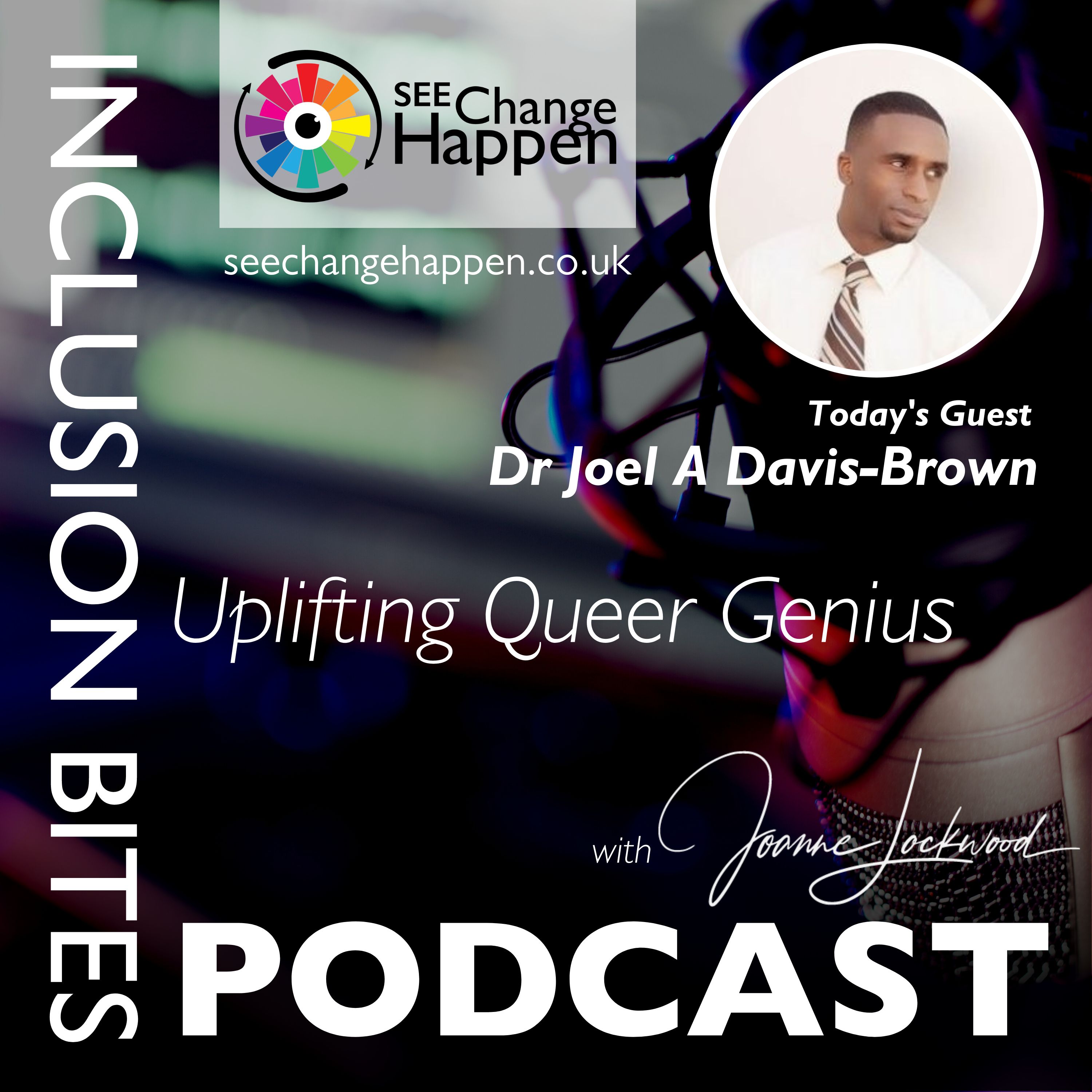
Uplifting Queer Genius
with Joel A. Brown · 27 October 2023
Lived Experience Identity
Joanne Lockwood speaks with Dr Joel A Davis-Brown about what they call “queer genius”: the skills, values, and ways of navigating the world that many queer people develop through self-discovery, coming out, and living outside social norms.
They discuss how negative stereotypes and hostile narratives continue to shape how queer people are perceived, and why it matters to move from merely “including” queer characters or colleagues to recognising queer experience as culturally rich and socially valuable. The conversation explores community-building, interconnectedness, and how queer people often create connection and resilience despite legal, political, and social oppression.
Joanne and Joel also explore intersectionality, including Joel’s experiences as a Black queer man and Joanne’s perspective as a trans woman, touching on the different kinds of visibility, safety, and cognitive load that can come with being read as “different” in everyday life. They reflect on media representation, global political trends impacting LGBTQ+ rights, and the importance of equity when confronting intolerant views.
Overall, the episode invites listeners to challenge inherited assumptions, embrace authenticity, and rethink queer identity through an asset-based lens—highlighting what queer communities contribute to leadership, culture, and social change.
About Joel A. Brown
One-sentence summary
Dr Joel A Davis-Brown believes that the very traits forged in queer survival—self-examination, courage, interconnectedness and creative resistance—are not threats to society, but gifts the world urgently needs.
---
Synopsis
Dr Joel A Davis-Brown speaks as someone shaped by both queerness and Blackness—two identities that have taught him early that the world may see you before it knows you. He has lived the relentless awareness of walking into rooms as “the only one”, of managing assumptions before speaking a word. Yet rather than allowing that hyper-visibility to shrink him, he has turned it into clarity. He describes the quiet, daily leadership of queer life: “we have to excavate our truths… we have to give ourselves permission to be free.” His story is not one of bitterness, but of integration. He wants to be “all of me, all of the time”, refusing to compartmentalise parts of himself just to make others comfortable.
What he is trying to change is the narrative that frames queer people as a social problem to debate rather than a cultural force to learn from. He sees a world quick to stereotype but slow to study queer resilience. In his words, there is “cultural genius” in a community that, despite criminalisation and hostility, has built connection, creativity and hope. He wants that genius recognised—not as spectacle, not as stereotype, not as ‘just people who like to party’—but as a deeply human practice of freedom that can help a fractured world relearn courage, community and self-determination.
---
10 Small, digestible concepts for easy learning
1. Coming out is an act of leadership.
Choosing yourself, publicly, is the first step in leading anything else.
2. Freedom begins with self-permission.
Waiting for approval keeps you small; giving yourself permission sets you free.
3. Hyper-visibility builds awareness muscles.
When society scrutinises you, you become more conscious—but that awareness is a strength.
4. Celebration is not frivolous—it’s survival.
Queer joy is a response to erasure, not an escape from reality.
5. Resilience is cultural knowledge.
Communities that survive hostility develop insight others could learn from.
6. Not blending in doesn’t mean not belonging.
Some identities will always stand out; acceptance begins within.
7. Questioning is a creative act.
To be “queer-minded” is to refuse false binaries and search for new possibilities.
8. Rest is resistance.
Constant vigilance burns the soul; survival requires joy and pause.
9. Tolerance has limits.
A society cannot protect dignity while platforming beliefs that erase it.
10. Identity is layered, not singular.
“You’re going to get a little bit of everything,” he says—wholeness resists reduction.
---
The “why” in the story
What they believe is true about people
People are capable of far more freedom and authenticity than they allow themselves.
What they cannot unsee
That queer communities have built connection, creativity and leadership under extraordinary pressure—while still being framed as a threat.
What they are no longer willing to tolerate
Narratives that reduce queer people to caricature, debate topic, or disposable minority.
What they are trying to build instead
A world that studies queer resilience as wisdom—and protects the dignity and safety of all identities.
---
Narrative structure
1. The trigger:
Living through cultural backlash and political regression, especially in the US, while knowing that queer people continue to thrive despite criminalisation in dozens of countries. The dissonance between persecution and brilliance sharpened his resolve.
2. The tension:
The exhaustion of being visible yet misunderstood. The false equivalence that treats dehumanising views as “just another opinion.” The longing to live, not constantly fight.
3. The insight:
Queer people are already practising the leadership the world needs—self-examination, interconnectedness, reinvention, courage. “We give ourselves permission,” he says. That is transformative.
4. The pivot:
He reframes queerness from deficit to asset—calling it “cultural genius”. He chooses integration over assimilation: “I am all of me, all of the time.”
5. The destination:
A society where difference is neither erased nor sensationalised—where people are free to live, rest, love and belong without constant negotiation.
---
Five key takeaways and learning points
1. Leadership starts with self-leadership.
When you claim your identity without apology, you shift the cultural atmosphere around you.
2. Resilience is a transferable skill.
The awareness and adaptability forged under pressure can improve how communities and institutions function.
3. Joy is not naïve.
Celebration sustains people who are otherwise asked to endure too much.
4. You don’t have to platform harm to prove inclusivity.
Equity means protecting dignity, not balancing oppression with airtime.
5. Integration is freedom.
Living as a whole person—not splitting off parts to fit in—reduces internal conflict and models authenticity for others.
---
Ten distinct ideas explained
1. Queer cultural genius
A body of knowledge built through survival—how to form chosen families, how to adapt, how to read social risk, how to rebuild identity from scratch.
2. Excavating truth
Many queer people must consciously examine who they are. That depth of introspection rarely happens accidentally.
3. Interconnectedness as survival
When biological families or systems reject you, community becomes intentional, not incidental.
4. Visibility as burden and tool
Being seen against your will sharpens awareness—but can also become a platform for change.
5. Integration over assimilation
Trying to blend entirely can fracture identity; integration allows complexity to coexist.
6. False equivalence harms dignity
Treating prejudice as just another viewpoint ignores histories of violence and power imbalance.
7. Cultural backlash cycles
Progress and regression move in waves; remembering past resilience prevents despair.
8. Celebration as affirmation
Pride, parties and performance are collective affirmations of worth in a world that questions it.
9. Choosing when to fight
Boundaried activism sustains long-term impact; constant vigilance depletes.
10. Identity as mosaic
Queerness intersects with race, nationality, class and more; representation must reflect that complexity.
---
How people should change as a result
1. Think
- Move from seeing queerness as difference to understanding it as lived expertise.
- Recognise that resilience is learnt under pressure—not randomly distributed.
- Understand that neutrality in the face of dehumanisation is not neutral.
- See identity as layered; reduce no one to a single trait.
2. Feel
- Shift from defensiveness to curiosity.
- Move from pity to respect.
- Replace fatigue with perspective—social cycles do change.
- Transform fear of difference into appreciation of complexity.
3. Act
- Ask deeper questions instead of relying on stereotypes.
- Create spaces where people don’t have to constantly explain themselves.
- Interrupt conversations that treat dignity as debatable.
- Celebrate queer contributions explicitly—not just quietly include them.
- Support organisations and leaders who centre equity.
- Make room for people to rest from activism without judgement.
- Amplify intersectional voices, not only the most palatable ones.
---
One thing to remember
The courage it takes to be queer in an intolerant world is not a flaw—it is a form of leadership the world desperately needs.