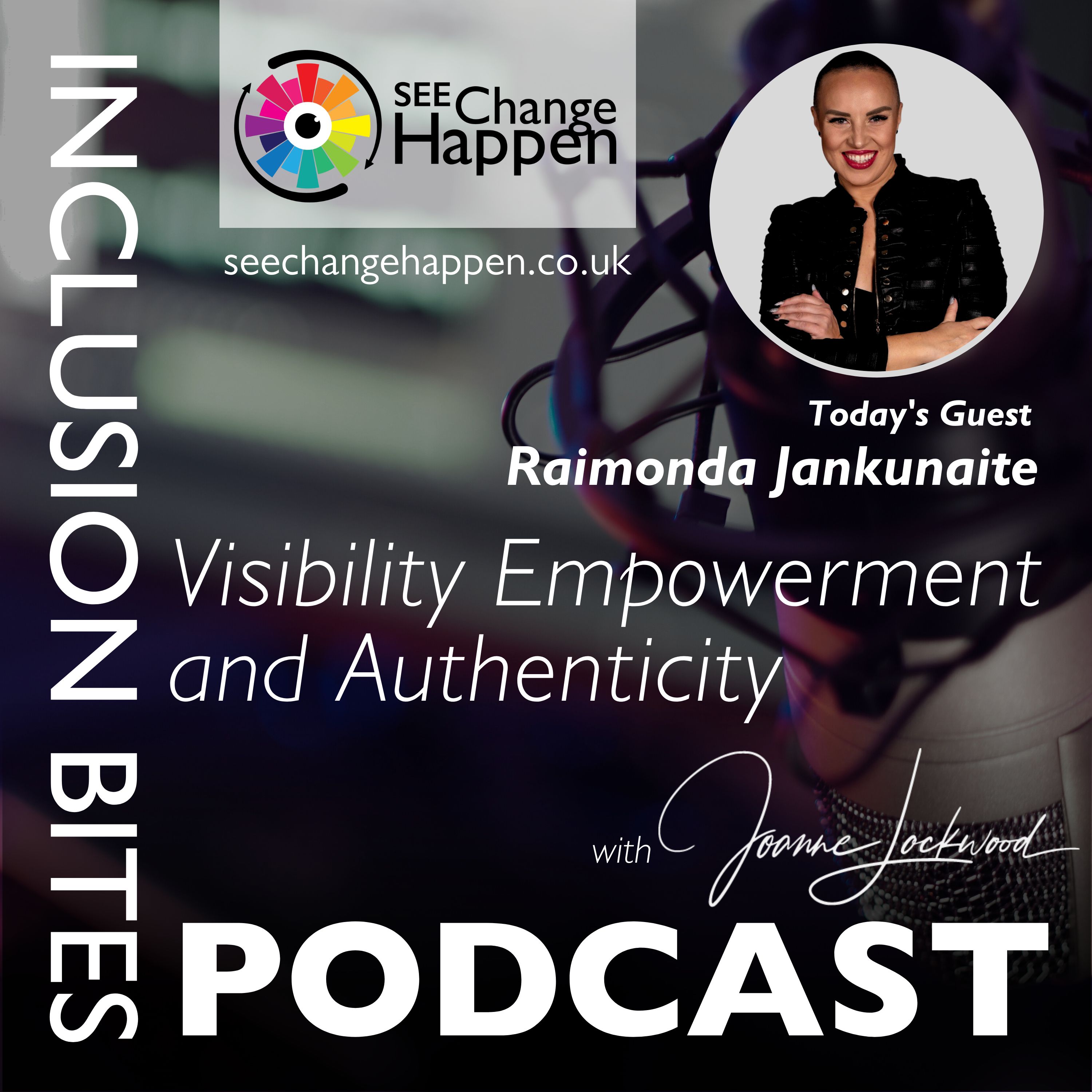
Visibility, Empowerment And Authenticity
with Raimonda Jankunaite · 04 July 2025
Lived Experience Identity
Joanne Lockwood is joined by visibility and empowerment mentor Raimonda Jankunaite to explore what it means to be seen, heard and unapologetically yourself.
Raimonda shares her personal journey, from growing up in Lithuania and later navigating life in the UK as an immigrant, to rebuilding her sense of identity after a traumatic and toxic relationship left her feeling voiceless and disconnected from who she was. Together, they talk about how fear, shame and social conditioning can lead people—especially women—to mask, stay quiet and shrink to fit.
The conversation moves from personal liberation to wider social realities: beauty standards, workplace perceptions of women’s leadership, and the importance of finding communities where it feels safer to speak up. Raimonda describes her decision to shave her head as a symbolic act of self-acceptance and a practical rejection of expectations placed on women’s appearance.
They also reflect on global political shifts, the rollback of inclusion efforts, and why visibility and collective voice matter when rights and representation are being challenged. The episode closes with a call to action: build supportive networks, use your platform—however small—and be an ally for those whose voices are being silenced.
About Raimonda Jankunaite
One-sentence summary
Raimonda Jankunaite’s life is a refusal to stay silent — a promise to herself, and to other women, that losing your voice is not the end of your story.
---
Synopsis
Raimonda Jankunaite grew up between strength and silence. Raised in Lithuania in a women-led household, she witnessed resilience first-hand — and also suppression: domestic violence normalised, men controlling money, authority resting firmly with fathers. At 13, she arrived in the UK unable to speak English, an immigrant navigating a world where she was suddenly “other”. Later, a toxic relationship stripped away not just her confidence but her basic sense of self. “I literally couldn’t speak,” she says of the two years when trauma left her depressed and voiceless. Looking in the mirror, she no longer recognised the person staring back.
What she is trying to change began in that silence. When she told her mentor, “I want to speak because I know what it’s like not to have a voice,” something crystallised. Now she builds platforms where women are seen, published, amplified — not for aesthetics, but for impact. Her work is about dignity: about women who have been told to stay quiet finally claiming space. In a world she believes is rolling backwards, she refuses retreat. “If your answer will be, I sat back and watched it all unfold, it’s not going to be good enough.” She is not chasing visibility for attention; she is protecting the right to exist unapologetically.
---
10 Small, digestible concepts for easy learning
1. Silence has a cost.
When you lose your voice, you don’t just lose words — you lose identity.
2. Authenticity is learned, not gifted.
It often comes after shedding shame, fear and expectation.
3. Trauma fractures self-recognition.
When you can’t see yourself clearly, you start living behind a mask.
4. Rebellion can be healing.
Small acts of defiance — even shaving your head — can restore agency.
5. Visibility is protection.
When you are seen, you are harder to erase.
6. Conditioning is subtle but powerful.
What you absorb as a child shapes what you tolerate as an adult.
7. Oppression often hides in normality.
What is “just the way it is” can quietly diminish dignity.
8. Community restores courage.
Safe spaces multiply individual bravery.
9. Power fears plurality.
Diverse voices challenge the myth of one “correct” way to exist.
10. Resistance begins at home.
Change does not start with presidents; it starts with personal responsibility.
---
The “why” in the story
What they believe is true about people
That every person has a voice worth hearing — and that most are far more powerful than they have been allowed to believe.
What they cannot unsee
How easily shame, trauma and conditioning strip people — especially women — of their sense of self.
What they are no longer willing to tolerate
Silence imposed by fear. Narratives that tell women to be smaller, prettier, quieter or more agreeable.
What they are trying to build instead
A movement of unapologetic expression — where women speak, publish, lead and show up as they are.
---
Narrative structure
1. The trigger:
A traumatic relationship left her emotionally, spiritually and physically violated. “I literally couldn’t speak.” Two years of depression and disconnection culminated in a realisation: she understood the pain of not having a voice.
2. The tension:
She still feels the pull of conditioning — the voice that says stay quiet, don’t upset people, fit in. On a global scale, she sees rights being rolled back and fears of erasure becoming real.
3. The insight:
“Something I realised is that up until now, the enemy was hiding in plain sight.” Silence benefits those in power. Visibility disrupts them.
4. The pivot:
She stopped hiding. She owned her truth publicly. She shaved her long blond hair — once a symbol of conformity — and cried with relief when she saw herself without a mask.
5. The destination:
A world where the next generation can ask, not “why didn’t you speak?”, but “thank you for standing up.” A world where authenticity feels ordinary, not rebellious.
---
Five key takeaways and learning points
1. Your voice matters even when it shakes.
Speaking imperfectly is stronger than silent perfection.
2. You can reject the script you inherited.
Cultural norms are powerful — but they are not destiny.
3. Visibility can feel terrifying — and freeing.
What you fear losing may be the very mask holding you back.
4. Oppression thrives on disengagement.
Opting out may bring short-term peace but long-term erosion of rights.
5. Empowerment is contagious.
When one woman speaks, others realise they can too.
---
Ten distinct ideas explained
1. Mask-wearing as survival
After trauma, she performed being “fine” to function — proof that invisibility can sometimes be a coping strategy.
2. Immigrant empathy
Arriving in the UK at 13 without English forged solidarity with other marginalised groups.
3. Normalised violence
Growing up where domestic violence was socially accepted shaped her refusal to tolerate it later.
4. Beauty as distraction
Modelling and long blond hair brought attention, but she didn’t want to be known for appearance over impact.
5. Hair as identity
Shaving her head was not cosmetic — it dismantled years of external validation.
6. Supportive love as liberation
Her partner’s reassurance — “You’re going to look amazing” — reinforced that love is not contingent on conformity.
7. Back-against-the-wall clarity
She believes visible threats galvanise people more than hidden injustices ever did.
8. Financial and collective power
Even when political leaders fail, communities still hold influence in choices, spending and solidarity.
9. Macro to micro change
Transformation begins in workplaces, friendships and small acts of calling out injustice.
10. Collective amplification
Her publishing platform is not about her story alone — it’s about shared resonance restoring dignity.
---
How people should change as a result
1. Think
- From “This doesn’t affect me” to “Whose voice is being limited?”
- From “It’s just politics” to “This shapes people’s daily dignity.”
- From “She’s being dramatic” to “What courage did it take to say that?”
- From “That’s the norm” to “Who decided that was normal?”
2. Feel
- From defensiveness to curiosity.
- From apathy to responsibility.
- From shame to self-acceptance.
- From isolation to solidarity.
- From fear of judgement to quiet self-trust.
3. Act
- Share one personal truth you’ve kept quiet out of fear.
- Support a woman-led platform, publication or venture.
- Call out dismissive language in everyday settings.
- Create or join a small community space for honest conversation.
- Refuse beauty or behaviour standards that diminish you.
- Use your spending power to back inclusive businesses.
- Mentor someone who doubts their right to speak.
---
One thing to remember
When you reclaim your voice, you don’t just change your life — you make it harder for the world to silence someone else.