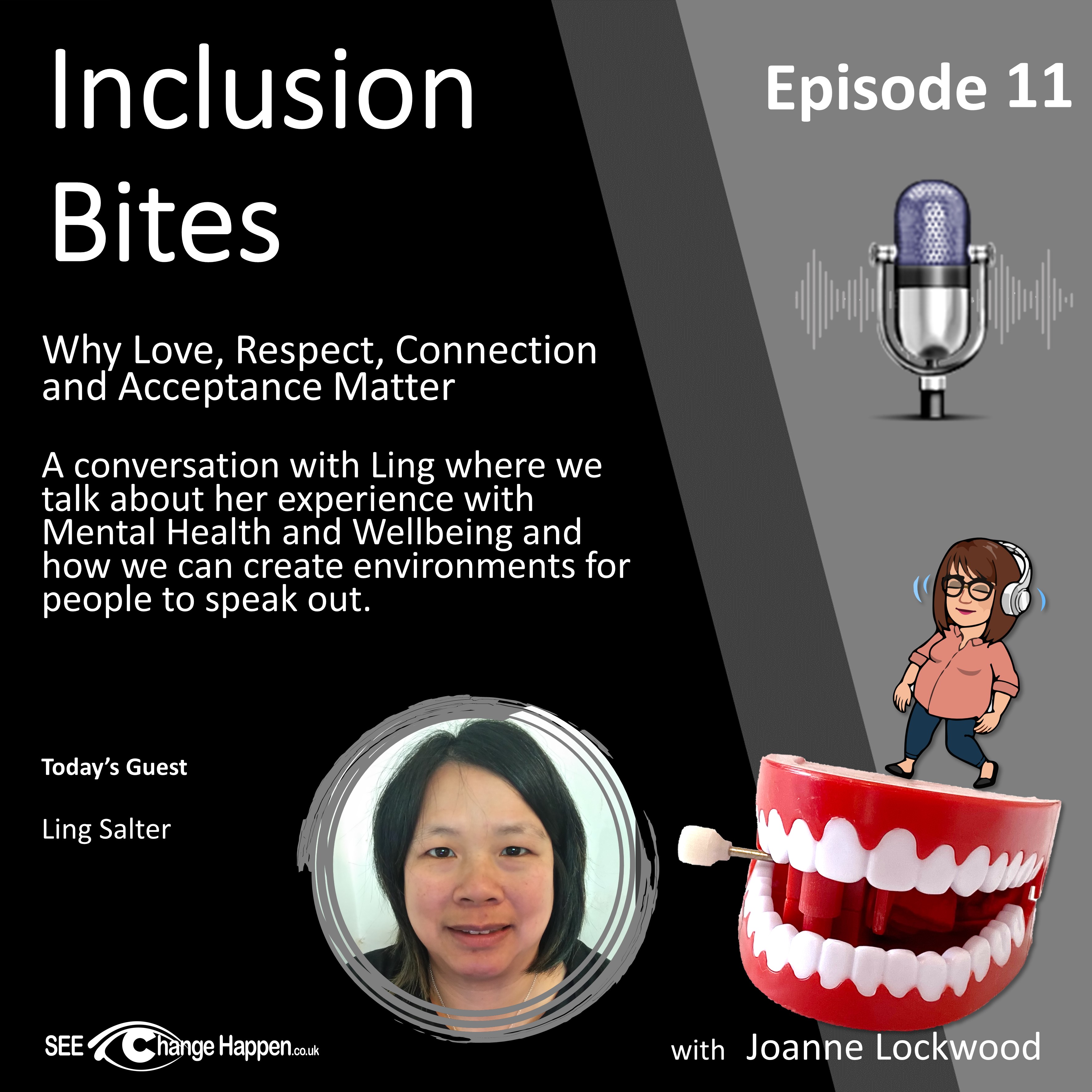
Why Love, Respect, Connection And Acceptance Matter
with Ling Salter · 27 August 2020
Mental Health Wellbeing Trauma
Joanne Lockwood is joined by Ling Salter, a former mental health nurse and founder of the social enterprise Compassionate Cuppa, to explore why love, respect, connection and acceptance matter for wellbeing.
They discuss how being truly listened to can create connection and belonging, and how disconnection and unmet needs can contribute to distress. The conversation examines the stigma around “mental health,” why reaching out can feel difficult, and how compassionate, non-judgemental listening can be a first step toward support.
They also reflect on the pressures of an always-on online world and the added uncertainty and disruption brought by COVID-19—from lockdown and shifting routines to anxiety about returning to workplaces and public spaces. Ling shares how her approach focuses on meeting people where they are, exploring what’s possible, and helping individuals reconnect with purpose and acceptance. The episode closes with Ling’s reflections on Reiki as a personal practice that supported her recovery from physical pain, and how it may complement her broader wellbeing work over time.
About Ling Salter
One-sentence summary
Ling Salter believes that when people are truly listened to with kindness, their suffering loosens its grip and their sense of worth begins to return.
---
Synopsis
Ling Salter is a former mental health nurse of Chinese descent who spent years working in some of the most complex environments, including prisons, where human pain is often loud but rarely heard. What stayed with her was not just the chaos, but the quiet absence beneath it — the unmet need to be understood. She describes vulnerability as her superpower, not because it is easy, but because it is the doorway to connection. Her work has been shaped by watching people disconnect from themselves, suppress emotions, internalise stigma, and carry suffering alone. She has seen how quickly allegiance shifts when someone, anyone, offers attention — even if that attention comes wrapped in harm.
What she is trying to change is deceptively simple: the way we relate to one another. Ling wants to create spaces where people are listened to without judgement, where compassion is practical rather than sentimental, and where acceptance is discovered rather than imposed. She is not interested in quick fixes or shiny solutions. Through Compassionate Cuppa, she is building something slower and more human — conversations that help people uncover their unmet needs, challenge internal battles, and reclaim agency. For Ling, love and respect are not abstract ideas; they are daily practises that protect dignity, especially when someone feels most lost.
---
10 Small, digestible concepts for easy learning
1. Being heard is rarer than being spoken to.
Real connection happens when someone truly “gets you”, not when they simply reply.
2. Unmet needs don’t disappear — they look for somewhere else to belong.
If authority won’t listen, another group will.
3. Suppressing feelings doesn’t solve them; it stores them.
What we avoid has a habit of returning, often louder.
4. Suffering can eclipse value.
When someone is in pain, they forget the parts of themselves that still matter.
5. Withdrawal can feel like protection.
We retreat to stay safe, but the longer we stay hidden, the harder it is to reach back out.
6. Stigma begins with language.
The word “mental” can carry shame before a conversation has even begun.
7. Acceptance cannot be commanded.
It must be arrived at personally, not imposed by someone else.
8. Connection without kindness is incomplete.
Attention alone isn’t enough; how we listen matters.
9. Not everything can be changed — but something always can.
If the situation is fixed, your relationship to it can still shift.
10. Mental health is not an add-on to health.
As Ling says, “without mental health, there is no health”.
---
The “why” in the story
What they believe is true about people
Ling believes people fundamentally want to belong and to matter. Even at their lowest, they are seeking relief from suffering, not an end to life.
What they cannot unsee
She has witnessed what happens when people are not heard — in prisons, in services, in homes — and how disconnection breeds despair, anger or misplaced loyalty.
What they are no longer willing to tolerate
Systems that offer rigid solutions without listening. Language that shames vulnerability. Conversations that skim the surface and miss the need underneath.
What they are trying to build instead
A compassionate community where people can explore what is really going on inside them, at their own pace, and rediscover agency and worth.
---
Narrative structure
1. The trigger
Years working in mental health services where “the service is what it is”, regardless of whether it truly fits the individual. Watching people cycle through interventions yet remain unheard.
2. The tension
Balancing compassion with a world that values speed, productivity and visible results. Offering slow, reflective conversation in a culture that wants instant solutions.
3. The insight
Often, “when we complain about something, usually it's about an underlying need that's unmet”. The work is not about fixing events, but uncovering needs.
4. The pivot
She created Compassionate Cuppa — a space that adapts to the person rather than requiring the person to adapt to the service.
5. The destination
A society where people feel safe to voice suffering early, where neighbours cheque in on each other, and where emotional wellbeing is treated as foundational, not optional.
---
Five key takeaways and learning points
1. Listening is an intervention.
Sometimes the most powerful act is to give someone your full attention without trying to repair them.
2. Belonging shapes behaviour.
If people feel excluded or ignored, they will gravitate towards whoever offers recognition — for better or worse.
3. You cannot bully yourself into resilience.
Acceptance grows through understanding, not force.
4. Isolation distorts perspective.
Suffering can feel total, even when it is one part of a larger life.
5. Mental health underpins everything.
Your decisions, relationships and sense of freedom all begin in your inner world.
---
Ten distinct ideas explained
1. Connection as prevention
Early, compassionate conversations can interrupt spirals before they deepen into crisis.
2. The cost of not being heard
When voices are dismissed, people internalise the message that they do not matter — and that erosion of worth has consequences.
3. The stigma of “mental”
Words carry history. If language triggers shame, people will avoid seeking help.
4. The danger of suppression
Emotions denied do not dissolve; they return in the body, in behaviour, or in breakdown.
5. Suffering versus identity
Pain may dominate someone’s present, but it is not the whole of who they are.
6. Acceptance as freedom
Fighting the unchangeable traps energy; accepting reality releases it.
7. Community as medicine
Mutual aid, neighbourly check-ins and shared ritual remind us we are not alone.
8. Autonomy and agency
When people feel powerless, their wellbeing declines; when they regain choice, vitality rises.
9. Purpose over performance
Goals can disappoint; purpose carries people through uncertainty.
10. Compassion as a skill
Kind, attentive presence is not soft sentiment — it is structured care.
---
How people should change as a result
1. Think
- Mental health is not weakness; it is the foundation of every action you take.
- When someone withdraws, they may be protecting themselves, not rejecting you.
- Before judging behaviour, ask what unmet need might sit underneath.
- Not all problems require fixing; some require understanding.
- Belonging is a human necessity, not a bonus.
2. Feel
- Move from impatience to patience with slow emotional change.
- Shift from judgement to curiosity.
- Replace helplessness with shared responsibility.
- Let defensiveness soften into empathy.
- Trade shame for compassion — towards yourself and others.
3. Act
- Offer someone five uninterrupted minutes of genuine listening.
- Ask, “What do you need right now?” rather than “What’s wrong with you?”
- Cheque in on a neighbour or colleague who lives alone.
- Notice your own suppressed feelings and name them honestly.
- When facing something unchangeable, consciously decide what you can influence.
- Reduce exposure to spaces that erode your wellbeing, especially online.
- Create small rituals of connection — a weekly call, a shared walk, a compassionate cuppa.
---
One thing to remember
When someone feels heard with kindness, their life can begin to feel bearable again.