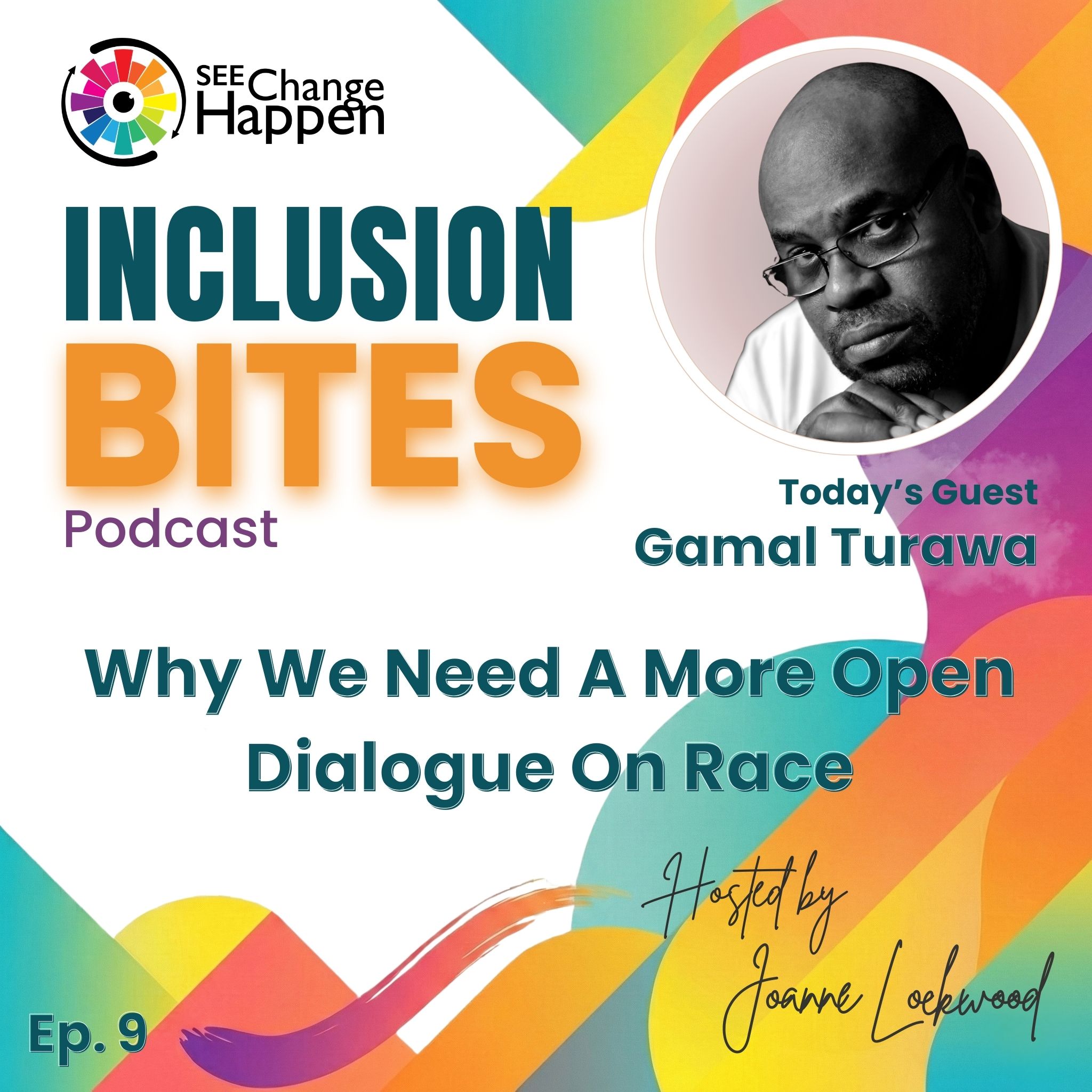
Why We Need A More Open Dialogue On Race
with Gamal Turawa · 13 June 2020
Workplace Culture Systems
Recorded during the early months of COVID-19 and amid the global resurgence of Black Lives Matter following the murder of George Floyd, Joanne Lockwood speaks with Gamal Turawa about why we need more open, honest dialogue about race.
Gamal shares reflections as a Black, openly gay, now-retired police officer and diversity and dignity facilitator, including how emotions like fear, anger and frustration can block meaningful conversation unless they are acknowledged and navigated. Together they explore privilege, what it means to be white, and the importance of moving from difference to empathy and then to dignity.
The conversation also touches on identity as multi-layered and not fixed, the harm of “colour-blind” language, and the responsibility to shift from being “not racist” to being actively anti-racist. Gamal recounts aspects of his lived experience, including being fostered, cultural dislocation, and reaching a point of suicidality before learning to define himself on his own terms.
They reflect on wider social context including Grenfell, Windrush, media stereotypes, statues and historical legacy, and why symbolic actions must be matched by systemic change. The episode closes with a focus on turning anger into constructive action and sustaining momentum for long-term progress.
About Gamal Turawa
One-sentence summary
Gamal Turawa’s story is about reclaiming the right to say “I am” — and refusing to let fear, silence or comfort steal anyone’s dignity again.
---
Synopsis
Gamal Turawa is a black, gay, former police officer who describes his superpower as “invisibility” — not because he wants to disappear, but because he has learned how to create space for others to see themselves more clearly. His life has been marked by identity fractures that would have broken many: fostered as a Nigerian child by a white family in Kent, told jokes about jungles and belonging, then abruptly taken back into a Nigerian Muslim household whose rules and culture were foreign to him. He later hid his sexuality for decades, absorbing the message that being gay and being black made him “less than”, until the weight of that silence led him to the brink of suicide. It was only when he was forced to answer the question “Who defines you?” that he began to rebuild himself from the inside out.
What he is trying to change is not simply how people talk about race, but how deeply they are willing to look at themselves. He believes conversations stall because of anger, fear and fragility — yet he insists those emotions are not the enemy. The real barrier is refusing to sit with them long enough to grow. He wants people to recognise that dignity is not abstract: it is the difference between being seen as human or being reduced to a stereotype. For Gamal, a more open dialogue on race matters because silence costs lives, fractures identity, and forces people to carry burdens they never chose. What he protects is the right for every person to stand in their own “I am” without apology.
---
10 Small, digestible concepts for easy learning
1. You don’t have to understand someone’s world to respect it.
Appreciation comes before comprehension.
2. Privilege isn’t an accusation — it’s awareness.
It’s noticing which doors open without friction.
3. Identity is layered, not fixed.
We speak from many selves at once.
4. “I don’t see colour” often means “I don’t see you.”
Erasing difference erases struggle and strength.
5. Silence is not neutral.
Doing nothing sustains the status quo.
6. Anger can build or destroy.
The difference is what you choose to do with it.
7. Empathy is a bridge, not a destination.
You cross it to honour dignity, not to compare pain.
8. We all carry social conditioning.
Growth begins when we notice it surfacing.
9. History must be acknowledged, not erased.
Symbols matter — but they are only the start.
10. Change is slow, shared work.
It’s pushing the boulder together, not waiting for perfection.
---
The “why” in the story
What they believe is true about people
That most people want to belong, to be valued, and to live with dignity — even if they don’t yet know how their behaviour affects others.
What they cannot unsee
The quiet harm of invisibility. The internal damage of being told, subtly and overtly, that your identity is wrong. The mental toll of absorbing those messages for decades.
What they are no longer willing to tolerate
Silence disguised as politeness. Being asked to be both the wound and the cure. Conversations that avoid discomfort while others carry the cost.
What they are trying to build instead
A space where people can be angry without being destructive, honest without being shamed, and actively committed rather than quietly sympathetic — a movement from “them and us” to a chosen “we”.
---
Narrative structure
1. The trigger
Growing up between cultures without anchor; internalising homophobia and racism; reaching a breaking point where suicide felt closer than self-acceptance. Being asked, for the first time, “Who defines you?”
2. The tension
Navigating rooms where people expect him to educate, soothe and fix; witnessing backlash that risks undoing progress; knowing that some will remove their hands from the “boulder” when discomfort arises.
3. The insight
You will never fully understand someone else’s world — but you can choose to value it. Real change happens not when we declare ourselves “not racist”, but when we act against injustice.
4. The pivot
Claiming the words “I am a black gay man” without apology. Choosing to facilitate conversations rather than retreat from them. Transforming anger into focused action rather than bitterness.
5. The destination
A society where people do not have to fracture themselves to survive; where dignity is protected instinctively; where future generations can use their voices freely without paying the price his generation did.
---
Five key takeaways and learning points
1. Being seen matters more than being tolerated.
So what: When you acknowledge someone’s full identity, you affirm their worth.
2. Fear reveals your conditioning.
So what: That split-second reaction is an opportunity to grow, not to self-condemn.
3. Dialogue begins with emotion, not logic.
So what: If you ignore anger or grief, the conversation never truly starts.
4. History is complex — people are too.
So what: You can hold pride and critique at the same time.
5. Sympathy fades; commitment lasts.
So what: Feelings must translate into sustained action.
---
Ten distinct ideas explained
1. The invisibility paradox
When people forget his race or sexuality mid-conversation, he knows the dialogue has deepened. Yet he has fought hard to value those parts of himself. Being unseen should never mean being erased.
2. Internalised shame
Years of negative messaging led him to believe authenticity was selfish. That distortion nearly cost him his life.
3. Two boxes, stacked
Those in the “top box” often cannot see the structural weight pressing on those below. Denial of the lower box is itself part of the problem.
4. Appreciation over understanding
You do not need to grasp someone’s lived experience in detail to grant it legitimacy.
5. The cost of cultural fracture
Moving between Nigeria and Britain left him belonging fully to neither. Identity conflict can become trauma when there is no space to reconcile it.
6. Symbol versus substance
Removing statues is symbolic; systems require deeper change. Both matter, but symbolism alone is not transformation.
7. The myth of neutrality
Saying nothing in the face of bias reinforces it. Inclusion demands visible stance-taking.
8. Conditioning surfaces under stress
Even experienced facilitators can feel prejudice flicker through them. Growth lies in catching it.
9. Anger as fuel
Anger focused on building can inspire; anger directed at destruction can undo years of progress.
10. Shared progress
Each generation inherits a voice enlarged by previous struggle. The responsibility is to widen it further.
---
How people should change as a result
1. Think
- Move from “Are things really that bad?” to “What might I not be seeing?”
- Replace “I don’t get it” with “I can respect that it matters.”
- Recognise privilege as context, not accusation.
- Understand that discomfort is not harm.
- See identity as multi-layered, including your own.
2. Feel
- Shift from defensiveness to curiosity.
- From guilt to responsibility.
- From passive sympathy to active solidarity.
- From fear of saying the wrong thing to courage to learn.
- From fatigue to steadiness.
3. Act
- When bias surfaces — in yourself or others — pause and name it.
- Challenge discriminatory language with calm clarity.
- Seek out voices different from your own and listen fully.
- Support policies and practices that widen access, not just representation.
- Stand visibly beside those asking for change.
- Stay engaged after the headlines fade.
- Transform anger into constructive contribution.
---
One thing to remember
It is not enough to be appalled — you must decide what you will build from that feeling.